Mkango Magnetic Materials has agreed to acquire the remaining 10 per cent of HyProMag Germany, which is commissioning a rare earth magnet recycling and manufacturing plant in Pforzheim. The £1.06m transaction would leave HyProMag UK holding all the shares in the German company, subject to regulatory acceptance and a notarised transfer. The agreement is not yet completion of the acquisition, and the Pforzheim plant has not reached its proposed full manufacturing capacity.
HyProMag UK already owns 90 per cent of the German company after a convertible loan was converted into equity and the capital increase was registered on 19 October. The remaining stake is held by founding shareholder Professor Carlo Burkhardt, who is expected to continue as a consultant after completion. HyProMag UK is a wholly owned subsidiary of Maginito, the joint venture through which Mkango holds an economic interest in the operation. The corporate simplification should not be confused with a new plant commissioning milestone.
Of the agreed £1.06m consideration, £757,900 is to be paid through the issue of 2,569,152 new Mkango shares valued at 29.5p each, based on the 27 October closing price. The other £302,100 is cash, payable when the Pforzheim plant is commissioned and in any event by 31 December 2026. The shares are subject to a six-month lock-up. These terms mean most of the stated purchase price is equity consideration, not an immediate cash payment of the entire acquisition value.
Maginito is owned 79.4 per cent by Mkango and 20.6 per cent by CoTec Holdings. CoTec is contributing £218,360 in cash, while Mkango will contribute the consideration shares and £83,740 in cash. Following completion, Maginito’s wholly owned HyProMag UK subsidiary would own 100 per cent of HyProMag Germany; Mkango’s effective economic interest would rise from approximately 71.5 per cent to 79.4 per cent. Directly describing the German plant as wholly owned by the listed Mkango parent would therefore be inaccurate.
HyProMag Germany’s manufacturing route is based on Hydrogen Processing of Magnet Scrap, or HPMS, developed through University of Birmingham research. Hydrogen causes neodymium-iron-boron magnets to break down into a recoverable alloy powder, which can then be processed by milling, aligning, pressing and sintering into new magnet products. The short-loop route seeks to preserve useful alloy constituents rather than separating every rare earth element chemically before making fresh material. Feedstock quality and downstream processing still influence the performance of the final magnets.
Recycled magnets must meet demanding composition and magnetic-performance requirements. Feedstock from motors, generators and other equipment may contain different alloys, coatings or contaminants, so sorting, powder preparation and production controls are central to the process. An operating HPMS reactor demonstrates one portion of the route; finished magnets still require reliable powder conditioning, pressing, sintering and quality assurance. The company has not established that the entire Pforzheim line is producing qualified material continuously at design throughput.
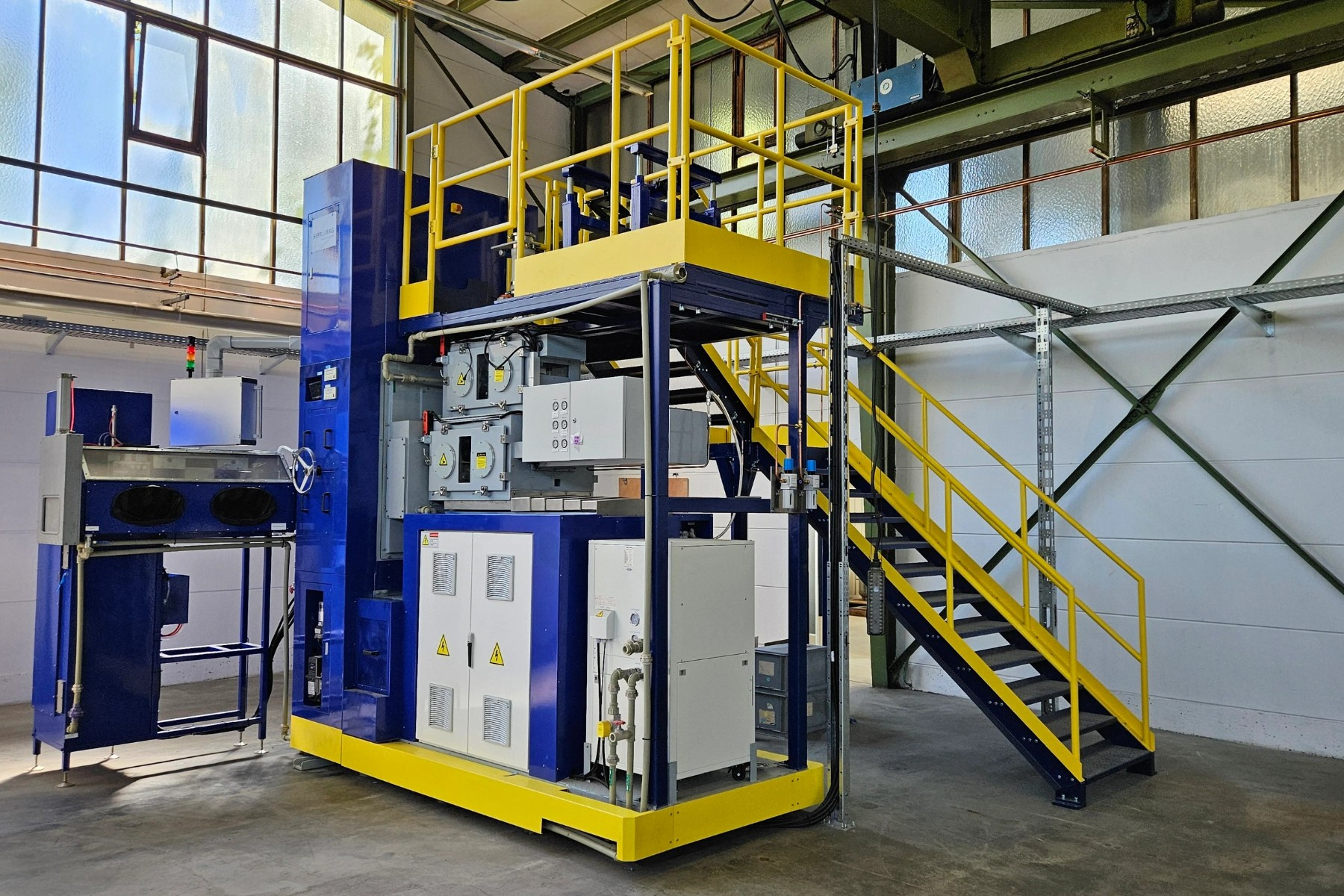
The first HPMS commissioning runs were completed in April, with the jet mill, alignment equipment, sintering furnace and associated services commissioned or installed in stages. Plant infrastructure has included gas storage and an upgraded electrical supply. Individual equipment milestones are not interchangeable with commercial production at the intended volume. Commissioning will need to establish repeatable processing and viable output across the entire sequence, not merely successful operation of the hydrogen reactor in isolation.
HyProMag has described an initial production capacity of about 100 tonnes a year of neodymium-iron-boron magnets and alloys once the site is fully commissioned. Multiple-shift operation could increase capacity towards 350 tonnes, while permission exists for as much as 750 tonnes annually. The 750-tonne figure is a permitted ceiling and an expansion option under assessment, not an established current run rate. No annual volume at any of these levels has been demonstrated in the latest acquisition announcement.
The Pforzheim project was designated an EU Critical Raw Materials Act Strategic Project earlier in October, a separate development. Such designation recognises its proposed role in European rare earth material supply and does not establish that this minority-share transaction has completed. New magnet-making capacity could provide a local route for some recovered alloy material used in motors and generators, although the scale of supply will depend on commissioning, feedstock availability and customer qualification.
Completion requires final acceptance from the TSX Venture Exchange and execution of the German notarised share transfer, with a further company notice expected. Burkhardt is to remain available as a consultant. The ownership change would simplify control of the German company through HyProMag UK, while operating performance will be determined separately by the Pforzheim line’s progression from equipment trials to qualified, repeatable magnet production.