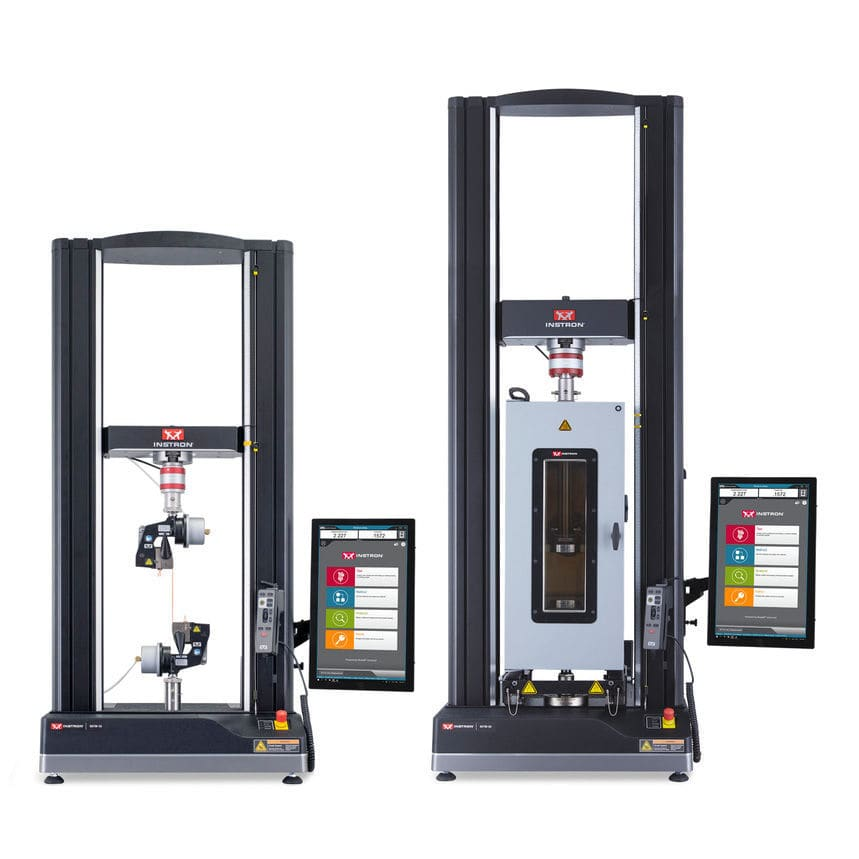
Instron will demonstrate a 100kN benchtop universal testing system alongside electrodynamic fatigue and drop-weight impact equipment at Advanced Engineering in Birmingham. The 68TM-100 extends the load capacity available within the company’s dual-column table model range, with the forthcoming exhibition providing a UK industry showcase for the system. The manufacturer will also present its ElectroPuls E20000 and 9450 Drop Tower at the NEC on 4–5 November, covering three distinct ways of measuring how materials and components behave under force.
The new 68TM-100 is intended for controlled mechanical tests on specimens including metals, composites and polymers. Universal testing machines apply a measured tensile or compressive load to a specimen through a moving crosshead and suitable grips or fixtures. Test instrumentation records force and movement, and additional measurement equipment can be used to obtain strain data. The resulting measurements support assessments of characteristics such as strength, stiffness and extension before failure, provided the relevant test method, specimen preparation and measurement configuration are appropriate.
The 68TM-100 is rated for loads up to 100kN, extending Instron’s 68TM table-model range for work involving stronger or larger specimens. A universal testing machine advances a crosshead to apply tensile or compressive loading while recording the force and movement of the test. Actual test capacity depends on more than the frame’s headline rating: the load cell, fixtures, grips, specimen dimensions, extensometer and relevant test method must all suit the material. Instron offers extra-height and extra-width arrangements within the wider dual-column family.
Accurate measurement depends on keeping the test specimen aligned and secured. Grips that slip can distort a force-extension trace, while off-axis loading adds bending to a test intended to measure uniaxial strength. An extensometer provides strain measurements where crosshead displacement alone would include movement elsewhere in the loading system. Instron’s 68TM equipment uses Bluehill Universal software for method configuration, data capture and reporting. The company has not published a comparable throughput or accuracy improvement for the 68TM-100 against a specified predecessor.
ElectroPuls E20000 serves a different purpose. Its electrodynamic drive can apply repeated loads for fatigue evaluation as well as controlled static tests, using an all-electric system rather than a conventional servo-hydraulic arrangement. The model has a linear capacity of 20kN and, in its combined axial-torsion configuration, torque capacity of 130Nm. Instron says this doubles the E10000’s linear capacity in virtually the same machine footprint. That comparison concerns the specified capacity, not a claim that fatigue life or testing accuracy is automatically doubled.
Fatigue testing uses repeated load or displacement cycles to investigate the response of specimens under changing stress. In the E20000, an electrically driven actuator provides dynamic loading of up to 20kN, while combined axial-torsion versions can also impose torque of up to 130Nm. The torque figure applies to the appropriate configuration, not every E20000 model. Instron lists software for specifying test waveforms, recording response and analysing results, but fatigue life still depends on the specimen, environment, stress history and the applicable test standard.
Its electrodynamic design removes the need for a hydraulic oil circuit, and Instron describes it as using less energy than traditional hydraulic systems. That is a supplier comparison rather than a measured saving for a defined duty cycle. Test frequency, actuator demand, cooling and auxiliary equipment all affect laboratory consumption. Compared with the 100kN universal tester, the E20000 addresses repeated rather than principally monotonic loading, and its force rating should not be compared as though both instruments performed the same test.
Impact behaviour requires another approach because a rapidly applied load does not necessarily produce the same material response as slow tension or compression. Instron’s 9450 Drop Tower uses a falling mass and appropriate impact tooling to deliver a controlled impact event. The manufacturer offers different carriages, masses, striker arrangements and specimen supports for varying materials and component geometries. Its published 9450 system specifications show an impact energy range extending to 1,800 joules, depending on configuration, but the equipment shown in Birmingham has not been described as a new 9450 model.
Instron’s 9450 Drop Tower completes the group with an impact method rather than a slowly applied or repeated load. A falling mass and selected striker deliver an impact to a supported specimen, with measurements used to assess fracture or deformation under the chosen event conditions. Instron’s product data lists configurations operating from 0.59 to 1,800 joules, although that range depends on the selected carriage, geometry and equipment. Results from a test coupon cannot automatically be substituted for the performance of a complete assembly under every real-world impact.
Instron will show the 68TM-100, E20000 and 9450 in Hall 3, stand S160, at Advanced Engineering on 4–5 November. The higher-capacity universal machine is being previewed, while the E20000 and established 9450 demonstrate different loading methods. No price or general supply date for the 68TM-100 is specified in the exhibition information. Laboratories assessing the new frame will still need to confirm its configuration and compatible measurement hardware against the tests they intend to run.