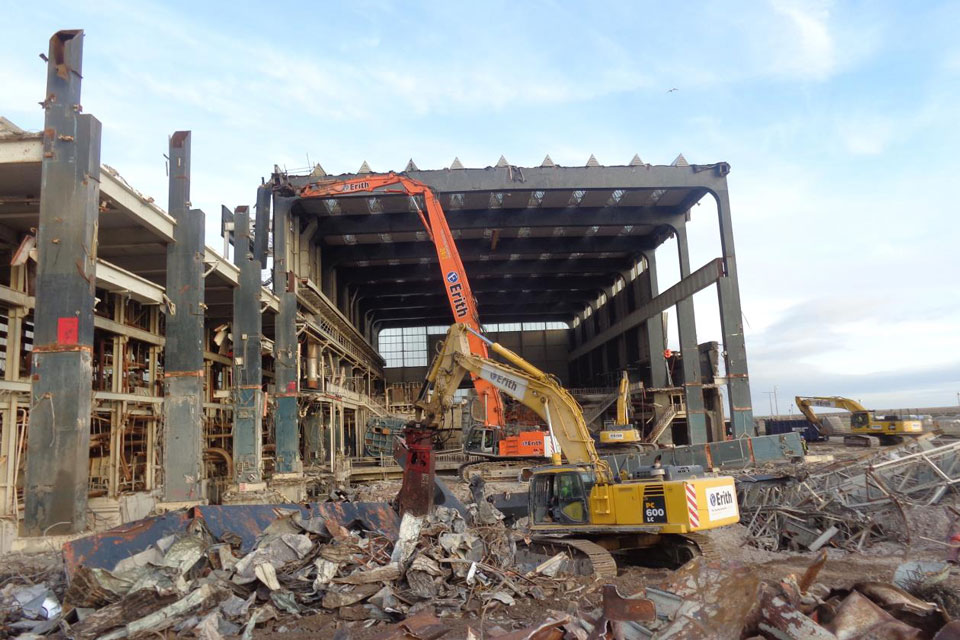
Aureos has been appointed to remove eight large boiler units from Dungeness A in Kent under an engineering contract worth up to £190 million. Nuclear Restoration Services (NRS), which is responsible for the former Magnox power station, has selected the infrastructure contractor to deliver one of the most substantial remaining dismantling packages at the site. Each boiler weighs approximately 800 tonnes, and the work also covers associated plant and structures that must be dealt with to create a safe removal route.
NRS plans to extract the eight boilers using a jack-and-slide system after the station’s main enabling works. The method uses jacks to take the weight of an assembly before it is transferred horizontally along a prepared route, reducing the dependence on a single long crane movement. Its application to structures installed during the station’s original construction will require careful control of supporting loads and clearances. The appointment confirms the selected contractor and proposed handling approach, although NRS has not published an individual removal sequence or the start and finish dates for the boiler movements.
The physical route available for each boiler depends in part on earlier demolition work. NRS completed four years of site preparation, including the infill of more than 5,000 square metres of the former turbine hall basement, where removed equipment can be laid down ahead of disposal. The space was filled with more than 10,500 cubic metres of material, delivered in over 1,400 lorry loads. Before any 800-tonne component can be transferred across it, the project team must establish the loads imposed on its temporary supports, travel route and prepared ground. The backfill provides working space; it does not, on its own, establish the approved lifting design.
Dungeness A’s original Magnox reactors used gas cooling, with heat transferred through boilers to the steam system supplying the turbines. The boilers are therefore part of the generating plant rather than the nuclear fuel itself. The station stopped generating in 2006 and completed defuelling in 2012, but the removal of spent fuel did not eliminate the considerable amount of redundant process equipment and structure remaining on the site. The new contract concerns that physical decommissioning work, not a return to operation or the removal of the reactor cores.
Moving a boiler weighing around 800 tonnes requires the team to control both vertical loading and horizontal travel within the remains of a power station. A jack-and-slide arrangement separates the initial lift from the subsequent movement, with temporary supports carrying the load between stages. Actual loads depend on the boiler’s centre of gravity, attachment points and the support arrangement chosen for its particular route. NRS has confirmed the method but has not disclosed engineering drawings, individual move dates or the final disposal route. No boiler extraction has been reported as complete.
NRS expects the programme to remove about one third of Dungeness A’s above-ground structures when the wider work is complete. That measure concerns the eventual site footprint, rather than one third of the radioactive inventory or one third of the overall decommissioning programme. Removing large redundant assets can also reduce the amount of building fabric requiring continuing inspection, weather protection and maintenance, although future care arrangements still depend on the condition and regulatory status of the structures left behind.
Dungeness A occupies a coastal location designated for its environmental importance, placing additional controls around demolition traffic, waste movements and potential disturbance. The planning considerations reported during the enabling phase included local roads, ecology and the neighbouring community. Site work also remains subject to nuclear safety controls and regulation of the material that is removed. The contract award establishes Aureos as the delivery contractor; detailed work packages and their permitted execution must still reflect those requirements.
Aureos, formerly Keltbray Infrastructure Services, operates across energy and transport engineering. It was selected after a competitive procurement process that considered technical capability, certainty of delivery, innovation, social value and price. The company will be expected to organise specialist labour, equipment and supporting subcontractors around a sequence that has to maintain access and safety throughout the work. The £190 million figure is an upper contract value, not evidence that the full amount has been spent or that all individual work packages have been completed.
NRS expects the completed boiler and ancillary plant programme to remove around a third of the site’s above-ground structures, reducing the buildings that require continued inspection and upkeep. Alongside the engineering work, Aureos is expected to engage local suppliers and education providers as the project moves forward. The first physical movements will be a more concrete indication of progress than the contract value alone, while the wider decommissioning of Dungeness A will continue beyond this package. NRS has not set a public completion date for all eight boiler removals.