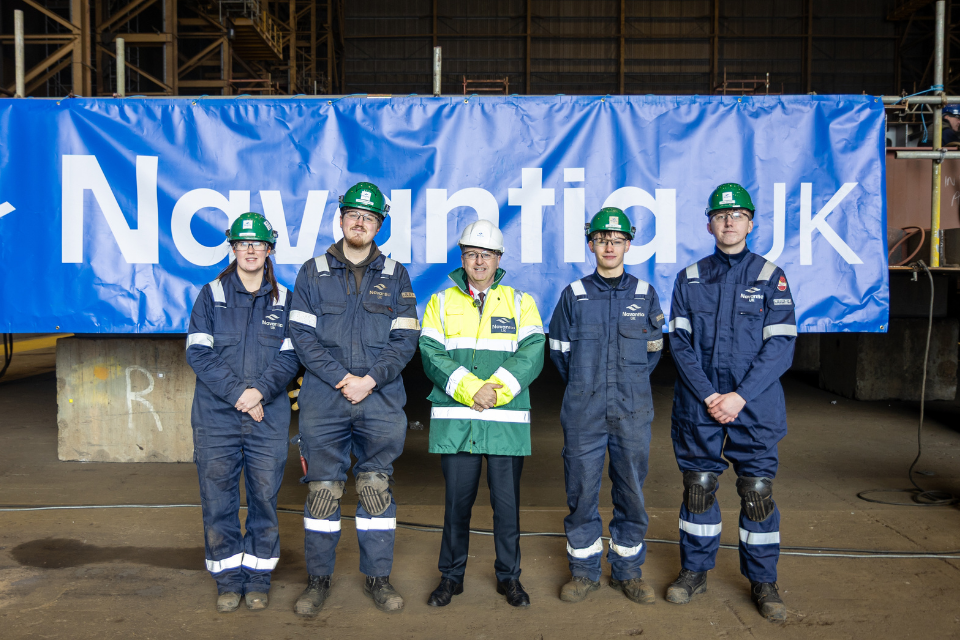
Navantia UK has increased its nationwide apprenticeship recruitment commitment from 500 to 750 by 2030 as it adds capacity and equipment across its British shipbuilding operations. The revised target accompanies a £26.7 million investment programme at the Methil yard in Fife, where the workforce has risen from 180 to 275 since the business acquired the facility in January 2025. Ministers visiting the yard inspected a newly completed paint shop and other production improvements.
The national figure of 750 is a group-wide commitment covering UK operations rather than a pledge to employ that number of apprentices at Methil. Seventy-five apprentices are currently training at the Fife facility, including 21 who joined this year. Navantia’s four UK sites at Methil, Arnish, Belfast and Appledore took on a combined intake of 121 apprentices in 2026, in addition to 222 already employed in apprenticeship roles before that intake, according to the company. The revised 2030 figure refers to recruitment over the programme, not the present workforce.
The investment sits within a distributed shipbuilding programme in which work is divided between Navantia’s British and Spanish facilities. Appledore is building bow sections for the three Fleet Solid Support ships, while Belfast is responsible for final assembly, integration and trials. Methil has supported that manufacturing chain by building the Seahorse transport barge, rather than acting as the final assembly site for the support ships. Of the £26.7 million invested in Methil since acquisition, £12 million was announced during 2026 for training provision, machinery, infrastructure and technology.
A completed paint shop is a practical addition to that manufacturing chain. Coating facilities enable steel structures to be prepared and protected within managed production conditions, an important requirement for work that will subsequently face corrosive maritime environments. Surface preparation, coating application and inspection have to be coordinated with fabrication and assembly because access becomes more difficult after complex steel sections have been joined. Navantia has not provided throughput or productivity figures for the new shop, so its measurable impact on output remains to be demonstrated.
Methil has already built the purpose-designed Seahorse barge, which supports the movement of ship blocks between Appledore and Belfast. At 85 metres long and 25 metres wide, the transport vessel was designed to carry substantial prefabricated units between the company’s facilities. During the keel-laying of the first Fleet Solid Support ship, RFA Resurgent, at Appledore, a bow block was lowered onto Seahorse. This use of marine transport allows structures manufactured at one yard to be incorporated into larger assemblies at another.
Methil’s employment needs extend beyond apprenticeships. Navantia recently secured its second new vessel export order at the yard and began recruiting for 60 experienced workers, including welders, platers, riggers, scaffolders and painters. Recruitment for these posts is distinct from the training commitment, and the company has not claimed that all 60 positions have already been filled. Its workforce figures also relate to the period since the acquisition, rather than solely to the export order.
Navantia’s apprenticeship routes span fabrication and welding, electrical engineering and computer aided design, with Level 2 and Level 3 provision at Methil. Each trade feeds a different part of yard production: weld preparation and inspection determine structural quality, electrical installation connects shipboard equipment, and accurate drawings and digital models support the fit-up of fabricated units. The company has not specified how the 250 additional places in its national commitment will be divided among trades or sites. An intake target is also different from a prediction of how many people will qualify by 2030.
Existing yard work helps explain the parallel demand for experienced staff and trainees. Methil completed the Seahorse barge and subsequently secured a second vessel export contract, prompting a recruitment campaign for 60 welders, platers, riggers, scaffolders and painters. Those posts are separate from the apprenticeship target, and the company has not confirmed that the recruitment campaign has been completed. Apprentices can participate in supervised production while developing their qualifications, but the capability to build larger or more complex structures also depends on experienced trades, fixtures, inspection and planning.
Methil’s new paint shop adds a controlled stage for preparing and coating fabricated steel. Corrosion protection needs suitable surface preparation, coating application and inspection before assemblies become difficult to access; the presence of the facility alone does not establish how much faster the yard can turn round structures. Ministers Douglas Alexander and Luke Pollard inspected the completed shop during their visit to Methil. Navantia has disclosed the investment and workforce figures, but no measured productivity increase attributable to the new building or other individual upgrades.
Navantia now reports 275 employees and 75 apprentices at Methil, compared with a workforce of 180 when it acquired the yard in January 2025. The wider company recruited 121 apprentices during 2026 and has increased its cumulative 2030 recruitment commitment to 750. Future intakes, trade allocations and the pace of recruitment remain to be specified, while confirmed shipbuilding and export work continues across its UK sites.