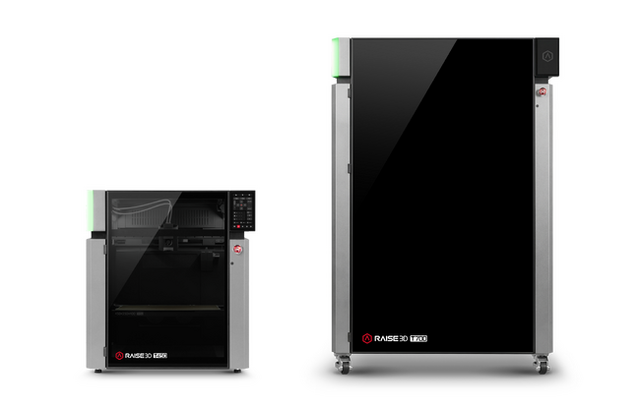
Raise3D has introduced two large-format industrial 3D printers, the T450 and T700, alongside a $15 million financing round intended to support further development of its additive manufacturing equipment and software.
The new fused filament fabrication systems provide build volumes of 450 × 350 × 400mm and 700 × 500 × 1,000mm respectively. Both combine actively heated chambers with a four-motor motion system and a dual-feed extrusion arrangement designed for engineering thermoplastics.
Raise3D unveiled the equipment ahead of Formnext 2026, where the machines are scheduled to be demonstrated in Frankfurt from 17 to 20 November. The manufacturer has also introduced updates to its selective laser sintering equipment and a separate automated post-processing system.
The T450 provides a nominal build volume of 63 litres, while the larger T700 offers 350 litres and can produce suitable components up to one metre high. The machines target applications including manufacturing fixtures, tooling, casting patterns, prototypes, and selected low-volume production components.
Build dimensions affect the manufacturing process because a component exceeding the available working envelope must either be redesigned or manufactured in separate sections.
Producing sections individually can create additional work involving alignment, joining, finishing, and dimensional inspection. The resulting assembly must also accommodate any loads transferred through the joints between printed components.
A larger build volume can remove those operations where the component's geometry and selected material allow it to be produced in one piece. However, part orientation, support requirements, thermal behaviour, and the actual clearance around the printing head still determine whether a particular design can be manufactured successfully.
Both new systems use fused filament fabrication, in which thermoplastic feedstock is heated and deposited along programmed paths. Successive layers form the finished component as material cools and bonds to the material deposited earlier.
The process depends on controlling deposition temperature, movement, material flow, and the thermal conditions surrounding the growing part. Variations in those parameters can affect surface finish, dimensional accuracy, and bonding between layers.
Raise3D has developed a four-motor CoreXY motion system for the T Series. The arrangement uses motors mounted to the machine frame to drive movement in the horizontal printing plane through a coordinated belt system.
Increasing the number of motors is intended to provide additional motion capability across the machines' larger travel distances. The manufacturer says this helps limit vibration, surface ringing, and positional errors that can arise during rapid changes in direction.
The printers are specified for movement speeds of up to 600mm/s under defined conditions. That figure does not represent a guaranteed printing speed for every component, since actual production time depends on geometry, material, extrusion rate, layer height, and the selected settings.
Material delivery is handled through the company's TwinFlow extrusion system. Two filament paths converge through a Y-junction before feeding a single nozzle, allowing the machine to operate in different material supply modes.
In high-flow mode, two filaments of the same material are supplied together to increase the volume available for deposition. The approach is intended to support faster material delivery where the required temperatures and flow conditions remain within the capabilities of the nozzle.
Raise3D reports a maximum volumetric flow of 80mm³/s for the T450 under specified test conditions. The result was obtained using Hyper Speed ABS V2 filament at a nozzle temperature of 250°C, through a 0.4mm nozzle while producing a single-wall test structure.
The result should not be applied to every engineering polymer or nozzle configuration. Actual material flow depends on the viscosity and thermal behaviour of the feedstock, the nozzle geometry, and the printing parameters.
TwinFlow can also operate with different materials supplied sequentially through the same nozzle. This supports selected applications involving removable support material or dual-colour printing.
Because the two feedstocks share the final flow path, material changes require appropriate control of the transition between them. The compatibility of the polymers and the amount of purging required can influence print quality and material consumption.
Temperature management is particularly important when printing large components. The T450 has an actively heated chamber capable of reaching 70°C, while the T700 is specified for chamber temperatures up to 60°C.
Maintaining a controlled environment can reduce the temperature differences developing between newly deposited layers and regions of the component that have already cooled.
Some engineering thermoplastics contract considerably as their temperature falls. Uneven cooling can generate internal stresses, causing warping, dimensional variation, or separation between layers when the resulting forces exceed the strength of the deposited material.
The heated chambers are intended to help maintain more stable conditions during longer printing operations, but the correct chamber temperature still depends on the selected polymer and the characteristics of the component.
Both machines are specified for nozzle temperatures up to 420°C and build plate temperatures up to 120°C. Their nozzles combine a copper-chromium-zirconium body with a silicon carbide tip designed to resist abrasion from reinforced filaments.
Supported materials include ABS, ASA, and TPU, alongside selected carbon-fibre-reinforced grades of PET, PPA, and PPS.
Reinforcement can alter stiffness and other material properties, but fibre-filled polymers also increase wear on extrusion components. Suitable nozzle materials and temperature control are consequently important when processing these feedstocks repeatedly.
Raise3D lists monitoring capabilities including filament run-out detection, nozzle blockage monitoring, camera observation, and selected automated fault detection functions. Availability varies according to the machine configuration, software, and firmware, so individual features must be confirmed against the delivered equipment.
The manufacturer has also presented a production application involving battery maker CATL. The project used additive manufacturing and design optimisation to develop cell transport trays for manufacturing operations.
According to Raise3D, the revised trays reduced weight from approximately 8kg to 2kg, while the production period fell from around 40 days to ten. These are company-reported results from a particular application rather than independently established productivity gains across the T Series.
The lighter tray design also changes handling requirements within the production environment. Its suitability ultimately depends on whether the printed components provide the dimensional stability and mechanical performance required during repeated use.
Alongside the filament printers, Raise3D has increased the build height available on its RMS220 selective laser sintering system from 350mm to 450mm through a software update.
Selective laser sintering manufactures polymer components by selectively fusing powder within a build chamber. Increasing the usable build height allows different arrangements of components or taller parts, subject to the equipment's other dimensional constraints.
The new B520 automated sandblaster provides another stage of the polymer powder manufacturing workflow. The equipment combines programmed abrasive treatment, air blow-off, and ionisation to help remove residual powder and finish suitable printed components.
Its operation can reduce the amount of manual attention required during selected post-processing tasks, although complex geometries may still require additional cleaning or inspection.
Raise3D completed a $15 million C2+ financing round to support further development of its FFF, SLS, and DLP technologies, including work on software integration, materials, and manufacturing applications.
The T450 is priced from $4,999 in the United States and €4,999 in Europe, with initial deliveries expected by the end of December 2026. The T700 starts at $15,999 or €15,999, with deliveries expected by the end of January 2027. Regional taxes, configuration, shipping, and service arrangements may affect the final purchase price.
The new machines extend Raise3D's manufacturing equipment portfolio towards larger components and selected production applications. Their performance in service will depend on the material, component geometry, operating parameters, and the repeatability achieved during extended production runs.