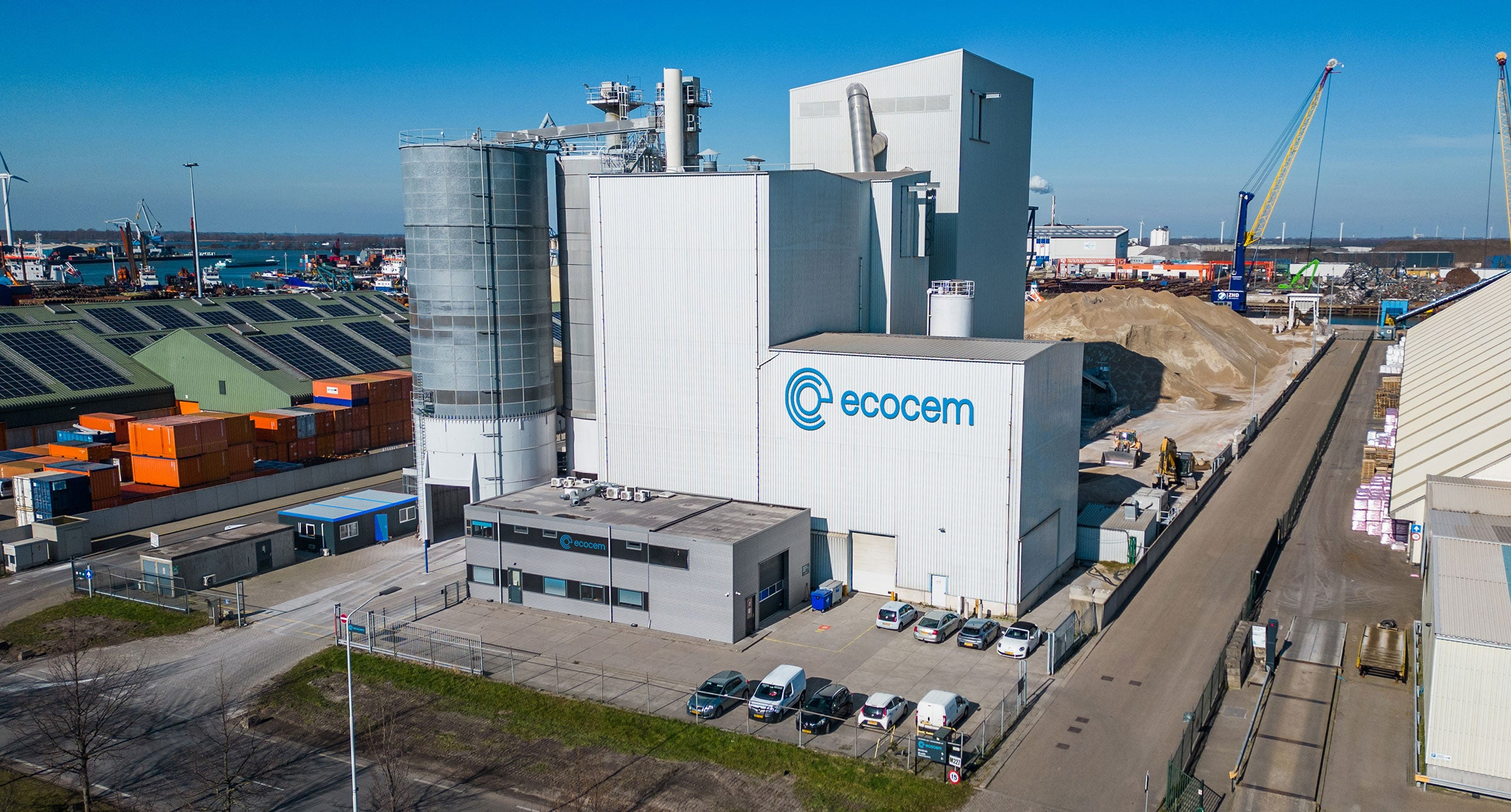
Ecocem is investing €12 million in its Moerdijk manufacturing operation in the Netherlands, adding blending equipment, silo capacity, and laboratory facilities to expand production of lower-carbon cement products.
Construction is under way, with the new blending installation expected to be completed by mid-2027. The investment will enable Ecocem to manufacture a wider range of cement and binder formulations using ground granulated blast furnace slag and other materials intended to reduce reliance on conventional Portland cement clinker.
The expansion supports three product developments: ECO2CEM R, ECO2CEM III, and the company's ACT low-clinker cement technology. Each addresses a different manufacturing requirement, ranging from faster strength development in precast production to greater flexibility in the raw materials used to produce lower-carbon cement.
The investment was presented at an event held at the Moerdijk factory on 6 November and confirmed publicly on 10 November. It builds on the company's existing slag processing and cementitious materials business in the Benelux region.
Ground granulated blast furnace slag, known as GGBS, is produced by grinding suitably processed granulated slag generated during ironmaking. Its cementitious properties allow it to replace part of the Portland cement clinker used in certain concrete mixtures.
Reducing clinker content can substantially lower the carbon emissions associated with producing the binder. Conventional clinker manufacture requires limestone and other raw materials to be heated in a kiln, creating emissions both through fuel consumption and the chemical release of carbon dioxide during calcination.
GGBS provides an alternative cementitious component, but its use must be considered against the required properties of the concrete. Material composition, fineness, temperature, water content, and the proportions of other ingredients can all influence setting and strength development.
Early strength is particularly important in precast concrete manufacture. Components are cast in reusable moulds and must achieve sufficient strength before they can be removed, handled, and prepared for subsequent operations.
Where early strength development is slower, a component may need to remain in its mould for longer. This can reduce the number of production cycles achieved by a manufacturing line and increase the space required for components awaiting further curing.
Those constraints influence the economics of using supplementary cementitious materials. A formulation may reduce clinker consumption but still be unsuitable for a particular production process if it prevents the factory from maintaining the required output.
Ecocem developed ECO2CEM R to address that problem. The product uses an optimised composition intended to increase early reactivity, allowing a greater proportion of GGBS to be incorporated into concrete while maintaining the strength development required by precast manufacturers.
The company developed the formulation through its research and innovation operations near Paris. Its proposed benefit is a reduction in clinker use without extending the period before manufactured components can be removed from their moulds.
Paul Roos, managing director of Ecocem Benelux and Ireland, said: “The challenge in decarbonising precast concrete is to reduce CO₂ emissions without losing sight of production efficiency.”
The final performance of a concrete mixture will depend on the complete formulation and curing conditions. The manufacturer has not published a universal cycle-time reduction that can be applied to every precast product using ECO2CEM R.
ECO2CEM III addresses another constraint in the industry: the equipment available to handle and combine different cementitious materials.
Some concrete manufacturers operate separate storage silos and weighing systems for Portland cement and supplementary materials, allowing them to vary the proportions during batching.
Other producers have more limited storage or blending capability. Maintaining multiple material streams may require additional equipment, handling operations, and quality controls that are difficult to accommodate within an existing factory.
ECO2CEM III is being developed as a pre-blended CEM III product for precast applications. The finished material is intended to provide the required cement composition without obliging the customer to install a separate blending system.
Pre-blending transfers part of the formulation process to the cement manufacturer. Ecocem must therefore control material proportions, mixing consistency, and finished-product quality before the binder is delivered to the concrete producer.
The additional blending equipment at Moerdijk will support these activities by combining different raw materials and GGBS fractions in controlled proportions.
New silo capacity will allow materials to be stored separately before blending and provide additional flexibility in the production schedule. Separate storage arrangements are important where incoming materials have different physical properties or must be maintained within particular quality specifications.
The planned laboratory facilities will support development and quality assessment as the number of formulations increases. Cement testing can include measurements of composition, fineness, setting behaviour, and strength development, depending on the product requirements.
Consistent manufacturing becomes more demanding as a plant moves from processing a relatively limited range of materials to producing several different binders. Each formulation requires its own controls, while equipment must be configured to avoid unacceptable variations between production batches.
Ecocem expects commercial deliveries of ECO2CEM R and ECO2CEM III to begin during the second half of 2027, following completion of the new blending installation.
The third development, ECO2CEM ACT, is based on the company's ACT technology, which has been developed through more than a decade of research.
ACT is intended to produce cement with substantially reduced clinker content by incorporating a wider range of supplementary cementitious materials and engineered fillers.
That broader material selection is relevant because GGBS availability depends on blast furnace ironmaking. As steel production methods change, the supply of suitable slag may also change, making reliance on a single supplementary material a constraint on long-term expansion.
Using alternative materials could allow lower-clinker cement production to develop in regions with limited access to conventional blast furnace slag, provided that suitable resources and manufacturing processes are available.
Ecocem claims that ACT formulations can reduce cement-related carbon emissions by up to 70% compared with conventional cement while meeting the performance requirements of intended applications.
The figure represents the company's technology claim, not a measured reduction achieved by the new Moerdijk blending equipment. Actual results will depend on the selected formulation, manufacturing inputs, and the basis used for comparison.
The commercial timetable for ACT differs from that of the two ECO2CEM precast products. Ecocem expects to begin supplying ACT from its Dunkirk facility in France during the first quarter of 2027.
The Moerdijk investment will increase the Dutch operation's ability to manufacture different lower-carbon cement formulations, but the November announcement does not establish a separate confirmed start date or annual production volume for ACT at that site.
Ecocem operates four manufacturing facilities across Ireland, the Netherlands, and France, supported by two UK terminals. The company reports combined annual production capacity of approximately 2.4 million tonnes across its existing network.
Its wider development programme includes investment intended to expand industrial production of ACT and other cement technologies. The €12 million Moerdijk project forms a defined part of that activity, with its own equipment and completion schedule.
Further manufacturing development will require coordination between raw material supply, production equipment, quality assurance, and the qualification procedures used by concrete producers.
The intended reduction in clinker consumption will be realised commercially only where the finished cement meets the technical requirements of the application and can be supplied reliably at a viable cost.
At Moerdijk, the immediate industrial milestones are completion of the blending installation in mid-2027 and the expected introduction of ECO2CEM R and ECO2CEM III during the following six months.