
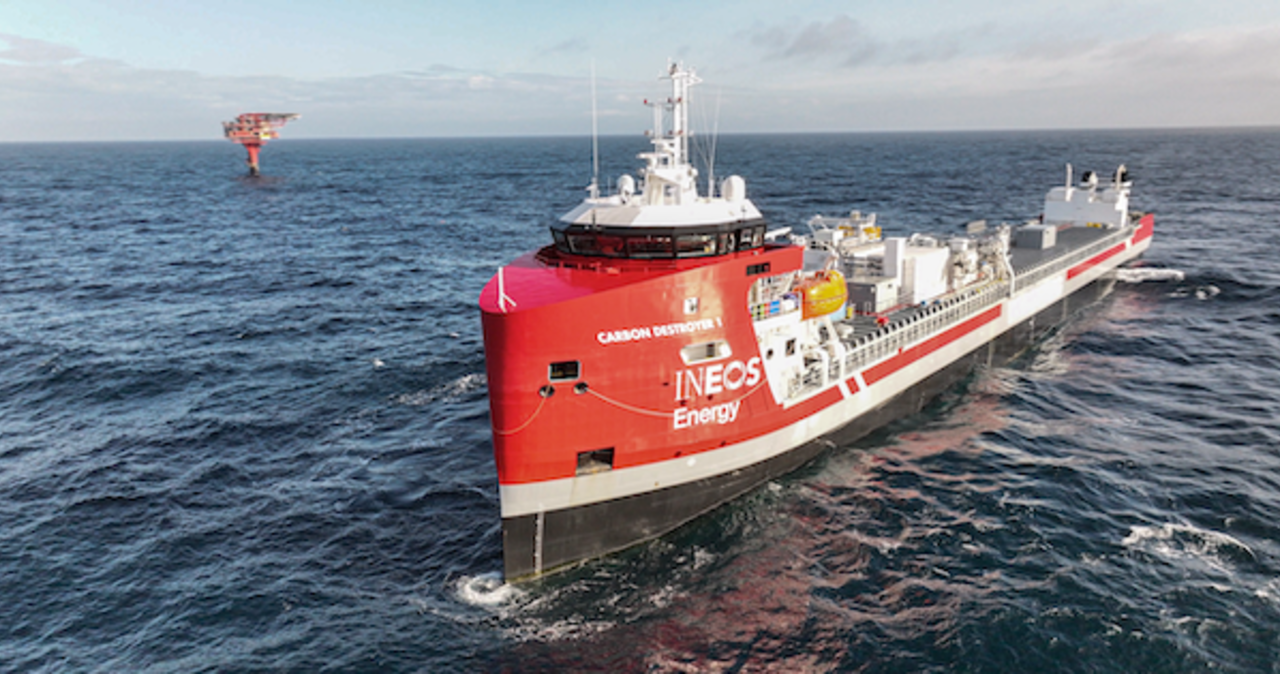
INEOS has moved the Greensand carbon storage project into commercial operation in Denmark, establishing a complete transport and offshore injection chain with initial capacity to store up to 400,000 tonnes of carbon dioxide each year.
The facility was officially opened at the Port of Esbjerg on 18 September and is led by INEOS Energy with Harbour Energy and the Danish North Sea Fund, Nordsøfonden. The partners describe Greensand as the European Union’s first full-scale operational CO₂ storage facility, following earlier pilot injection work in the Danish North Sea.
Its first commercial phase uses carbon dioxide sourced primarily from Danish biomethane plants. Captured CO₂ is liquefied, taken by road tanker to a dedicated terminal at Esbjerg, held temporarily on shore and loaded aboard Carbon Destroyer 1 for transport to the offshore storage site.
The vessel carries the liquid CO₂ roughly 250 kilometres into the North Sea, where it is injected into the Nini West reservoir approximately 1,800 metres beneath the seabed. Nini West is a depleted oil field whose storage integrity has been assessed by the Geological Survey of Denmark and Greenland, while DNV has provided independent safety verification.
Greensand’s initial 400,000-tonne annual capacity is modest beside the volumes envisaged for European carbon capture and storage, but the infrastructure has been designed for expansion. INEOS estimates that the site could ultimately handle four million to eight million tonnes each year as industrial capture projects and contracted demand develop.
The step into routine operation addresses one of the sequencing problems that has held back CCS investment. Industrial plants are reluctant to spend heavily on capture equipment without confidence that transport and permanent storage will exist when they need it, while storage developers require sufficient committed CO₂ to justify terminals, vessels, wells and reservoir infrastructure.
Starting with relatively accessible biogenic carbon dioxide allows Greensand to operate the logistics and injection chain while larger industrial capture projects advance. The arrangement also separates emitters physically from the offshore reservoir: a plant does not require its own pipeline to Nini West if liquefied CO₂ can be delivered into the Esbjerg transport system.
That gives the port a role comparable with a bulk logistics hub. Road transport provides the initial collection leg, shore tanks create buffer capacity between deliveries and vessel sailings, and dedicated shipping connects the terminal with offshore injection wells. As volumes increase, utilisation across each part of that chain will become central to storage costs.
The model differs from carbon storage developments built primarily around fixed pipeline networks. Shipping can give the Danish site a wider geographical catchment, allowing emitters around the North Sea and Baltic regions to connect through suitable port infrastructure rather than waiting for a continuous cross-border pipeline system.
The technical and commercial requirements do not disappear simply because the transport mode changes. Customers still need compatible CO₂ specifications, liquefaction and loading equipment, contractual access to transport and storage capacity, and regulatory arrangements covering cross-border movement and permanent geological disposal.
Other North Sea projects are advancing through different stages of the same build-out. Offshore construction work for Britain’s Northern Endurance Partnership is already drawing established marine contractors into defined CCS packages, while Norway’s Havstjerne programme is progressing reservoir, well and subsea engineering ahead of investment.
Greensand differs in having a complete commercial chain in service. Carbon dioxide can now move from an operating capture source through liquefaction, road transport, port handling and shipping before being injected into a verified offshore reservoir, rather than remaining dependent on a future infrastructure milestone.
Capacity remains the larger challenge. The EU is working towards at least 50 million tonnes of annual CO₂ injection capacity by 2030, rising towards 250–280 million tonnes by 2040. Greensand’s first-phase capability accounts for less than 1% of the earlier target.
Reaching even the lower end of the project’s proposed four-million-tonne expansion will require considerably more capture capacity, terminal throughput, shipping activity and injection infrastructure. It will also require industrial customers whose avoided emissions and regulatory costs make capture sufficiently valuable to support long-term transport and storage contracts.
The economics vary sharply between industries. Cement, lime, refining, chemicals and waste-to-energy plants have different CO₂ concentrations, heat requirements and site layouts, so the cost of capturing and preparing a tonne of carbon dioxide for transport can differ substantially even when the storage charge is identical.
Greensand has now removed one uncertainty from that calculation by putting storage infrastructure into operation. Its next phase is less about proving that carbon dioxide can be injected beneath the Danish North Sea than about filling the system with enough industrial volume to expand from hundreds of thousands of tonnes towards several million each year.
