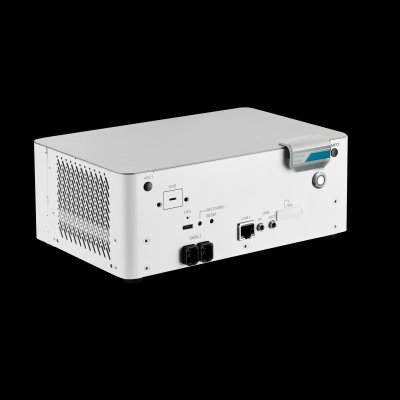
Aetina has released the AIE-KT78 and AIE-KT68 edge AI systems for robotics, combining NVIDIA Jetson Thor compute, high-bandwidth sensor interfaces and EtherCAT machine control within a single industrial platform. The systems are aimed at cobots, humanoid robots and autonomous machinery that need to process several perception streams while running multimodal AI models and controlling physical movement in real time.
The higher-performance AIE-KT78 uses NVIDIA’s Jetson T5000 module with 128GB of 256-bit LPDDR5X memory and is rated at up to 2,070 FP4 TFLOPS of AI performance. The AIE-KT68 uses the Jetson T4000 with 64GB of 256-bit LPDDR5X and delivers up to 1,200 FP4 TFLOPS.
Both systems use NVIDIA’s Blackwell architecture and are available for shipment now. Aetina is positioning them around the increasing computational load created by physical AI, where a machine has to perceive its environment, interpret information and convert that interpretation into physical action.
A conventional industrial robot can execute deterministic motion from a tightly defined programme with relatively modest perception requirements. A robot expected to interpret images, language and changing surroundings has a different workload.
Several high-resolution sensor streams may need to be processed at the same time as large multimodal models, while motors and joints still require predictable control timing. The engineering problem is therefore not simply adding more AI compute.
The KT systems support local execution of multimodal generative AI, large language models, vision-language models and vision-language-action models. Running those models on the machine reduces dependence on a cloud connection for every inference step and keeps sensor information closer to the equipment generating it.
That can reduce communications latency and simplify some data-control requirements, although application performance will still depend on the model, software implementation and the way compute resources are shared between workloads.
Sensor connectivity is a major part of the platform design. The systems include QSFP28 networking providing up to 100Gbps of aggregate bandwidth depending on configuration, alongside two 10GbE interfaces.
They can also support up to eight GMSL2 camera inputs, giving developers routes to combine high-resolution cameras with LiDAR, radar, depth sensors, inertial measurement units and other industrial inputs.
That bandwidth matters because robotic perception is increasingly a sensor-fusion problem rather than a single-camera task. A machine may need several viewpoints for spatial awareness, depth information for object location and inertial data for movement, all interpreted quickly enough for the resulting decision to remain relevant.
A dedicated 1GbE RJ45 interface provides EtherCAT Master functionality for connection to motors, joints, sensors and external actuators. EtherCAT is widely used in industrial motion systems because it supports tightly synchronised device communication.
Aetina’s architecture uses that connection to bring high-level AI inference and deterministic machine control into the same hardware platform rather than treating perception compute and actuation as completely separate systems.
The distinction between those workloads remains important. An image or language model can tolerate variation in inference time that would be unacceptable in a servo-control loop. Motor control has to execute on predictable cycles even when the AI side of the system is processing a complex input.
Combining both functions therefore still requires an architecture capable of protecting time-critical control from the variable computational demands of AI. Aetina says the EtherCAT interface can operate as an independent master with microsecond-level synchronisation.
That gives system integrators a route to connect the platform directly into an industrial motion architecture and potentially reduce the number of separate computing devices required between perception and control.
It does not remove the need for appropriate functional-safety systems. Cobots and humanoid machines working around people still require safety functions designed and validated for the application, and Aetina is not presenting AI inference as a replacement for certified safety control.
The mechanical platform is also designed for deployment beyond a development bench. Both systems are 80mm thick, accept a 9–48VDC input and are specified for operation between -25°C and +55°C.
They also provide USB 3.2, isolated digital I/O and M.2 expansion, giving integrators additional routes to connect storage, communications and application-specific hardware.
Software support includes NVIDIA JetPack 7, CUDA, TensorRT, DeepStream, Holoscan and Isaac ROS. The stack spans low-level acceleration, inference optimisation, streaming vision, sensor processing and robotics software, reducing the amount of platform integration required before an application team can begin working on its own perception and control functions.
Richard Hung, Vice President of Product Division at Aetina, said: “The competitive edge for cobots and humanoid robots has shifted from the compute performance of a single model to whether a system can integrate perception, reasoning, decision-making, and action in real time in real-world environments.”
That point also explains why headline TFLOPS figures provide only part of the system picture. Deployed robots are limited by memory movement, sensor bandwidth, control timing, software efficiency and thermal performance as well as raw AI throughput.
A processor capable of running a large model is useful only if the surrounding architecture can keep it supplied with appropriate data and convert its output into timely machine behaviour.
The KT78 and KT68 consequently sit between a conventional industrial computer and a dedicated robotics controller. Their proposition is to consolidate more perception, reasoning and control without forcing developers to construct the platform from several separate compute and communications layers.
Whether that genuinely reduces overall system complexity will depend on how much additional safety, I/O and specialised control hardware each application still requires.
Aetina is targeting the transition from robotics prototypes into repeatable production deployments, where environmental tolerance and system integration become more important than demonstration performance. A laboratory prototype can operate around exposed boards, external switches and temporary wiring; a machine intended for continuous industrial use needs defined power, thermal and mechanical behaviour.
General availability therefore marks a more useful industrial milestone than another Jetson Thor demonstration. The compute module is only one element of a deployable robot. By packaging it with high-bandwidth sensor interfaces and an EtherCAT control route, Aetina is attempting to close the gap between running advanced AI at the edge and using that AI as part of a machine expected to perceive its surroundings and act on them continuously.