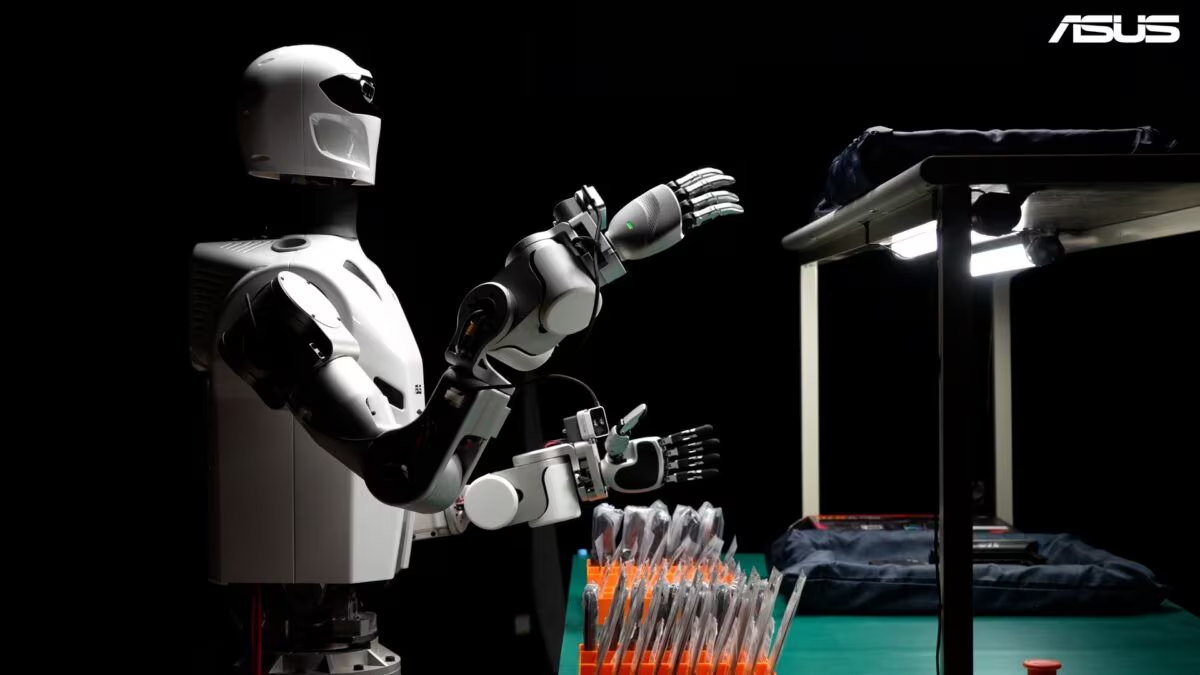
ASUS is testing its Gallop humanoid robot on a motherboard accessory packing station at one of its group electronics manufacturing plants, using work performed by experienced employees to train the system. The robot is being developed for repetitive packing tasks rather than demonstrated as a general-purpose machine. ASUS plans customer pilots in 2027 and is targeting commercial availability during the second half of 2028, but has not published evidence that the equipment has reached its required production performance.
The initial station involves placing 15 small accessories into motherboard packaging, including items enclosed in thin, transparent bags. ASUS says the established workstation takes approximately 20 seconds per board and has set the robot a target of 99.5% successful completion within that time. This is a development requirement, not a reported measured success rate. The company’s 13 November technical account says that the demonstration, learning and production-line test cycle is working, without providing reliability data across a complete shift.
Small, flexible packages make the station a demanding manipulation problem. A robot must locate each item, distinguish a transparent wrapper from its contents, grasp it without dropping or damaging it and place it in the correct position. Thin bags can move, fold or change appearance during handling, while the next package may not sit precisely where the previous one was presented. Traditional fixed automation can handle highly repeatable placement tasks, but may require carefully controlled part presentation and specialist tooling when components vary substantially in form.
Gallop currently works at a defined workstation with two arms on a fixed base. ASUS plans a wheeled version, but the current packing test does not require the robot to travel between production areas. It is intended to use a station configured for human work, which may reduce the need to redesign every part of the line around a dedicated robot cell. This does not eliminate the need to verify clearance, safeguarding, cycle time and the reliability of presenting and gripping each item during a complete production shift.
The training process begins with existing open AI models and examples gathered from the job itself. Skilled employees wear a small head-mounted camera with their consent while performing the packing operation, providing visual records of real parts and working conditions. ASUS then generates variations in simulation to represent changes a machine may encounter on the line. During further training, an operator uses a virtual reality headset and gloves to guide the robot through the same task, allowing the system to connect demonstrations with the movements of its own arms and hands.
Records from the robot’s own tests are intended to feed subsequent training cycles. When a small bag moves or a grasp fails, additional demonstrations and simulated variations may help improve the response. The process cannot substitute for physical verification: simulation does not reproduce every change in friction, packaging shape or contact force, and a successful sequence in a laboratory does not establish consistent throughput on the factory floor. ASUS says the demonstration, training and testing cycle is functioning, but has not published a measured success rate for that loop in routine production.
ASUS describes the robot’s software as four connected layers. A planning system interprets the scene and divides the work into steps, while a supervisory component checks progress and can revise the sequence when a step goes wrong. A separate skills layer handles tasks such as reaching, grasping and placement, with a control layer responsible for moving the arms and stopping motion when required. These are the company’s stated design functions; no independent safety certification or quantitative stopping performance result was supplied with the announcement.
Computation runs on a single NVIDIA Jetson AGX Thor device inside the machine, according to ASUS. The company develops the robot body and is working on its own dexterous hand with tactile sensing, while sourcing conventional motors and other components from established partners. Its modular design is intended to allow improved AI models to replace earlier versions without rebuilding the entire machine. The challenge is to maintain reliable interaction between perception, planning and motion control as individual components evolve, particularly when the equipment must work predictably around factory staff.
The electronics factory provides an existing workstation, real components and staff who know how the packing task is assessed. Those conditions support the development process but do not establish readiness for use at another company’s plant. ASUS has not disclosed Gallop’s price, rated payload, full-shift availability, measured fault frequency or any completed external customer pilot. Its initial commercial focus is electronics manufacturing, with service and healthcare uses described as possible later applications rather than products with committed deployment dates.
Production performance depends on more than a single successful grasp. The robot would need to sustain the workstation’s cycle time as parts, batches and presentation conditions change, recover from recoverable errors and alert a person to faults that cannot be safely resolved. A 99.5% task success target also leaves questions about how success is counted, how long a test lasts and what happens after an unsuccessful cycle. Those measures will determine whether the technology can reduce labour demand at a station without introducing new inspection or rework burdens.
ASUS plans to show Gallop at Computex 2027, while adding its own tactile hand and developing the wheeled version. External customer pilots are planned for 2027, with market availability targeted for the second half of 2028. Before that timetable can support production purchasing decisions, the company will need to demonstrate repeatable performance against its stated station requirement, including how failed picks are detected and recovered without creating unacceptable rework or interruptions.