GlobalFoundries and Marvell have expanded a multi-year manufacturing agreement to increase silicon-germanium capacity at GlobalFoundries’ Burlington, Vermont, fab, targeting optical interconnects used in AI and cloud data-centre infrastructure. The agreement covers additional production for next-generation pluggable transceivers, near-packaged optics and co-packaged optics.
GlobalFoundries says the expanded arrangement builds on existing manufacturing for Marvell and will add significant SiGe capacity, although neither company has disclosed the additional wafer volume, investment value or precise timing of the increase.
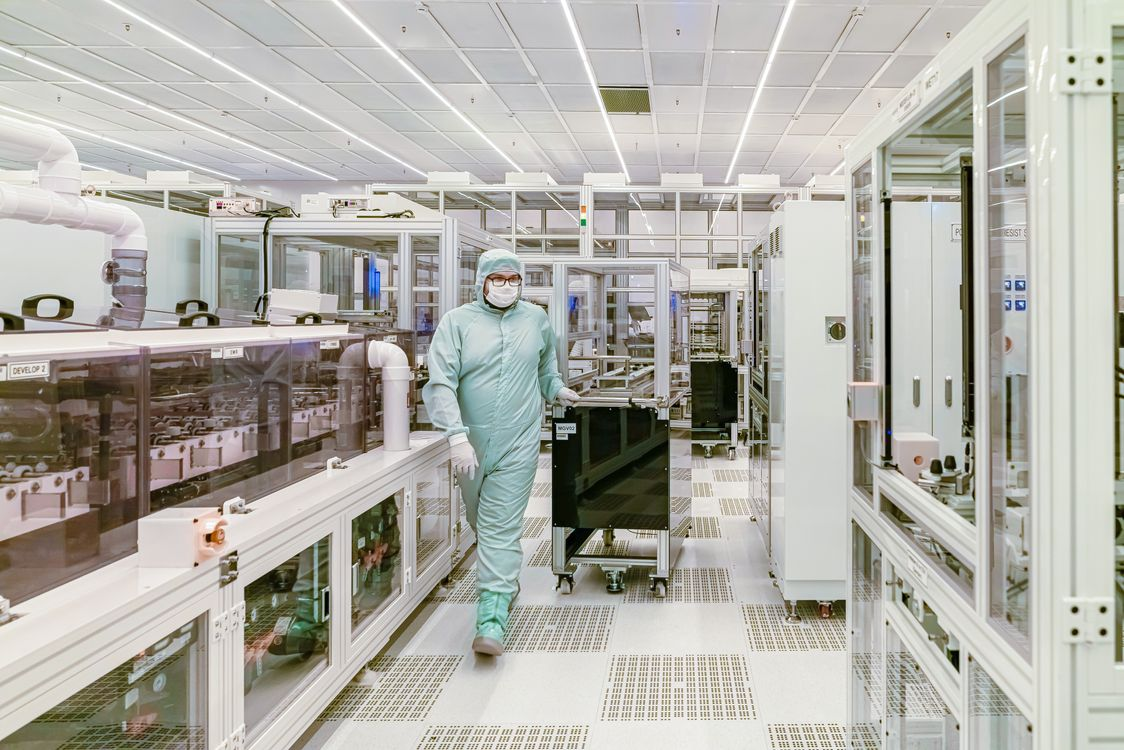
The work will remain at Burlington, a long-established 200mm specialty fab used for radio-frequency, silicon-germanium, gallium-nitride and other analogue and mixed-signal technologies. That makes the agreement a capacity expansion within an existing industrial platform rather than construction of a new semiconductor facility.
Silicon germanium has a particular role in high-speed connectivity. Adding germanium to silicon alters device characteristics in ways that support transistors operating efficiently at very high frequencies while retaining compatibility with established silicon manufacturing techniques.
In optical-networking systems, SiGe is useful in analogue and mixed-signal functions surrounding photonic devices and digital signal processing. Those circuits have to handle very high data rates while controlling power consumption, noise and signal integrity.
GlobalFoundries’ current SiGe platform supports 200G-per-lane optical connectivity, with higher-speed generations planned as network bandwidth increases. A 200G lane can be combined into multi-lane interfaces supporting 800G and 1.6T-class systems, making the manufacturing agreement relevant to several generations of optical hardware rather than one transceiver design.
The underlying demand is being driven by changes inside large AI systems. Accelerators increasingly operate in clusters where overall performance depends on moving enormous volumes of data between processors, memory and network resources.
As those clusters grow, electrical links become harder to extend over distance without increasing power use and signal-conditioning requirements. Optical connectivity is consequently moving deeper into the data centre, shortening the electrical path between high-bandwidth silicon and fibre.
Pluggable optical modules remain the established approach at the edge of switches and servers. Near-packaged optics move optical engines closer to the switching or compute device, while co-packaged optics place the optical interface within or immediately beside the package environment.
Each step reduces the length of high-speed electrical connections but increases the need for tightly integrated analogue, optical and packaging technologies. SiGe manufacturing becomes one part of a wider system in which digital logic receives most of the attention but cannot operate effectively without high-frequency interfaces around it.
Marvell has been expanding its optical portfolio around the same transition. Its recent 1.6T optical DSP products use 200G-per-lane interfaces as data-centre networks move beyond 800G connectivity.
The GlobalFoundries agreement addresses another layer of that architecture. It increases manufacturing capacity for the SiGe technology used in the analogue optical chain rather than simply increasing supply of the digital signal processors controlling the link.
Burlington provides a manufacturing base with unusual longevity. The facility began operating in 1957, later became part of IBM Microelectronics and was acquired by GlobalFoundries in 2015. The company says the site employs around 1,800 employees and contractors and has total capacity of approximately 600,000 200mm-equivalent wafers a year across its technology portfolio.
SiGe capacity therefore has to coexist with production serving wireless, automotive, defence, power and other specialist markets. Increasing output is not simply a matter of assigning more finished wafers to one customer. Tool availability, process steps, cycle times, yields and the mix of products moving through the fab determine how much usable capacity can be released.
The agreement follows other manufacturing commitments made by GlobalFoundries during September. Monolithic Power Systems is moving power-management processes into GlobalFoundries’ Singapore operation, targeting automotive, industrial and AI applications.
The Singapore programme is distinct from the Marvell agreement, but together they show the foundry allocating different fabs and process technologies to parts of the semiconductor market where customers expect sustained infrastructure demand.
The Marvell expansion also illustrates why AI manufacturing requirements extend well beyond leading-edge processors. Accelerator clusters need optical interfaces, analogue functions, power conversion, packaging and high-volume specialty semiconductor processes before they can operate as complete systems.
Capacity constraints can consequently emerge inside mature or specialised fabs even where the headline compute devices are manufactured on far smaller process nodes. The age of a fab says little about the relevance of the technology running through it if that process performs a function that advanced digital silicon cannot replace.
Neither company has quantified the additional SiGe capacity covered by the agreement, so the industrial scale will have to be measured through production rather than the announcement alone. Useful markers will include GlobalFoundries’ progress beyond 200G-per-lane technology and Marvell’s adoption across pluggable, near-packaged and co-packaged designs.
For Marvell, the agreement provides a longer-term manufacturing route for a component technology that becomes more important as AI networks demand more bandwidth. For GlobalFoundries, it adds another customer commitment to a specialty process built around an established Vermont fab.
The result is an infrastructure investment at two levels. AI data centres need more optical connectivity to move information between increasingly dense compute resources, while that connectivity requires additional manufacturing capacity inside fabs whose specialised analogue processes remain essential to the system around the latest digital processors.