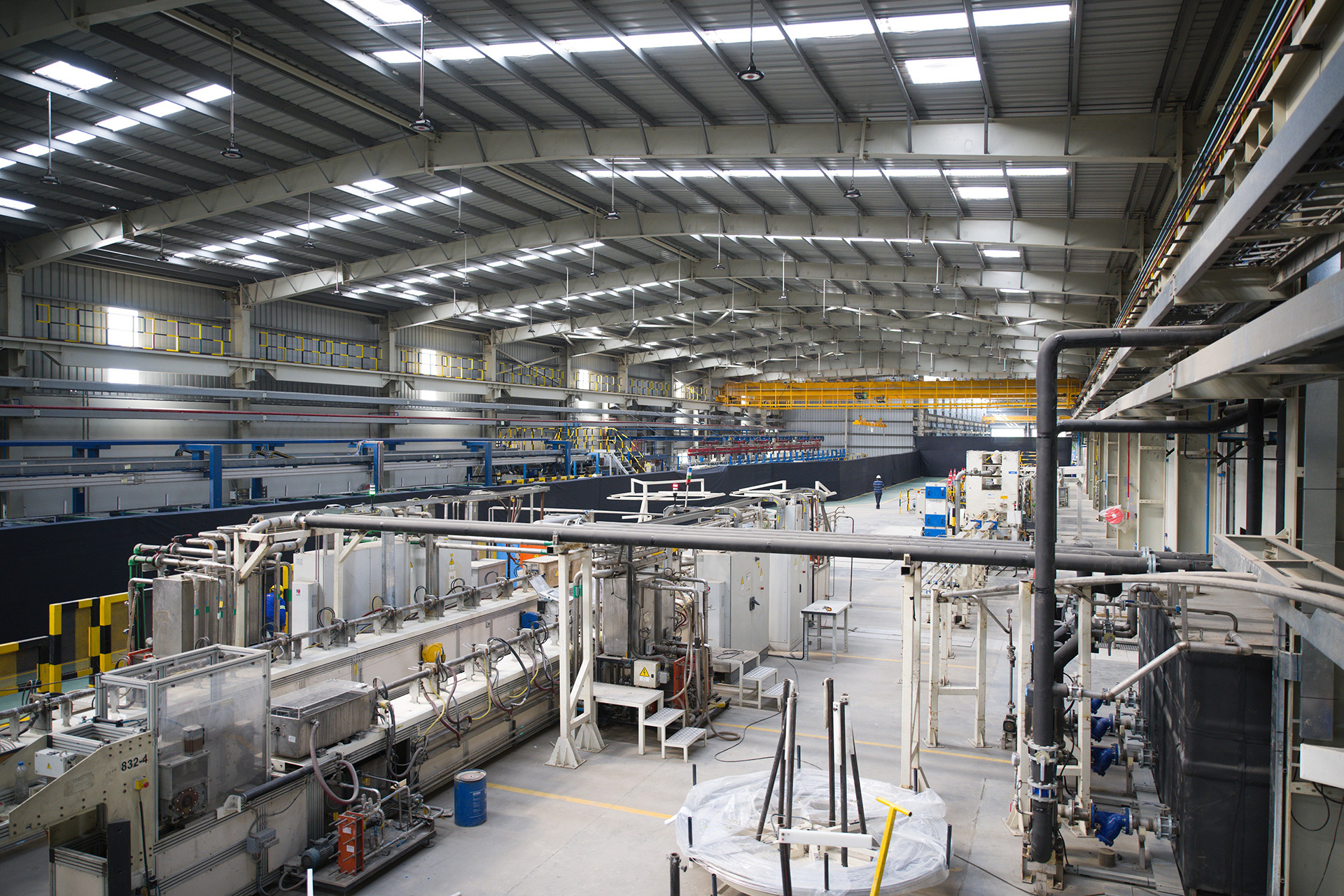
Alleima is investing approximately SEK220 million at its Mehsana manufacturing site in India, expanding local production of advanced tubing for fertiliser, chemical, petrochemical, compressed natural gas, hydraulic, and instrumentation applications.
The programme represents the next expansion phase at a plant that Alleima has already enlarged substantially. The latest investment will establish local production of advanced tubes for the fertiliser industry, increase capacity for larger-dimension application tubing serving chemical and petrochemical customers, and add further precision-tube capability for compressed natural gas fuel systems and other hydraulic and instrumentation uses.
The new capacity is scheduled to become operational during 2028. Alleima says the investment will shorten lead times for customers across the region while also supporting selected export markets, continuing a localisation strategy that has progressively shifted more technically specialised tube production closer to Asian industrial customers.
That strategy has been developing for several years. Alleima began a three-phase expansion at Mehsana in 2019, adding a cold-finishing line for heat-exchanger tubing, a hydraulic and instrumentation tube factory, and a further heat-exchanger tube facility. The programme was completed in 2023 after approximately SEK180 million of investment.
The new SEK220 million commitment is therefore larger than the previous multi-year expansion programme and broadens the site’s product range rather than simply reproducing existing capacity. Local manufacture of fertiliser-industry tubing adds another process-sector application where corrosion resistance, dimensional control, material consistency, and pressure integrity can directly affect maintenance requirements and plant availability.
Application tubing in chemical and petrochemical facilities operates in conditions where material selection is an engineering decision rather than a procurement detail. Process fluids, temperature, pressure, contaminants, and cyclic operating conditions can all influence corrosion behaviour and service life, making metallurgy and manufacturing repeatability as important as dimensions and delivery price.
Alleima specialises in advanced stainless steels and special alloys for such applications. Its broader portfolio is based on more than 900 active alloy recipes and includes seamless tubes for energy, chemical, aerospace, medical, and industrial markets, giving the Mehsana expansion a substantially different technical profile from a conventional commodity-tube capacity increase.
Localisation also changes the supply-chain calculation. Imported specialist tubing can involve longer replenishment cycles, additional inventory, currency exposure, and international freight and customs risk. Producing more of the required grades and dimensions closer to Indian customers can reduce some of those constraints, although the benefit will ultimately depend on which products are qualified locally and how quickly customers approve them for critical applications.
The earlier Mehsana programme shows how that process develops. A hydraulic and instrumentation tubing factory entered operation in March 2023, followed later that year by a heat-exchanger tube facility designed to manufacture advanced alloys locally. Alleima subsequently added production of higher-performance grades for urea, chemical, petrochemical, refinery, and marine applications.
The 2026 investment extends that progression into larger application tubing and additional precision products. Compressed natural gas systems require tubing capable of handling elevated pressures, while hydraulic and instrumentation lines perform control, measurement, sampling, and fluid-transfer functions throughout process plants and industrial machinery. Their physical size may be modest compared with the equipment they serve, but a failed line can still stop a much larger asset.
Alleima has linked the latest investment to growth in India’s chemical and petrochemical industries and to increasing demand associated with natural gas. Those market assessments come from the company, but the decision to commit another SEK220 million only three years after completing the previous expansion provides a more concrete indication of how it expects regional demand to develop.
The project also fits Alleima’s strategy of concentrating capital on higher-value industrial markets where materials performance, certification, and lifecycle reliability carry more weight than simple tonnage. Chemical and petrochemical applications are among the company’s targeted growth segments, alongside other areas requiring specialised alloys and tightly controlled manufacturing.
For Mehsana, the practical challenge now moves from capital approval to industrial execution. Additional machinery has to be installed, processes qualified, employees trained, materials controlled, and customers satisfied that local output meets the same technical requirements as products manufactured elsewhere in Alleima’s network.
The company had around 6,800 employees and revenue of approximately SEK19 billion in 2025. Its next Indian capacity step will take roughly two years to reach operation, leaving the immediate significance in the manufacturing commitment rather than new output. By 2028, the useful measure will be whether Mehsana has converted that investment into qualified local capacity, shorter lead times, and repeatable production of the specialised tubing customers were previously sourcing through longer supply chains.