Brigham Pressings has completed a six-week tooling programme for a chemical dispensing system used on automotive and aerospace assembly lines, combining component redesign with die manufacture and production commissioning.
The Birmingham precision pressings specialist was brought into the programme by an unnamed global supplier of hand-held chemical dispensing equipment. The customer wanted a lighter, more ergonomic applicator that could improve operator change-over performance while retaining compatibility with its existing production environment.
Annual demand is expected to reach 900,000 units, which pushed the development towards high-volume manufacturability rather than prototype optimisation alone. Brigham held design-for-manufacture workshops with the customer and converted the original CAD concept into two production-ready pressed components.
The parts are manufactured from DC04 mild steel in 2.3mm and 1.6mm thicknesses. Brigham used 3D modelling to refine finger contours and handling while retaining the original mounting envelope, allowing the redesigned assembly to fit into the customer’s existing equipment without requiring a wider change to the production interface.
Tooling was developed alongside the component geometry. New wear-resistant dies were designed with maintenance requirements and long-term production volumes considered from the outset, rather than leaving tool life and serviceability to be addressed after the parts had been frozen for manufacture.
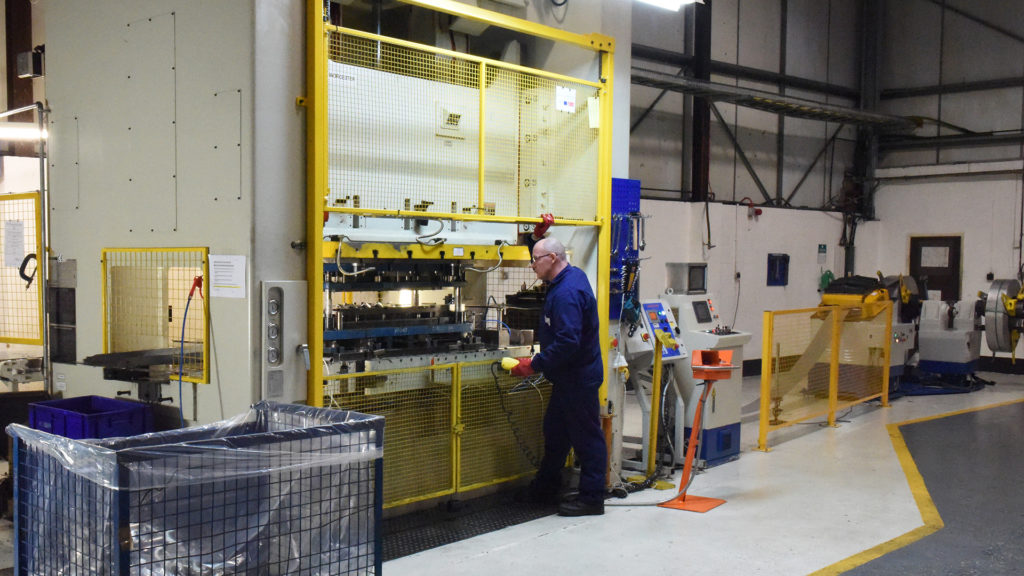
Brigham completed the tool build in six weeks, followed by a further week of commissioning at the customer’s site to bring both dies up to production speed. The resulting tooling was qualified for the stated annual requirement of 900,000 units, with manufacture allocated across Brigham’s Chin Fong, Bruderer, and S&B press capacity.
On-site trials were also used to check the ergonomic changes under production conditions. Operators confirmed that the redesigned assembly met the required hand-force parameters and target change-over time, providing an operating test of the design rather than relying on CAD geometry and dimensional inspection alone.
The programme demonstrates the point at which design engineering and subcontract manufacture become difficult to separate. In high-volume presswork, apparently minor decisions around material thickness, bend radii, formed features, tolerances, tool access, and component orientation can affect tool complexity, scrap levels, maintenance intervals, and achievable cycle time across hundreds of thousands of parts.
Early involvement from the presswork supplier can therefore reduce the risk of producing a component that performs well as a prototype but is unnecessarily difficult to manufacture at volume. Once production tooling has been cut, changes that would have been inexpensive during the CAD stage can involve substantial rework, additional trials, or an entirely new die set.
The same issue appears at the larger end of UK forming equipment. Group Rhodes’ recent expansion of large-press assembly capacity reflects increasing demand for more complex forming systems in aerospace, defence, composites, and advanced manufacturing. Brigham’s project sits much further downstream, but both depend on understanding the interaction between component geometry, tooling, press capability, and repeatable production.
The choice of DC04 mild steel also keeps the engineering focus on process rather than exotic material selection. The productivity gain comes from making conventional sheet material easier to form, assemble, handle, and produce consistently, which is often a more realistic route to manufacturing improvement than replacing an established material simply because a newer one is available.
With annual volumes approaching one million units, small inefficiencies multiply quickly. An unnecessary forming operation, excessive die wear, slow component change-over, or a marginal increase in scrap may appear insignificant on a single part but become commercially meaningful over a sustained production run.
The six-week tooling headline is therefore useful only because the programme continued through commissioning and qualification. Fast tool manufacture that creates instability in serial production simply moves the delay downstream, where it becomes more expensive and starts affecting customer schedules.
Brigham’s model brings presswork, tooling, design-for-manufacture support, and project management into the same operation. Its manufacturing quality and environmental systems are certified to ISO 9001 and ISO 14001, while the company’s equipment allows it to cover high-speed and heavier-duty press requirements across several engineering markets.
The current programme now moves from development into the less forgiving part of the manufacturing cycle. Maintaining geometry, tool condition, operator performance, and change-over targets over hundreds of thousands of strokes will determine whether the redesign has genuinely improved the product rather than merely produced an impressive commissioning week.