Group Rhodes is investing approximately £400,000 in assembly pits and material-handling equipment at its Wakefield operation, increasing the company’s capacity to build larger and more technically complex press systems.
The enlarged facilities will support machinery for aerospace, defence, advanced manufacturing, composites, and general engineering, with particular emphasis on superplastic forming, diffusion bonding, and polymer die-pressing applications.
Large presses impose demanding requirements before they reach a customer’s production floor because frames, platens, cylinders, heating equipment, vacuum systems, tooling interfaces, safety structures, and controls must be integrated with accurate alignment despite their scale and weight.
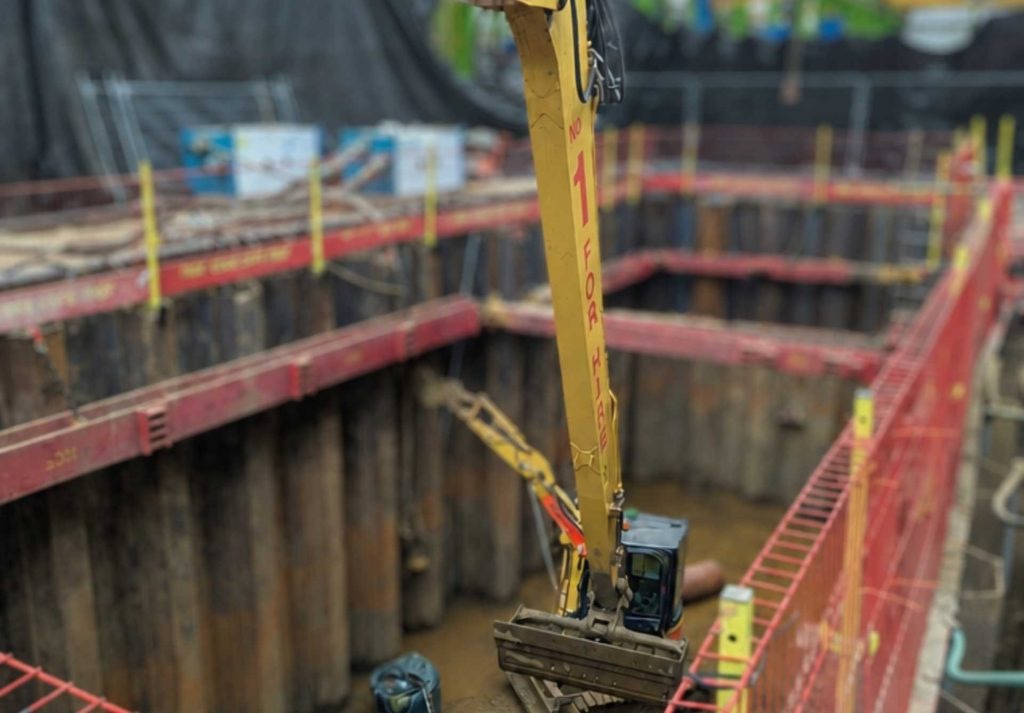
By allowing sections of machinery to sit below floor level during assembly and testing, the new pits will improve access around tall systems and support the installation of major components. They will also accommodate machines that would otherwise be restricted by the practical height and lifting limits of the building.
Additional material-handling equipment will allow heavy components to move through the factory under more controlled conditions. As machine dimensions increase, load stability, lifting capacity, access, and assembly sequencing become more critical, particularly where expensive machined surfaces or hydraulic equipment could be damaged through poor handling.
Mark Ridgway OBE DL, chief executive and chairman of Group Rhodes, said: “This investment is a clear statement of confidence in our people, our capabilities and the future of manufacturing here in the UK.”
With more than two centuries of engineering history, the company has worked with composite-forming technologies since the 1930s. Its Rhodes Interform business is among a small group of manufacturers capable of supplying commercial-scale automatic presses combining superplastic forming and diffusion bonding.
Superplastic forming uses carefully controlled temperature and gas pressure to shape suitable alloys while they are in a highly ductile condition, enabling complex geometries to be produced with fewer separate parts. Diffusion bonding joins prepared surfaces through heat and pressure without conventional welding or a separate filler material.
Used together, the processes can produce lightweight and structurally efficient components that would be difficult to manufacture through conventional forming and joining. Temperature distribution, gas pressure, surface preparation, tooling condition, and cycle control must remain tightly managed throughout production.
Press building extends beyond heavy fabrication
Modern forming systems require substantially more than a rigid mechanical frame, since customers expect programmable control, data acquisition, hydraulic monitoring, temperature management, recipe control, safety interlocks, traceability, and remote diagnostic functions to operate as an integrated package.
As machinery becomes more connected, the builder must define how production data will pass into customer systems and how the equipment will respond when communication is interrupted. Cyber security, user permissions, software maintenance, and long-term support increasingly sit beside conventional mechanical and electrical engineering.
Polymer and composite processing introduces another group of constraints because tool temperature, pressure uniformity, material flow, cure behaviour, and cycle repeatability affect structural and dimensional performance. Any inconsistency becomes harder to control as component size increases and thermal or load variation develops across a larger working area.
Customers in aerospace and defence also expect machinery to remain supportable for several decades. Spare parts, control upgrades, calibration, refurbishment, and technical support may continue long after the original installation, making maintainability and future modification important elements of the initial design.
Heavy engineering capability has become less common across parts of Britain, while rebuilding lost capacity requires substantial capital, suitable premises, specialist lifting equipment, and experienced employees. Remaining machine builders consequently occupy an important position within sectors that depend on large forming, assembly, and test systems.
The new Wakefield facilities will allow Group Rhodes to accept projects previously limited by floor layout or handling constraints, while improving assembly efficiency on existing machine sizes. Better access should reduce temporary lifting arrangements and give mechanical, hydraulic, electrical, and software teams a more stable environment in which to integrate complete systems.
Factory acceptance testing can also become more comprehensive when machinery is assembled under representative conditions before shipment. Unresolved faults are considerably more expensive after a machine has been dismantled, transported, installed, and connected at an overseas customer’s site.
Capacity alone will not determine delivery performance, since complex press projects require coordinated engineering and suppliers capable of producing large fabrications, precision components, hydraulic equipment, controls, and specialist tooling. The investment provides the physical environment in which those elements can be brought together and tested as a complete production system.
As manufacturers seek larger components, more automated operation, lower energy use, and stronger process data, the demands placed on specialist machinery builders continue to rise. Group Rhodes’ expanded assembly capability positions the Wakefield operation for projects where technical assurance, process knowledge, and through-life support carry as much weight as nominal press size.