Arnold Magnetic Technologies has presented the manufacturing capabilities and industrial applications of its established Flexmag portfolio, including magnetic sheets, strips, tapes, extruded profiles and custom converted materials. On 13 October 2026, the company outlined the capabilities of these existing ranges without introducing a newly developed magnetic grade or additional factory.
Arnold, a subsidiary of Compass Diversified, supplies magnetic materials and engineered components to industrial customers. Its Flexmag operation specialises in flexible composite products, combining magnetic particles with polymer-based binders to obtain characteristics different from those of solid metallic or sintered ceramic magnets.
A flexible magnet is not defined by flexibility alone. Magnetic performance depends on the formulation, particle loading, processing method and orientation of the magnetic material, while the binder contributes mechanical properties needed for bending, cutting or forming the finished part.
Those characteristics make composite magnets suitable for applications where a rigid magnet would be difficult to install or would require additional mechanical support. Strips can follow a defined profile, while sheets and tapes may be cut or converted to match the geometry of the product in which they will be used.
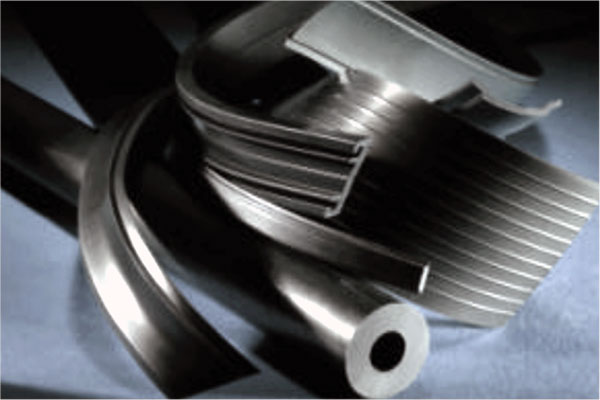
UltraMag extrusions are made by combining thermoplastic elastomer material with magnetic powders and forcing the mixture through precisely controlled dies. The process creates continuous profiles with selected cross sections, allowing long lengths of material to be produced for applications requiring repeatable dimensions.
Die design influences the profile produced, while formulation and manufacturing conditions affect the properties of the finished extrusion. A component designed to sit in a channel or provide magnetic retention must meet both its mechanical fit and the magnetic requirements of the assembly.
Manufacturers can specify material supplied either magnetised or unmagnetised, with the chosen production sequence depending on the subsequent processing and assembly operations. A component may need cutting, adhesive application or other conversion before its final magnetisation pattern is established.
The magnetic field arrangement is relevant to the force available in service. A strip’s magnetisation pattern, the distance from a mating component and the nature of the magnetic circuit influence performance; selecting material solely on the basis of a laboratory magnetic specification can therefore lead to an unsuitable design.
Arnold’s flexMAX FM-60 is among the higher-energy engineered options in the range. The company specifies a maximum energy product of up to 2.0 MGOe for the anisotropic extruded material, intended for applications requiring greater magnetic capability than some conventional flexible products.
Maximum energy product describes a property of the magnetic material and should not be confused with the holding force of a finished strip. That force varies with component dimensions, pole arrangement, nearby materials and the gap between the magnet and the surface it attracts.
FM-60’s anisotropic construction means the material has a preferred magnetic orientation established through its manufacturing process. This feature can be used in the design of suitable components, but the product remains subject to application-specific assessment of physical dimensions and magnetic performance.
The portfolio also includes printable magnetic media and flexible sheets designed to be processed into application-specific products. These materials may require different surface characteristics or converting arrangements from extruded strips, particularly where printing, cutting or repeated handling is involved.
Ferrosheet magnetic receptive sheeting performs a distinct function: it provides a receptive surface for use with suitable magnetic graphics and related products. It is not interchangeable with an actively magnetised strip, and the performance of a complete assembly depends on the magnetic media paired with the sheet.
Receptive materials can support changeable workplace information and other visual management applications where a removable magnetic display is appropriate. Attachment must still be evaluated against the surface conditions, cleaning regime, temperature and mechanical disturbance expected at the installation.
Other Flexmag composite products are used in more specialised applications, including gasket materials, radiation absorption and electromagnetic or radio-frequency interference shielding. These functions depend on the specific material formulation and should not be attributed indiscriminately to every product in the range.
Electromagnetic shielding illustrates the need for careful specification. Its effectiveness depends on frequency, material composition, thickness and how the shielding layer is integrated into the surrounding equipment. Material suitable for one frequency range or type of interference may perform differently when the conditions change.
Likewise, a composite chosen for mechanical sealing must be evaluated for compression, dimensional behaviour and the service environment. A magnetic retention function does not establish chemical resistance, sealing integrity or suitability for a particular temperature or pressure duty.
Arnold supplies engineering assistance to customers selecting and configuring flexible magnetic materials. Design work can involve the choice of formulation, component shape, magnetisation method, conversion process and the interface with adjoining components.
The company says its Flexmag facilities hold ISO 9001:2015 certification, while its relevant operations are registered under US International Traffic in Arms Regulations and can address applicable Defence Federal Acquisition Regulation Supplement requirements. Those declarations concern the appropriate quality management and regulatory scope, not an unconditional approval of every manufactured item for defence use.
Arnold also describes REACH and RoHS2 compliance for relevant Flexmag products. Applicability must still be checked for the specific material and intended market, while the manufacturer of a finished assembly remains responsible for conformity with requirements applying to that assembly.
Flexible composites can reduce the amount of secondary processing required for particular shapes, but their production still depends on consistent material feed, tooling and dimensional control. Where tight tolerances or repeatable magnetic properties are required, converting and inspection processes form part of the specification as much as the chosen material grade.
Flexmag has supplied flexible magnetic products for decades, serving applications in manufacturing and other sectors. The October portfolio statement discloses neither new orders nor additional industrial output, and the established FM-60 grade is not presented as an October product launch.
The updated product information gives engineers a basis for comparing available materials and manufacturing formats. Final selection will depend on whether the chosen product meets mechanical, magnetic and environmental requirements in the actual assembly rather than the headline characteristics of the broader portfolio.