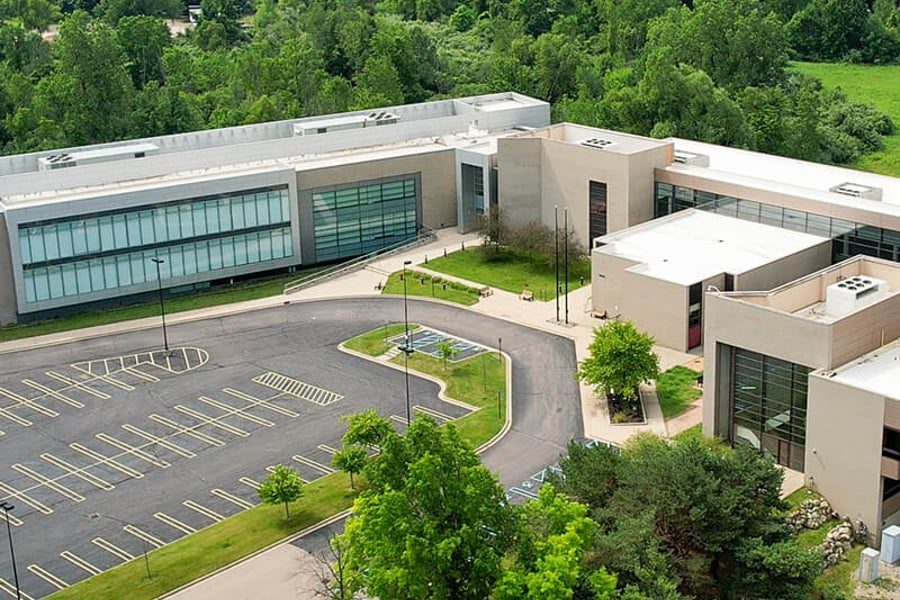
FANUC America has opened an industrial automation training academy in Auburn Hills, Michigan, investing more than $18 million in facilities for robotics, computer numerical control and manufacturing technology education. The new three-storey building contains 132,000 square feet of total space, including 56,300 square feet dedicated to practical and classroom instruction.
The FANUC Academy occupies part of the company’s West Campus and replaces the previous training operation at its Rochester Hills headquarters. FANUC published an initial announcement on 15 October, with wider distribution of the opening on 19 October. The industrial development is therefore the opening of a completed facility rather than a project first proposed in the later announcement.
The number of classrooms has risen from 13 to 28, allowing a greater range of training sessions and groups to be accommodated. FANUC describes the development as the largest corporate robotics and industrial automation training centre in the United States, a company claim specifically about corporate facilities rather than a comparison covering every university or publicly operated technical college.
The company’s training network comprises the new Academy and eight other regional locations. Taken together, those nine facilities can accommodate approximately 17,500 participants annually and have access to more than 160 industrial robots and over 40 CNC simulators. None of these figures should be treated as the annual attendance or equipment inventory of the Auburn Hills building on its own.
Training courses will serve technicians, engineers, manufacturing employees, system integrators, teachers and students. Although the groups may use related equipment, their learning requirements differ: equipment operators need to understand routine operation, engineers may programme or commission new applications, and maintenance personnel must be able to investigate faults and restore production safely.
Industrial robots perform controlled movements through combinations of mechanical arms, drives, controllers and application-specific tooling. Their use in manufacturing depends on coordinating those elements with workpiece positioning, conveyors, machines and safety systems. A robot’s rated payload or reach does not establish that it can perform a particular production operation without considering the completed installation.
Programming training therefore covers more than recording movement coordinates. A robot used for machine tending, for example, must exchange signals with the machine tool, manage the correct position of parts and respond appropriately when the process is interrupted. The mechanical design and permitted operating sequence determine what the controller can safely command.
The same integration requirements apply when vision systems and other sensors are added to automated equipment. Camera measurements can guide part location or inspection, but their reliability depends on lighting, calibration, image processing and the characteristics of the product. Trainees working on such systems need to understand the physical constraints behind the data rather than treating every software output as correct.
Automation safety is another part of the technical environment. A robot cell may require guarding, interlocks and other protective measures determined by the application risk assessment. A classroom demonstration can teach safe working principles, while each production installation still needs its own assessment and verification under the applicable rules.
CNC training addresses the use of computer-controlled machining equipment, where programmed toolpaths govern the movement of cutting tools and machine axes. Part quality also depends on tooling, workholding, material behaviour and the physical condition of the equipment, so knowledge of the programming language is only one element of competent operation.
Simulators can be used to examine machining sequences before a programme is transferred to production equipment. They help trainees identify possible collisions or incorrect movements, although the output still needs to be assessed against real machine characteristics and cutting conditions. Practical instruction provides the link between a digital representation and the behaviour of manufactured parts.
Combining classroom work with access to industrial robots and CNC equipment is intended to make that link more direct. Learners can develop an understanding of the controller and then observe the effects of their decisions in a supervised setting, without interrupting a customer’s production line or relying entirely on theoretical exercises.
FANUC also operates the Certified Education Training programme, known as CERT, which supports more than 1,700 schools across North America. The company says roughly 60,000 students participate annually through the wider education network. Those school programme figures are distinct from the approximately 17,500 places that the company’s own regional training facilities can accommodate.
The new Michigan facility will support educator certification, partnerships with community colleges, high school mechatronics activities and training for manufacturers and automation integrators. These different channels address both employees already working with industrial equipment and people preparing to enter technical occupations.
Industrial training capacity has become a constraint on some automation projects because the equipment often remains in service for many years. Once an installation has been commissioned, its performance depends on access to personnel who can diagnose mechanical and electrical faults, manage software changes and adapt programmes when product designs or production volumes change.
A new manufacturing system may also need several types of competence at the same site. Maintenance teams work with drive systems and sensors, production engineers investigate cycle times and process capability, and supervisors coordinate operating arrangements and training. Developing those skills across the workforce can reduce dependence on external specialists for routine adjustments, although more complex modifications may still require system integrator support.
The Academy’s construction was led by Frank Rewold & Sons with Michigan-based subcontractors. Alongside its instructional facilities, the building includes a cafeteria and 200 additional parking spaces. Space has also been provided for a future customer support call centre, which FANUC expects to complete in 2027; that function is not yet reported as operational.
The investment is separate from FANUC’s $110 million West Campus development opened in 2024 and from a $90 million Michigan manufacturing investment announced earlier in 2026. The latter is intended to create production-ready capacity for possible expansion of US robot manufacturing and associated engineering activities. Combining those amounts would misstate the cost of the new training academy.
FANUC president and chief executive Mike Cicco linked the development to manufacturing demand for advanced automation skills. The Academy’s opening provides additional teaching space and practical equipment, but the outcome will depend on the courses delivered, attendance and how the knowledge gained is applied to actual manufacturing equipment.
The next operational measures will be enrolment and completion figures for the expanded training programme, followed by the scheduled addition of customer support facilities in 2027. The training network’s stated annual capacity represents places available for instruction, not a forecast of newly created manufacturing jobs or a guarantee that the same number of people will qualify each year.