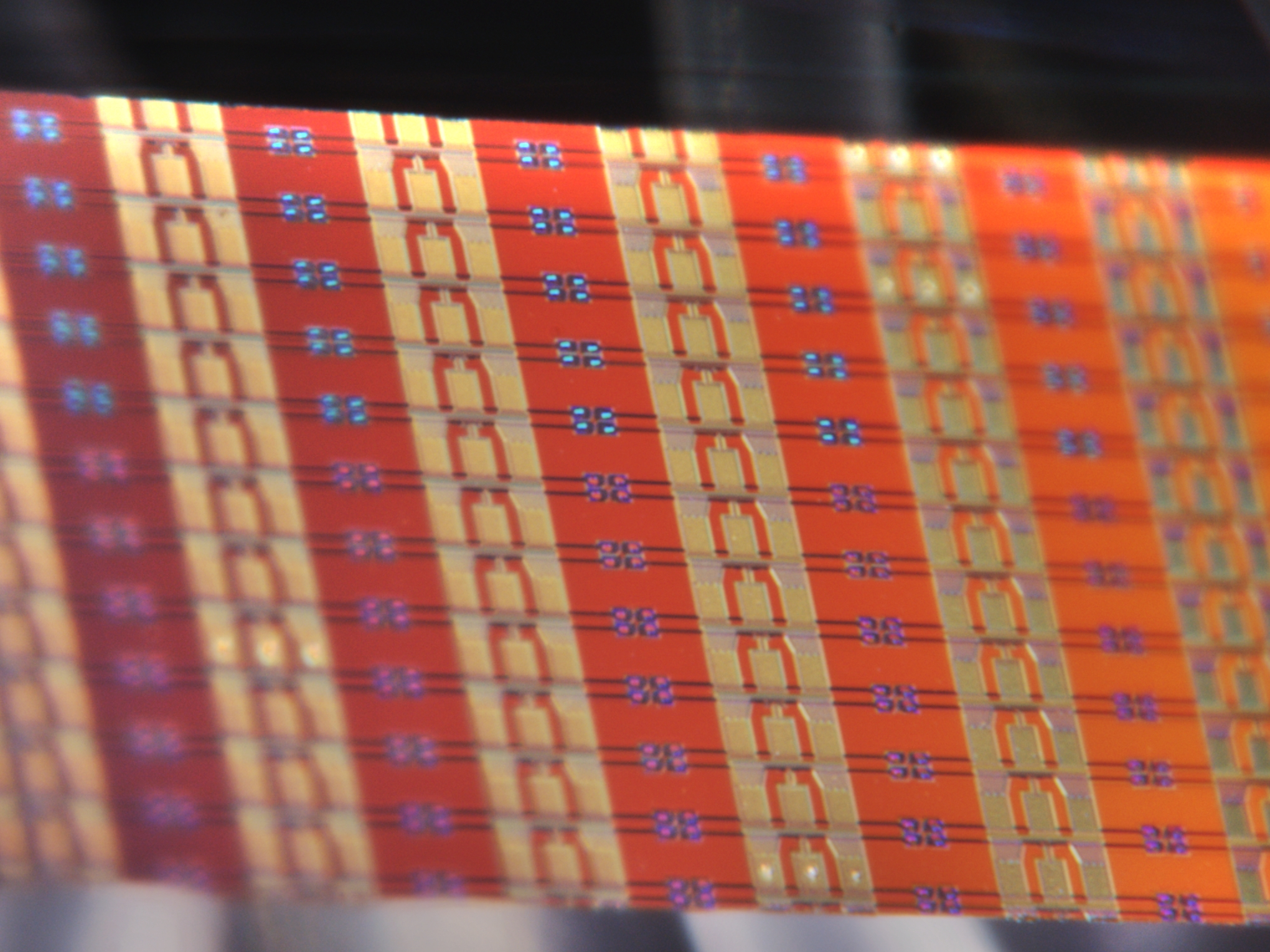
imec has demonstrated a germanium-on-silicon avalanche photodiode combining 100GHz bandwidth with 5V operation, using the device to receive a net 400Gbps optical signal on technology fabricated through its 300mm silicon-photonics platform.
The device achieved responsivity of 1.8A/W across both the O-band and C-band while delivering a 3dB improvement in receiver sensitivity compared with a conventional photodiode in the demonstrated link.
The combination addresses a long-standing compromise in avalanche photodiode design. APDs provide internal signal amplification, improving receiver sensitivity, but that gain has traditionally carried penalties in bandwidth, operating voltage, or both.
An avalanche photodiode uses a high electric field to multiply the electrical carriers generated when incoming light is absorbed. That amplification strengthens the signal before it reaches downstream receiver electronics and can provide additional link margin where optical losses are already close to the system budget.
Imec began from the established separate absorption, charge, and multiplication architecture but redesigned the multiplication section. The team reduced the multiplication layer to below 100nm, used a deeply recessed germanium-in-silicon structure, and removed the conventional charge layer.
The resulting device reached 100GHz bandwidth at 5V while maintaining a responsivity of 1.8A/W, equivalent to approximately twofold internal gain according to imec.
Comparable performance in both the O-band and C-band gives designers more choice over the wavelength used in a future optical link. That flexibility matters because different parts of the photonics ecosystem have developed around different wavelength ranges, with component availability and transmission behaviour varying between them.
Imec then combined the APD with a germanium-silicon electro-absorption modulator previously demonstrated at more than 110GHz. Together, the transmit and receive devices were used to establish what the research organisation describes as the first net 400Gbps optical link using an APD receiver.
The 3dB improvement in receiver sensitivity can be used in different ways at system level. A designer could reduce laser power while maintaining the same link performance, or use the extra margin to tolerate additional losses through waveguides, connectors, packaging, and fibre interfaces.
Neither option is trivial in large AI systems. Thousands of optical links can make laser power a significant part of overall energy consumption, while additional packaging losses become difficult to avoid as optical engines are moved closer to processors and integrated into increasingly dense assemblies.
The challenge is being driven by the scale of data movement inside AI computing systems. Large accelerator clusters require very high-bandwidth communication between processors, racks, and systems, while conventional electrical connections become harder to extend as data rate and distance increase.
Optical interconnects offer lower loss over distance, but the optical devices themselves still consume power and occupy package area. Lasers, modulators, photodetectors, drivers, amplifiers, fibre coupling, and thermal management all have to function as one manufacturable system rather than as separate laboratory devices.
That makes imec’s fabrication route particularly relevant. The APD was made on the organisation’s iSiPP300 300mm silicon-photonics platform, giving the work a path towards wafer-scale process integration rather than relying on a bespoke research flow for individual devices.
Manufacturing on 300mm wafers aligns photonics development more closely with established semiconductor production techniques. It also creates opportunities to integrate optical devices with electronic control and signal-processing technology through high-volume packaging approaches.
The result remains a research demonstration rather than a qualified commercial receiver. Imec plans further reliability work across a wider range of temperature and optical input-power conditions, both of which can affect avalanche behaviour and device lifetime.
Future work will also integrate the detector with high-speed receiver electronics. A 100GHz photodiode only delivers useful system performance when the amplifier, interconnect, package, and surrounding electronics preserve enough of that bandwidth.
Parasitic capacitance and inductance become increasingly important at these frequencies. Fibre attachment, optical coupling, electrical routing, and thermal design can all erode the performance measured from an isolated device.
The low 5V operating voltage helps by narrowing the gap between the APD and the electronics around it. Conventional high-voltage avalanche devices can require additional bias circuitry that adds power, area, and complexity to the receiver module.
The demonstration therefore advances two problems at once: achieving useful internal gain at very high bandwidth, and doing so at a voltage more compatible with tightly integrated photonic-electronic systems.
The remaining work is largely industrial. Reliability, packaging, yield, electronic integration, and repeatability will determine whether the device can progress from conference demonstration into a practical optical engine.
Imec’s 400Gbps link shows that the APD can operate as part of a complete signal path rather than merely producing an impressive detector measurement. The next step is proving that the same performance survives when the device is packaged and manufactured as part of the much larger optical-interconnect systems AI infrastructure will require.