Toyota Motor estimates that factory modernisation across its own operations, group companies and major suppliers could require spending of around ¥1 trillion annually from 2028 as automation and robotics are deployed through an ageing manufacturing network.
The figure, roughly $6.4 billion at current exchange rates, is an indicative estimate rather than an approved multi-year capital programme. Toyota has not committed publicly to spending the full amount for a defined number of years, making the figure a measure of possible industrial scale rather than a fixed investment budget.
Around 400,000 robots could be required across the network, including replacement machinery and additional systems. The estimate covers conventional industrial automation as well as newer forms of robotics and should not be read as a proposal to install 400,000 humanoid robots.
The modernisation effort is intended to address ageing equipment, labour shortages and changes in the way factories move materials and divide tasks between people and machines. Toyota is considering automation across production processes, logistics and applications where robots operate in environments shared with workers.
The size of the estimate illustrates why large-scale factory automation is more complicated than buying robotic arms. An operating cell also needs tooling, controls, sensors, machine vision, safety systems, electrical infrastructure, software, maintenance and engineers capable of understanding both the production process and the machines performing it.
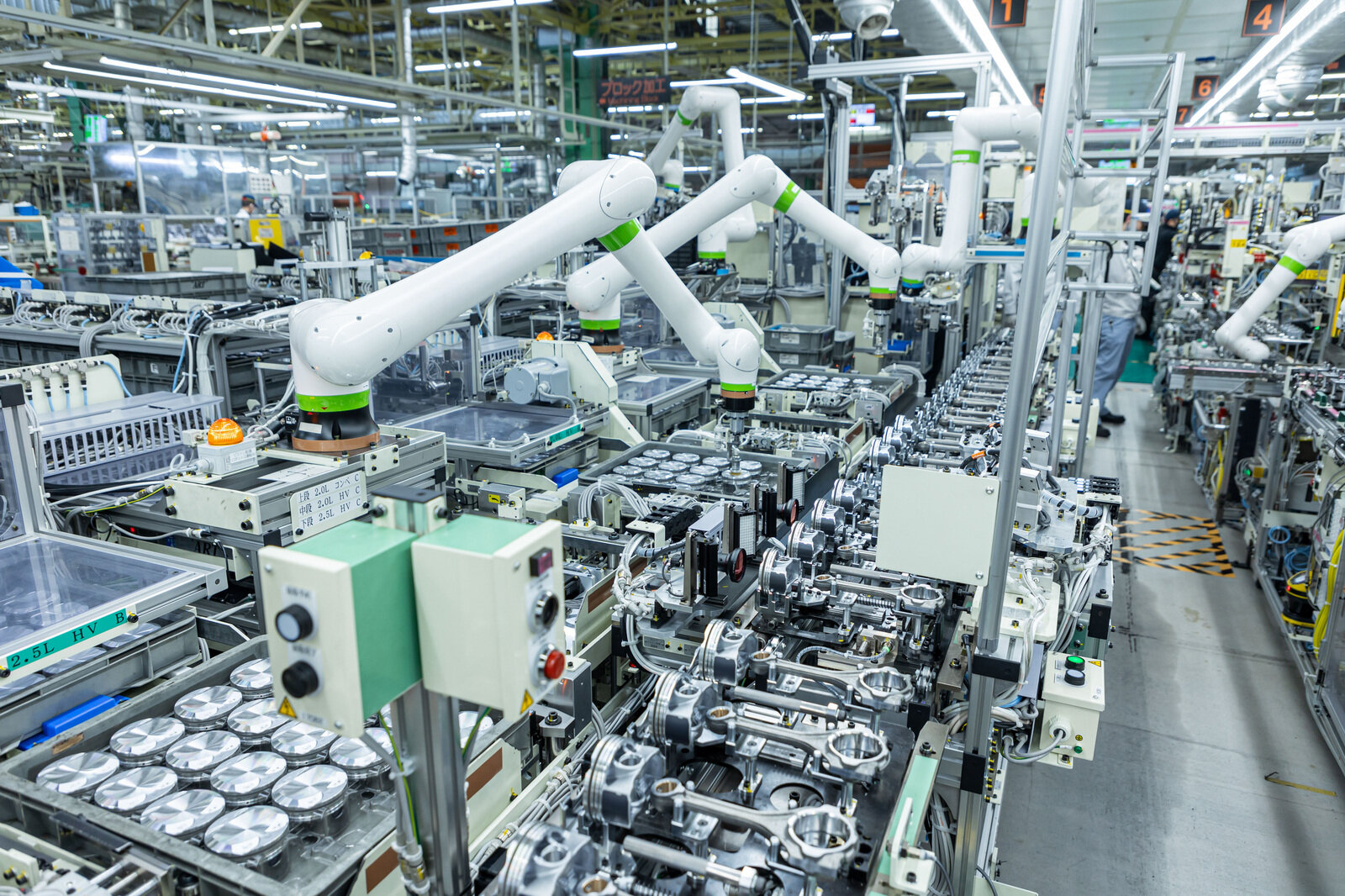
Toyota’s Kamigo engine plant provides a smaller example of the work involved. A piston subassembly line began operating entirely with robots in January 2025, reducing the number of direct operators on that particular process from three to zero.
The achievement took far longer than the installation itself. Toyota traces efforts to automate the line back to 2008, when an earlier push towards robotisation ran into a shortage of sufficiently experienced maintenance workers as engine production expanded internationally.
Some operations were returned to manual working because the equipment could not be supported effectively at overseas sites. Workers instead developed jigs and other improvements that increased manual productivity, preserving process knowledge that was later used when the company returned to full automation.
That history captures one of the constraints hidden inside a 400,000-robot estimate. Removing labour from a repetitive task does not remove the need for skills; it changes which skills the factory requires. Robot maintenance, programming, fault diagnosis, systems engineering and process knowledge become more important as direct intervention falls.
At Kamigo, Toyota says the piston line also had to reproduce movements developed by experienced workers rather than merely automate straight-line handling. Small changes in how parts are picked up or positioned can determine whether an assembly process works consistently, making practical production knowledge part of the robot programming problem.
The same relationship appears in the plant’s digital systems. A control centre established in 2022 monitors operating conditions across roughly 300 pieces of machining equipment, bringing data from production machinery into one location.
Energy use and other operating data are tracked in real time to identify abnormal behaviour before it produces breakdowns or large volumes of defective components. Toyota describes the system as combining digital monitoring with the experience of veteran employees who can interpret unusual machine behaviour and determine its cause.
Scaling those approaches across a global manufacturing network introduces another complication: factories begin from very different technical baselines. A new plant can be designed around automated logistics, modern data networks and robotic access, while an older factory may contain constrained floor layouts, legacy machinery and infrastructure never intended to support extensive automation.
Modernisation costs therefore extend beyond the robots themselves. Production lines may need to be rebuilt, equipment replaced, power and communications upgraded, guarding redesigned and material routes changed, all while vehicle or component output continues around the work.
The inclusion of Toyota group companies and major suppliers widens the challenge further. Automotive supply chains range from large tier-one manufacturers with substantial capital budgets to smaller businesses producing specialist components across several customer programmes.
The economic case for automation varies with that mix. A robot cell producing millions of identical parts can have a straightforward utilisation model, while a lower-volume supplier with frequent product changes may need flexible tooling and programming before automated equipment can earn an acceptable return.
Standardisation provides one possible route to reducing those costs. Toyota has long transferred manufacturing methods, equipment concepts and production-system knowledge between plants and suppliers, and repeatable automation cells could allow engineering developed in one operation to be used elsewhere.
Humanoid robotics adds another option but remains only one part of the wider programme. General-purpose robots are attractive where factories were designed around human movement and manufacturers want automation without rebuilding every workstation, yet conventional industrial robots and purpose-built machinery remain more mature for tightly defined production tasks.
Toyota’s ¥1 trillion estimate consequently describes the possible cost of modernising an industrial system, not a single robotics purchase. Replacement equipment, new automation, logistics systems and human-robot collaboration all sit inside a programme whose eventual duration and annual expenditure have not been fixed.
The significance lies in the scale even after those qualifications. Four hundred thousand replacement and additional robots would require an enormous integration and maintenance effort across Toyota and its suppliers, turning automation from a collection of factory projects into a long-term renewal programme for the manufacturing network itself.