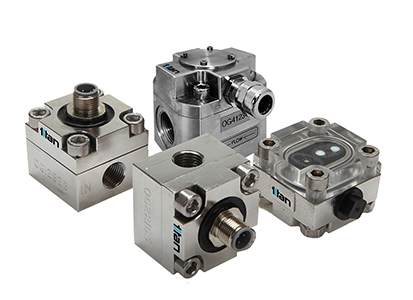
Titan Enterprises is positioning its Oval Gear flowmeters fitted with Namur sensors for pharmaceutical production environments where accurate liquid measurement and hazardous-area operation must be managed together.
The meters are designed to measure liquids ranging from low-viscosity solvents to more viscous pharmaceutical ingredients. Applications include solvent addition, blending, batching, dosing, transfer, and filling, where repeatable flow measurement contributes directly to product quality, operator safety, and cost control.
Pharmaceutical facilities often handle solvents and other flammable ingredients, which places stricter requirements on instrumentation than general liquid-handling applications. Equipment installed in hazardous or zoned areas has to support safe electrical operation while maintaining reliable performance across changing viscosity, temperature, chemical compatibility, and process duty.
Titan’s Oval Gear meters use a positive displacement principle, with fluid passing through the meter body and rotating a pair of oval gears. Namur sensors support intrinsically safe operation, while materials including 316 stainless steel, PEEK, and chemically resistant elastomers allow use with aggressive chemicals and cleaning regimes.
The compact design suits production areas where space is limited by cleanability, operator access, containment, maintenance, and existing skid layouts. Titan says the meters can operate without complex upstream flow conditioning, which can simplify installation where pipe runs are short or already fixed by surrounding equipment.
Process control depends on instrumentation that rarely attracts the same attention as reactors, mixers, fillers, or packaging lines. Fluid measurement sits inside many critical production steps. Inaccurate dosing can affect formulation, yield, batch repeatability, waste, and documentation. In regulated production, those faults can become compliance issues as quickly as engineering issues.
Pharmaceutical plants are also being asked to handle more complex products, shorter campaigns, smaller batches, and tighter documentation while maintaining safe and repeatable production. Existing facilities are often adapted rather than replaced, which means instrumentation must fit around legacy pipework, validated processes, and limited space. A flowmeter that combines chemical resistance, compact packaging, and hazardous-area compatibility can reduce the friction of those upgrades.
Hazardous-area measurement demands careful system design. Flammable solvents bring sensors, cabling, interfaces, and surrounding equipment into the safety case. A meter that performs accurately but cannot satisfy the electrical and zoning requirements is of limited use. Equally, compliant equipment that is hard to install, clean, or maintain can create operational problems on busy production lines.
The same pressure towards repeatability is visible across the medical manufacturing supply chain, where automated medical machining capacity is being added to improve production consistency and throughput. In process-led pharmaceutical production, the equivalent gains often come through measurement, control, validation, materials compatibility, and better data capture.
Flow measurement also has a direct cost dimension. Solvents, actives, excipients, and specialist ingredients can be expensive, while errors in transfer or dosing can generate waste, rework, delayed release, or batch rejection. Plants facing energy costs, regulatory scrutiny, and supply-chain constraints have less room for avoidable variation inside established production steps.
Positive displacement meters are widely used where direct volumetric measurement and repeatability are required, especially with viscous liquids, oils, and chemicals. Their behaviour can be advantageous where changing fluid properties make some alternative technologies more difficult to apply. In pharmaceutical production, that performance still has to be paired with materials that can withstand product exposure, cleaning regimes, and long-term operation.
As manufacturing lines become more data-driven, instrument output also needs to feed batch records, process monitoring, dosing controls, alarms, and quality systems. A flowmeter with reliable signal output becomes part of the digital manufacturing layer, even when the measuring principle is mechanical. Titan’s Namur-equipped Oval Gear meters are aimed at that practical interface between safe hardware, repeatable measurement, and regulated process control.