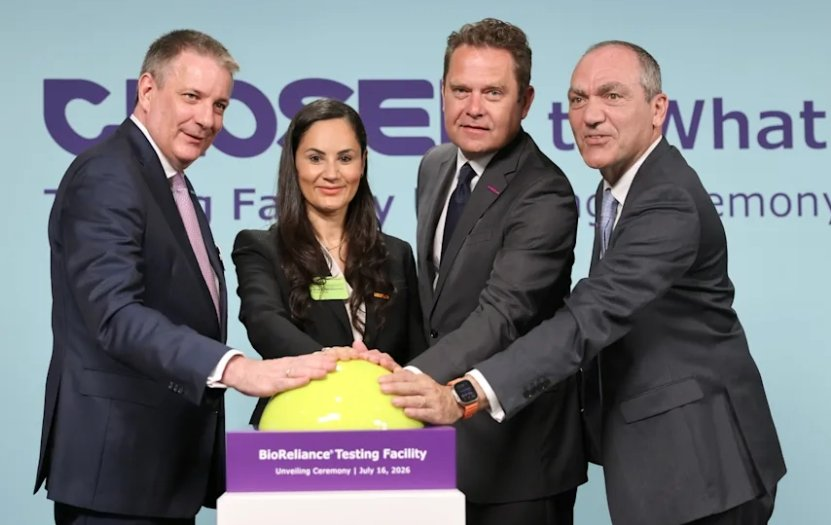
Merck has opened a €25 million BioReliance testing facility at its global headquarters in Darmstadt, expanding European capacity for commercial drug release and stability testing.
The 2,000 square metre operation will support drug substance and finished drug product testing under good manufacturing practice requirements, with capabilities extending to biologic medicines such as monoclonal antibodies and cell therapies.
Release testing provides the evidence required before a manufactured batch can enter the market or proceed to the next stage of production. Depending on the product, laboratories may assess identity, potency, purity, sterility, concentration, contaminants, and other critical quality attributes.
Stability studies examine how those characteristics change during storage, with samples held under defined temperature, humidity, light, or accelerated ageing conditions. The results establish shelf life, packaging suitability, transport requirements, and appropriate storage instructions.
Merck says the Darmstadt site will help customers meet European in-region testing requirements, while its location places the operation close to clinical and manufacturing activity in Germany, France, Spain, the Netherlands, Belgium, and Italy.
Workforce numbers are expected to rise as demand develops, with the facility requiring expertise across laboratory science, quality assurance, equipment maintenance, sample management, data review, and regulatory documentation.
Laboratory throughput governs batch availability
Pharmaceutical capacity is often measured through reactors, bioreactors, filling lines, and packaging equipment, although a completed batch remains unavailable until the required quality results have been produced, reviewed, and approved. Testing can therefore become a production constraint even when manufacturing equipment has spare capacity.
Biologics create particular demands because large molecules and cell-based products may require complex analytical methods, biological assays, microbiological testing, and carefully controlled sample handling. Some procedures take days or weeks, while unexpected results can trigger investigations, repeat analysis, or delayed release.
As portfolios expand, manufacturers must manage a growing number of methods, instruments, reference standards, and data sets. Transferring an analytical method from a development laboratory into routine quality control also requires extensive documentation, validation, and training.
Outsourced testing gives manufacturers access to specialist equipment and expertise without building every capability internally, while additional capacity can support product launches, site transfers, or periods of unusually high demand. Sample logistics, data exchange, defined responsibilities, and turnaround performance must remain tightly controlled.
European capacity reduces some of the time and risk associated with shipping biological samples across longer distances or customs boundaries. Temperature control, chain of custody, transport delays, and documentation can all affect testing schedules when laboratories are remote from manufacturing sites.
Cell and gene therapies add further complexity because products may have short shelf lives, small batch sizes, patient-specific characteristics, or demanding storage conditions. Conventional quality-control models developed for large, stable batches may not produce results quickly enough for those therapies.
Manufacturers and testing providers are consequently investing in rapid microbiology, automated sample preparation, digital laboratory systems, and analytical equipment capable of increasing throughput without weakening reliability. Automation must be introduced carefully because regulated methods require formal validation and controlled change management.
Comparable pressure is visible across diagnostics, where high-throughput laboratory platforms are being expanded through new automated assays. Although diagnostic testing and pharmaceutical release serve different purposes, both depend on repeatable workflows, traceable data, and instruments capable of handling larger volumes.
Data integrity is receiving equally close attention because laboratories must show who generated, modified, reviewed, and approved each result. Records must remain complete, secure, and accessible throughout the required retention period.
Laboratory information management systems, instrument connectivity, user access controls, and validated software therefore form part of testing capacity. Additional benches and analytical equipment cannot remove a bottleneck if review, approval, or data handling remains constrained.
European efforts to strengthen medicine supply resilience also depend on testing, raw materials, fill and finish, packaging, logistics, and regulatory release. Expanding drug substance production alone cannot protect supply if completed batches wait for scarce analytical capacity.
The Darmstadt facility will need to deliver reliable turnaround, successful method transfers, and consistent performance across a varied biologics pipeline. Its contribution will be measured at the point where manufactured material becomes a releasable product rather than an inventory awaiting laboratory approval.