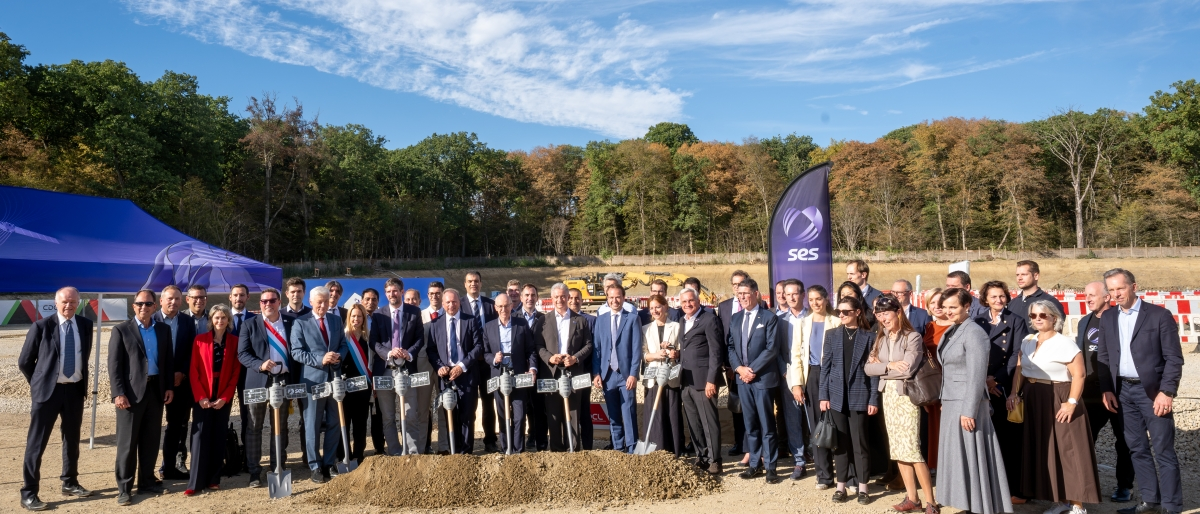
SES has started construction of a 16,000 sq m satellite engineering and manufacturing facility at Kockelscheuer in Luxembourg, extending its move towards greater vertical integration of spacecraft technology. The site is expected to open in 2028 and will combine engineering, manufacturing, testing, satellite assembly and supporting infrastructure.
The facility will support SES’s next-generation medium Earth orbit network, meoSphere, and contribute to Europe’s IRIS² programme through payload development and satellite assembly, integration and testing. It is being developed with CDCL Group and Poudrerie de Luxembourg’s ParcLuxite and forms part of Luxembourg’s wider Space Campus plans.
The project takes SES further into physical satellite production rather than limiting the company to operating networks and procuring completed spacecraft from established manufacturers. SES says the development builds on an existing pilot line and R&D facility, creating a larger base intended to shorten development cycles and give the operator more direct control over selected technologies and manufacturing activities.
Satellite assembly, integration and test work is demanding because the manufacturing sequence brings electronics, structures, thermal systems, communications payloads, power equipment and software controlled subsystems together into an asset that must operate without physical servicing once deployed. Each stage has to demonstrate that individual equipment works and that interfaces continue to perform through launch loads and the thermal and radiation conditions encountered in orbit.
Locating engineering and manufacturing together can shorten the feedback loop between design teams and production. Problems discovered during integration can be returned directly to engineers, while manufacturability and test requirements can be considered earlier in development. That is familiar practice in terrestrial manufacturing, but the consequences are greater for spacecraft because build volumes are lower, components are expensive and failures discovered late in integration can disrupt launch schedules.
The Kockelscheuer site also gives SES an industrial base for its next MEO architecture. meoSphere is being developed as a successor and expansion path beyond O3b mPOWER, with greater flexibility across commercial and government missions. Manufacturing capability does not imply that SES will produce every component internally, but it can give the operator more control over payload development, final integration and technologies it considers strategically important.
IRIS² adds a second European requirement. The programme is intended to establish secure multi-orbit communications infrastructure, combining institutional and commercial services across a large satellite network. SES expects the new facility to contribute through payload development and spacecraft assembly, integration and testing, placing manufacturing capability in Luxembourg directly inside the programme’s industrial ecosystem.
That is distinct from SES’s recent work with Elveo on European satellite manufacturing. The Elveo relationship concerns a broader manufacturing collaboration, while Kockelscheuer is a physical SES facility intended to develop internal engineering, integration and production capability. The two developments nevertheless point towards greater emphasis on European control of satellite technology and production capacity.
Vertical integration can offer supply advantages, but it also transfers more execution responsibility to the operator. Satellite manufacturers normally absorb much of the complexity associated with production planning, supplier qualification, component obsolescence, configuration control and factory acceptance. SES will have to develop enough of that capability internally for the activities it brings into the new centre while continuing to coordinate with external suppliers of specialist components and subsystems.
The location inside Luxembourg’s planned Space Campus is intended to support that partner model. The wider site is being developed as a centre for New Space companies and industrial collaboration, creating proximity between engineering organisations, suppliers and technology businesses. For spacecraft development, where specialist expertise may sit across several relatively small organisations, that concentration can reduce some of the practical distance between programme partners.
SES has not separated a project cost for the facility, saying capital expenditure is covered within existing guidance. The more useful industrial measure is therefore the capability being created: 16,000 sq m dedicated to engineering, manufacturing and test operations, backed by the pilot line and R&D work already established in Luxembourg.
The facility is scheduled to open in 2028, leaving a substantial construction, equipment installation and qualification programme before flight hardware can move through the site at scale. Clean manufacturing areas, integration equipment and test systems will have to be commissioned, while production processes must satisfy the traceability and configuration requirements associated with space programmes.
By the time Kockelscheuer opens, the significance of the project will depend less on the building itself than on how much design and manufacturing responsibility SES chooses to retain. Bringing payload work, assembly and test capability closer to the network operator changes the conventional boundary between satellite customer and satellite manufacturer, a boundary that European space companies are already beginning to redraw.