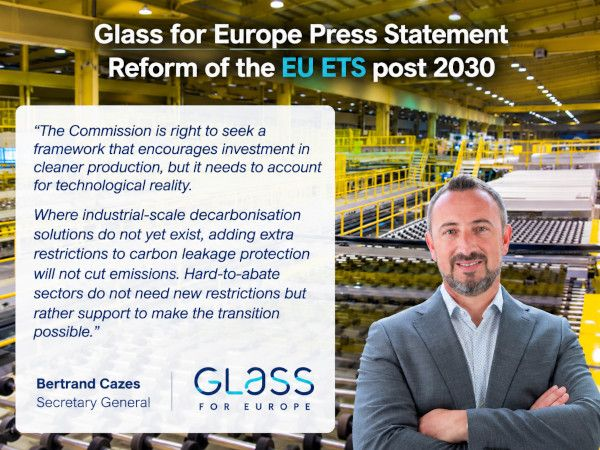
Glass for Europe has called for post-2030 reform of the European Union Emissions Trading System to reflect the technical and commercial constraints facing flat glass manufacturing.
The industry association wants reductions in free carbon allowances to be linked more closely to the availability of decarbonisation technologies at commercial scale, while electrification plans should account for the operating requirements of continuous glass furnaces.
Flat glass is used across buildings, vehicles, solar modules, appliances, and industrial equipment, with production requiring raw materials to be melted at high temperatures in furnaces that operate continuously over long campaigns.
Stopping and restarting a furnace is neither quick nor routine because shutdowns can damage refractory linings, interrupt production for extended periods, and require substantial capital work before output resumes. Major technology changes must consequently be aligned with furnace rebuild cycles that may be separated by many years.
European manufacturers are testing hybrid and hydrogen-capable systems, but the association argues that no widely available solution can yet deliver the required emissions reductions while maintaining product quality, production volume, and international competitiveness across the sector.
Full electrification also depends on sufficient grid capacity and reliable access to competitively priced low-carbon electricity. Plants developed around existing gas infrastructure may require major network reinforcement before they can transfer a larger share of furnace energy to electrical power.
Carbon policy meets continuous-process engineering
The European Union Emissions Trading System raises the cost of carbon emissions and is intended to encourage investment in cleaner production. Free allowances have historically reduced carbon leakage risk for industries exposed to international competition.
As those allowances decline, manufacturers face stronger incentives to decarbonise but also carry higher costs where replacement technologies remain unavailable or uneconomic. Imported products manufactured under less stringent carbon regimes can then gain a price advantage.
The Carbon Border Adjustment Mechanism is intended to address part of that imbalance by applying carbon-related costs to selected imports. Its effectiveness will depend on product coverage, emissions measurement, enforcement, and the ability to prevent circumvention.
Flat glass occupies a complicated position because its production is energy-intensive while the resulting material reduces emissions through insulated glazing, lightweight vehicles, and solar generation. A decline in European production could shift manufacturing emissions overseas while increasing dependence on imports required for domestic construction and clean-energy projects.
Longer transport distances also add cost, emissions, and breakage risk, particularly because large sheets of glass are comparatively difficult to move and store. Retaining regional capacity therefore intersects with energy, construction, automotive, and renewable manufacturing policy.
Hybrid furnaces offer one possible route by combining electrical heating with combustion, reducing fuel use while retaining operational flexibility. Their performance depends on furnace design, glass chemistry, electricity prices, electrode life, and the proportion of energy that can be supplied electrically.
Hydrogen could replace some natural gas, although combustion characteristics, burner design, nitrogen oxide emissions, flame behaviour, storage, and fuel availability require further engineering. Low-carbon hydrogen is also likely to remain expensive and face demand from several difficult-to-electrify sectors.
Greater use of recycled glass, or cullet, can lower melting energy because the material requires less heat than virgin raw ingredients. Flat glass recycling remains constrained by collection, contamination, coatings, laminates, and the quality requirements applied to new products.
Furnace efficiency, heat recovery, batch preparation, process control, and improved yield can provide incremental reductions before a complete technology change. Those gains are valuable, but they may not be sufficient to meet long-term climate targets without larger changes to energy supply and furnace design.
Investment decisions are complicated by the operating life of the assets involved. A manufacturer rebuilding a furnace today must choose technologies and energy sources that remain viable well into the 2030s, while delaying investment or selecting an immature system can each carry substantial risk.
Stable policy on carbon prices, energy infrastructure, state-aid rules, and import treatment will influence whether companies commit capital to new furnace designs. The withdrawal of allowances needs to proceed alongside equipment availability, grid connections, and commercially credible fuel supplies.
European flat glass producers face a narrow path between decarbonisation, production continuity, and international competition. Carbon reform must accelerate engineering development without creating a period in which existing plants close before lower-emission replacements are technically and commercially ready.