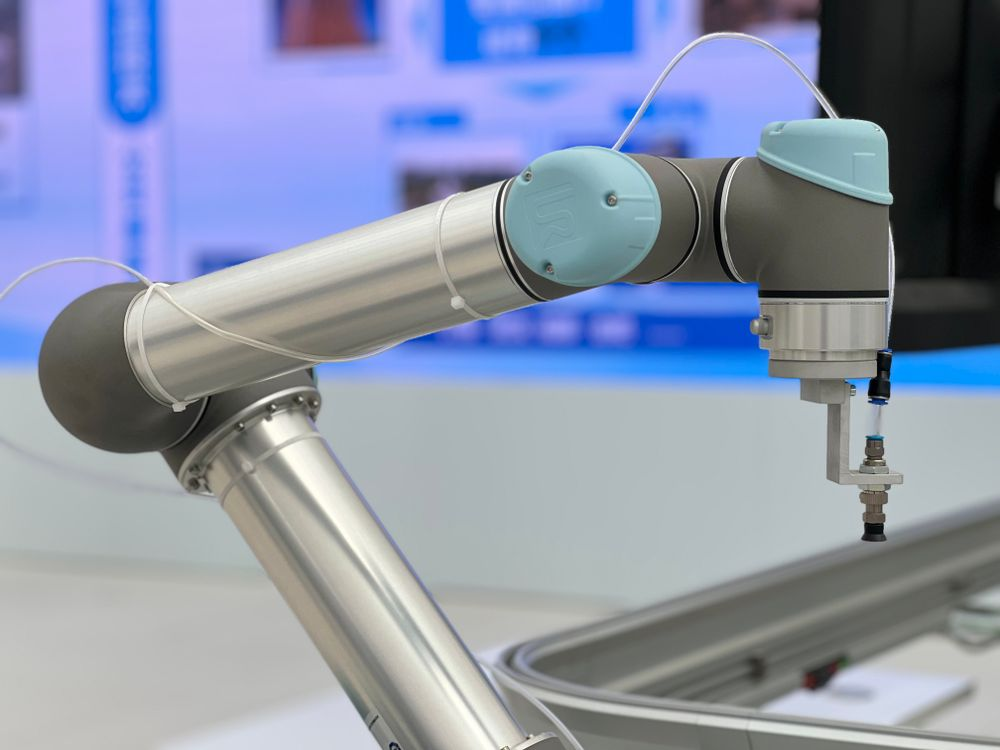
Kawasaki Robotics will introduce its CP110L palletising robot to North America at PACK EXPO International in Chicago on 18–21 October, demonstrating a compact 110 kg payload machine handling both boxed and bagged products within one packaging cell. A customised Piab end effector will lift dog food boxes and cat food bags without requiring a tooling change, showing an application intended for factories with limited floor space or ceiling height.
Kawasaki Heavy Industries launched the CP110L in Japan on 16 February 2026; its appearance at PACK EXPO on 18–21 October is the model’s North American introduction. The planned demonstration at McCormick Place, stand N-5933, will show one specified packaging arrangement alongside other Kawasaki case packing and palletising systems. Operating results from a permanent customer installation have yet to be reported.
Products arriving from a packing conveyor must be picked up, transferred and arranged into a stable pallet pattern, with each movement determined by package weight, shape and the available positions around the cell. Changing product dimensions or combining formats can require a different gripping approach, stacking sequence or placement programme. The planned use of one tool for cartons and bags therefore depends on coordinating the robot’s movement with the geometry of both products.
With a four-axis arrangement, the CP110L provides a maximum reach of 2,505 mm and a rated payload of 110 kg. Kawasaki also specifies 2,433 mm of maximum vertical motion and positional repeatability of ±0.05 mm at the wrist flange. Those values describe characteristics of the robot under the manufacturer’s conditions; a complete cell must additionally accommodate the gripper, package dimensions, stack arrangement and surrounding equipment.
Ceiling height and available floor area can determine whether a palletiser fits into an existing packaging line, particularly when the arm must pass above a growing pallet stack. Kawasaki quotes a rotational interference radius of 453 mm for the compact machine, but this figure covers only part of the robot’s geometry. Conveyors, guarding, pallet access and the movement of the complete gripper and load establish the actual space needed for safe operation.
The CP110L’s hollow wrist brings the services for its gripper through the arm, reducing the length of hose and cable exposed to the surrounding installation. External pneumatic lines can bend repeatedly or come close to guarding as the robot moves, creating maintenance and clearance requirements. Routing services internally can reduce those constraints, although fittings and flexible components still need inspection over repeated operating cycles.
The Piab end effector selected for Chicago is designed to lift rigid dog food boxes and flexible cat food bags in the same cell. A carton tends to present stable faces, whereas a bag can change shape under load and acceleration, affecting how a gripping force is applied. Tool contact, packaging material, product mass and movement speed must therefore be assessed together when establishing reliable handling for the two formats.
During the move to a pallet, acceleration and deceleration create forces that can cause a poorly supported load to slip or deform. The robot’s nominal 110 kg capacity includes the mass of the gripper as well as the product, with load distribution influencing the forces at the wrist. Longer travel distances and more complicated stack patterns also increase the time needed for each placement compared with a short reference movement.
Kawasaki quotes approximately 2,200 palletising cycles per hour for a specified movement carrying a combined load of 60 kg, including the hand. The reference cycle rises 400 mm, travels 2,000 mm horizontally and descends 400 mm. Throughput in a packaging plant also depends on conveyor presentation, load handling, pallet changes and the full motion required by the chosen pattern, so the published result cannot be applied automatically to the maximum 110 kg load.
Frequent changes in direction provide opportunities for the CP110L’s regenerative drives to recover electrical energy during deceleration. Some of that energy can be reused within the system, with actual savings affected by load, movement profile and operating frequency. The specific Chicago configuration has not been accompanied by independently measured energy consumption results.
The exhibition will also include a case packing cell developed with Design For Making using Kawasaki’s RS013N, together with an IRIS Factory Automation palletising arrangement incorporating an RS025N. Those installations use robots with lower payload ratings and demonstrate different choices of reach, tooling and cell footprint. Their inclusion allows comparison between handling arrangements without assuming that the largest robot is appropriate for every packaging task.
Once a line changes product size or pallet pattern, its controls must select the appropriate pick position, movement sequence and placement geometry. Even if the Piab tool remains in place, identification systems and conveyors have to deliver products in the expected orientation. Pallet exchange and protected access to the working area must also be coordinated with robot movement to prevent avoidable stoppages.
With nominal payloads across the CP series now ranging from 110 kg to 700 kg, the CP110L provides an option for installations where a larger arm would occupy too much space. The forthcoming North American demonstration will allow visitors to inspect the machine and its configured handling tool. Performance on customer lines will depend on the actual products, required stack patterns and the integration of surrounding equipment.