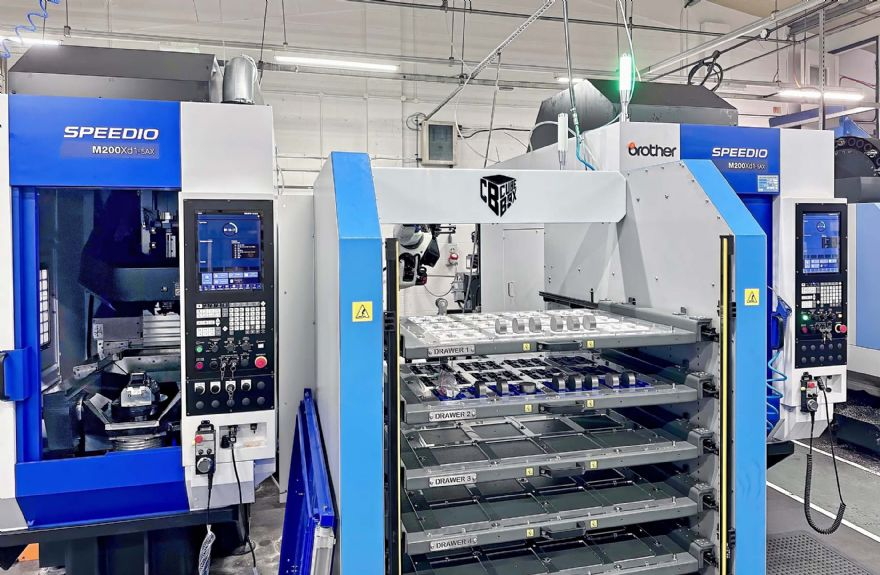
Kirkstall Precision has expanded its medical manufacturing capacity with an automated machining cell built around two Brother Speedio M200Xd1-5AX five-axis machining centres and a Tezmaksan robotic loading, unloading, and storage system.
The Leeds subcontract manufacturer has installed the cell through Whitehouse Machine Tools, the UK and Ireland sales agent for both Brother and Tezmaksan. The investment is intended to increase output for high-accuracy medical and veterinary components, including surgical instruments, orthopaedic parts, and implants.
Kirkstall has focused almost exclusively on medical-sector work for the past seven years, while also serving veterinary implant and instrument customers. The company is seeing year-on-year growth of around 15% to 20%, driven by demand for precision components made from difficult materials.
The first Brother Speedio M200Xd1-5AX was installed in standalone mode in mid-2025. The five-axis machine, equipped with a 16,000rpm BBT30 BIG Plus spindle, was selected for accuracy, repeatability, versatility, and compactness. A second machine has now been added, with both connected to a Tezmaksan CubeBOX Blues DR automation system.
The company is approved to ISO 13485, the quality management standard for medical devices. It mainly produces low-volume orthopaedic components from challenging materials including stainless steel, hardened stainless steel, titanium, and other tough alloys. The Brother platform combines five-axis prismatic machining with turning using a rotary torque table, reducing the need to move parts between separate operations.
The automation system is designed to support 24-hour production, including lights-out running. The CubeBOX Blues DR uses a six-axis industrial robot and integrated storage through a five-level drawer stacker. It can handle round billets from 5mm to 550mm in diameter, with a maximum height of 135mm and a maximum weight of 12kg.
Kirkstall expects the cell to increase production output by up to 50%, while allowing manual unloading and reloading to take place as the robot continues tending the two machining centres. Tezmaksan’s RoboCAM software allows operators to convert 2D CAD drawings into robot instructions without requiring specialist robot programming or CAM knowledge.
The investment reflects a broader shift in UK medical manufacturing. Precision subcontractors serving medical and veterinary customers are being asked to deliver smaller batches, more complex components, tighter documentation, and shorter lead times while maintaining validated quality processes. Automation is no longer limited to high-volume lines; it is increasingly being applied in high-mix environments where machine utilisation and repeatability are critical.
That balance is difficult to achieve. Medical components often involve tough alloys, fine features, controlled surface finishes, and strict inspection requirements. Automated handling must support consistency rather than simply move parts faster. A robot tending two five-axis machines improves utilisation only when the surrounding process is stable, with reliable fixturing, tool-life control, inspection discipline, and skilled operators able to intervene when variation appears.
The investment also responds to the skills pressure facing precision engineering. Experienced machinists remain central to medical manufacturing, but their time is increasingly valuable. Automating loading, unloading, and storage allows skilled staff to focus on process development, programming, inspection, problem solving, and improvement work rather than repetitive handling.
Energy efficiency adds another dimension to the decision. Compact machining centres with efficient motors, optimised coolant pumping, regenerative deceleration, LED lighting, low air consumption, and automatic power-off functions can help reduce energy demand against larger machining platforms. In medical subcontract work, where margins can be shaped by validation effort, material cost, inspection time, and customer documentation, machine efficiency is part of the production case.
The move also sits within a growing market for modular automation among SMEs. Standardised robotic cells can often be installed faster and at lower cost than fully bespoke integrations, making automation more accessible to manufacturers whose batch sizes do not justify dedicated transfer lines. Medical manufacturing rarely lends itself to crude automation, but compact systems can still extend spindle hours and reduce manual intervention.
Kirkstall’s Leeds installation shows how automation is entering high-value subcontract production in a practical way. The direction is not a fully unmanned medical factory, but a tighter link between skilled engineers, validated machining processes, compact robotic tending, and better machine utilisation. In a sector defined by precision, traceability, and delivery pressure, that combination is becoming increasingly difficult to avoid.