Hexagon has introduced OPC UA connectivity in SpatialAnalyzer, allowing precision metrology data to be exchanged directly with robots, programmable logic controllers, and automated production systems.
The 2026.1 release adds the software’s first OPC UA client, supported by encryption, authentication, and 25 new MP/SDK commands for developers creating automated measurement workflows.
SpatialAnalyzer coordinates large-scale measurement, alignment, inspection, and metrology-assisted assembly, while its connection to industrial controls allows production equipment to respond to verified position and geometry data rather than relying solely on programmed robot coordinates.
Hexagon has also introduced the SARCA robot-calibration device, which uses multi-zone and multi-tool calibration to improve industrial robot accuracy by up to ten times. The system is intended to prepare robots for higher-precision work before production begins.
Industrial robots provide strong repeatability but do not always deliver the absolute positional accuracy required for drilling, fastening, machining, or inspection across large structures. Small errors in robot geometry, tooling, temperature, loading, and installation become more significant as working reach increases.
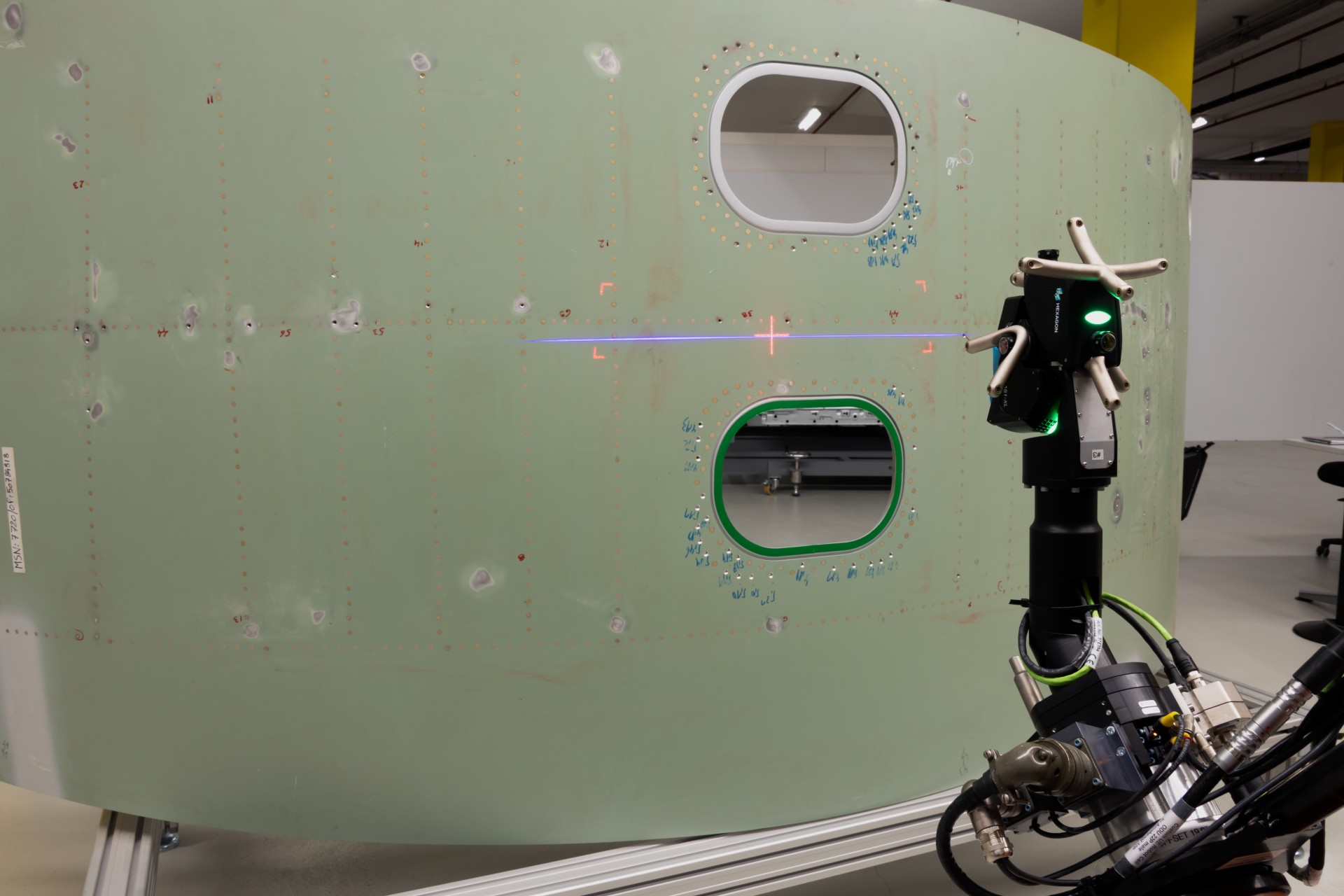
External metrology supplies an independent reference by measuring tools, components, and features, after which the software calculates corrections and verifies whether each operation has remained within tolerance.
Zach Rogers, product manager for SpatialAnalyzer at Hexagon, said large-format production requires a closer connection between robotic movement and measurement because increasing part size makes alignment more difficult.
Measurement enters the production control loop
Aerospace, defence, shipbuilding, and energy manufacturers are attempting to increase output without relaxing dimensional requirements. Airbus and Boeing held a combined commercial aircraft backlog of more than 16,000 aircraft at the end of May 2026, representing roughly a decade of production at recent delivery rates.
Automation can increase assembly capacity, although conventional robot programming assumes that the cell, tool, and workpiece remain close to their nominal positions. Large parts can distort under their own weight, fixtures move, and temperature changes affect both structures and measurement systems.
Metrology-assisted automation measures actual conditions, compares them with the digital definition, and feeds corrections into the process. OPC UA provides a common communication layer through which measurement software and industrial controls can exchange those results.
Authentication and encryption are particularly important because the connection can influence physical production. Manufacturers must still manage certificates, network segmentation, user permissions, and software updates, but secure communication reduces the risk of unauthorised systems sending instructions or intercepting data.
The release also expands support for the Leica Absolute Tracker ATS800, which can perform room scanning, conventional reflector-based tracking, and direct feature scanning. One device can therefore support several measurement tasks across installation, alignment, and production.
Direct scanning can reduce the need to place reflectors or probes on every point of interest, while conventional tracking remains valuable where continuous tool monitoring or the highest positional accuracy is required.
Hexagon is delivering ATS800 support through a revamped System Integrator Programme because automated metrology cells combine robots, controls, safety systems, fixtures, software, measurement devices, and application-specific tooling.
A capable sensor cannot create a productive process without careful integration. The cell must manage takt time, measurement uncertainty, calibration, part variation, fault recovery, and the transfer of results into quality and manufacturing systems.
SARCA addresses robot accuracy across the working envelope, recognising that positional error can vary between zones and between end effectors. Calibration at a single location or with one tool may leave unacceptable deviation elsewhere in the process.
SpatialAnalyzer 2026.1 also adds Google Sheets integration and wider support for API LADAR, Leica RTC360, and Nikon LR scanners, alongside compatibility with RDS 6.6 and the Leica TS20.
The range of interfaces reflects the mixed equipment found in large factories, where several generations of controls and measurement devices often remain in use. Automation software must therefore operate across existing hardware rather than assuming a complete cell replacement.
Metrology is moving from final inspection into active production control. Measuring a completed assembly can identify a defect, whereas measurement during drilling, alignment, or fastening can prevent the defect from being created.
That shift depends on data speed, measurement uncertainty, and system availability, because a slow or unreliable control loop can restrict output. Metrology must be engineered into the production architecture from the beginning rather than added after the automation cell has been installed.
Hexagon’s OPC UA integration and SARCA calibration hardware provide the technical building blocks, while production performance will depend on how effectively integrators convert them into stable, traceable processes capable of increasing throughput without sacrificing dimensional control.