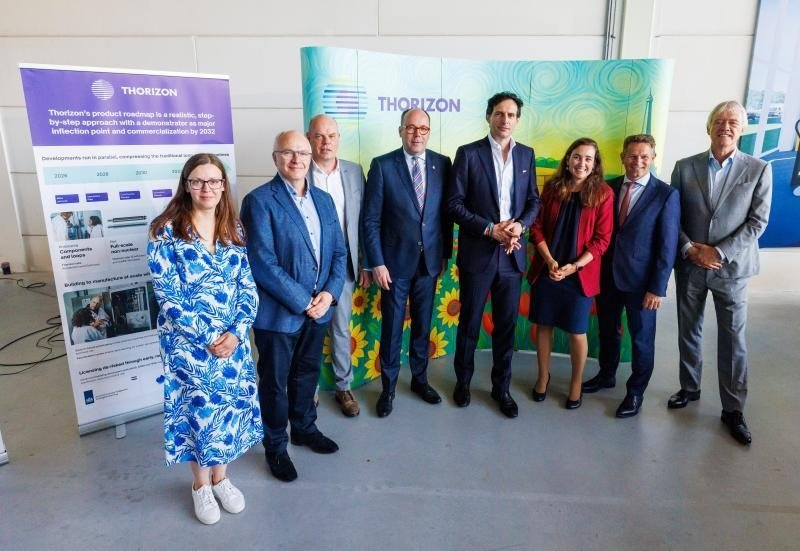
Thorizon and Dutch applied research organisation TNO have launched a materials and corrosion research programme intended to establish the evidence needed to qualify components for molten salt nuclear reactors. The collaboration will combine experimental testing with predictive modelling, supporting the proposed PIONEER nuclear demonstrator at Petten and the subsequent development of Thorizon One.
Announced on 14 October, the programme will be led by TNO, drawing on its work in materials characterisation, corrosion testing, failure analysis, coatings, and lifetime prediction. Researchers have begun defining the test arrangements, with initial activities involving Thorizon’s facilities in Amsterdam and TNO’s laboratories in Petten.
The agreement represents the start of a research programme rather than completion of material qualification. Neither partner has announced that the relevant components have passed all required tests, that their operating lifetimes have been independently established, or that the proposed reactors have obtained construction and operating licences.
Molten salt reactor technology presents different material requirements from those found in conventional water-cooled nuclear power stations. Hot liquid salts can interact chemically with exposed surfaces, while structural components may also experience radiation, mechanical loads, and changes in temperature during operation. The suitability of a material therefore depends on its behaviour under a combination of conditions rather than its initial strength alone.
Thorizon’s design uses sealed fuel cartridges intended to limit the time that selected components remain exposed to the reactor’s fuel salt. The company envisages replacing the cartridges every five to ten years, allowing assemblies to be inspected and removed before degradation compromises their intended function. That replacement period is a design assumption requiring validation through research and subsequent operating evidence.
The cartridge approach does not eliminate corrosion. Instead, it changes the engineering problem by establishing a defined interval over which the materials must retain acceptable properties. Reliable predictions of degradation are needed to demonstrate that the assemblies can complete that interval without exceeding their design limits.
Corrosion mechanisms in molten salt environments depend on the chemical composition of the fluid, its temperature, impurities, and the materials in contact with it. Constituents of a structural alloy can dissolve or redistribute, altering the surface and potentially reducing the amount of material available to carry mechanical loads.
These effects may differ between a laboratory specimen and a complete industrial component. Geometry, joints, local temperatures, and the presence of different materials can influence the development of degradation. Testing a material under one controlled condition consequently does not establish that it will behave identically throughout a complete reactor assembly.
TNO will investigate candidate materials through experiments designed to measure and characterise their behaviour. Analysis may assess changes in composition, surface condition, and mechanical properties after exposure, allowing researchers to identify degradation mechanisms and compare the performance of different materials or protective treatments.
Predictive models will be developed or refined using the experimental results. Such models can estimate how changes in temperature, exposure duration, or operating conditions may influence material performance, but their usefulness depends on validation against relevant physical measurements.
The programme is intended to connect laboratory evidence with design decisions. If testing establishes that a material deteriorates more rapidly than expected, engineers may need to change the material, operating conditions, component geometry, or proposed replacement interval. Evidence supporting acceptable performance would instead strengthen the technical justification for retaining the selected design.
Radiation introduces further considerations because exposure can affect material microstructure and mechanical behaviour. Research programmes must determine which combinations of chemical, thermal, mechanical, and radiation effects need to be represented in the evidence supporting a component’s qualification.
Laboratory testing cannot necessarily reproduce every reactor condition simultaneously. Researchers may therefore combine separate experiments with analysis to evaluate the relevant interactions, identifying uncertainties that must be addressed before the results can be used in licensing submissions.
Component inspection and replacement are also part of Thorizon’s proposed approach. A cartridge designed for periodic removal must have suitable mechanical interfaces and handling arrangements, while the surrounding equipment must permit the specified maintenance activities. Material testing alone cannot demonstrate that those operations will be practical in a completed nuclear installation.
The PIONEER project is planned as a research-scale nuclear demonstrator at NRG PALLAS in Petten. It follows other proposed development stages, including non-nuclear testing intended to verify components and system integration before nuclear operation. Thorizon One would subsequently apply the technology in a proposed commercial generating plant.
The companies’ earlier development roadmap identifies Thorizon One as a 100MWe project intended for Zeeland. Its proposed capacity and delivery timetable are future objectives, not output from a commissioned power station. The new materials programme supports that roadmap without replacing the engineering, financing, and regulatory approvals still required.
Licensing evidence must address the performance of complete systems under defined operating and fault conditions. Material qualification contributes to that assessment by establishing whether components can retain their required functions throughout the proposed service period, including allowances for degradation and uncertainty.
The research may also inform manufacturing specifications. Once materials have been selected, producers must be able to manufacture components with consistent composition, surface condition, dimensions, and quality. Production controls and inspection methods will be necessary to ensure that installed assemblies correspond to the designs supported by experimental evidence.
Thorizon and TNO intend to broaden cooperation with organisations including Delft University of Technology and NRG PALLAS. They also hope to involve France’s CEA and the European Commission’s Joint Research Centre. Those organisations are prospective participants in the expanded programme, rather than confirmed members of every activity already under way.
The immediate work will concentrate on defining tests, generating material data, and establishing models suitable for subsequent verification. Decisions about cartridge lifetime, component selection, and monitoring arrangements will depend on those results. The collaboration therefore advances the evidence base for molten salt reactor development without demonstrating an operational reactor or completing its licensing process.