Plasser & Theurer has inaugurated a new assembly and commissioning factory in Linz, Austria, following an investment of more than €60 million. The 12,000-square-metre facility brings the final stages of railway maintenance machinery production together under one roof, providing 15 assembly stations and four tracks for commissioning completed machines.
The opening took place on 16 October at Pummererstraße in the Linz industrial district, following approximately two years of construction. The company describes the project as the largest individual investment in its 73-year history. Operations will increase in stages, with the facility intended to support 180 positions, including 80 additional jobs.
The new building marks the completion of a major construction and installation stage rather than confirmation that production has reached its planned full operating level. Plasser & Theurer has previously identified early 2027 as the target for full operation, with assembly and commissioning activities transferred into the facility as the manufacturing arrangements are established.
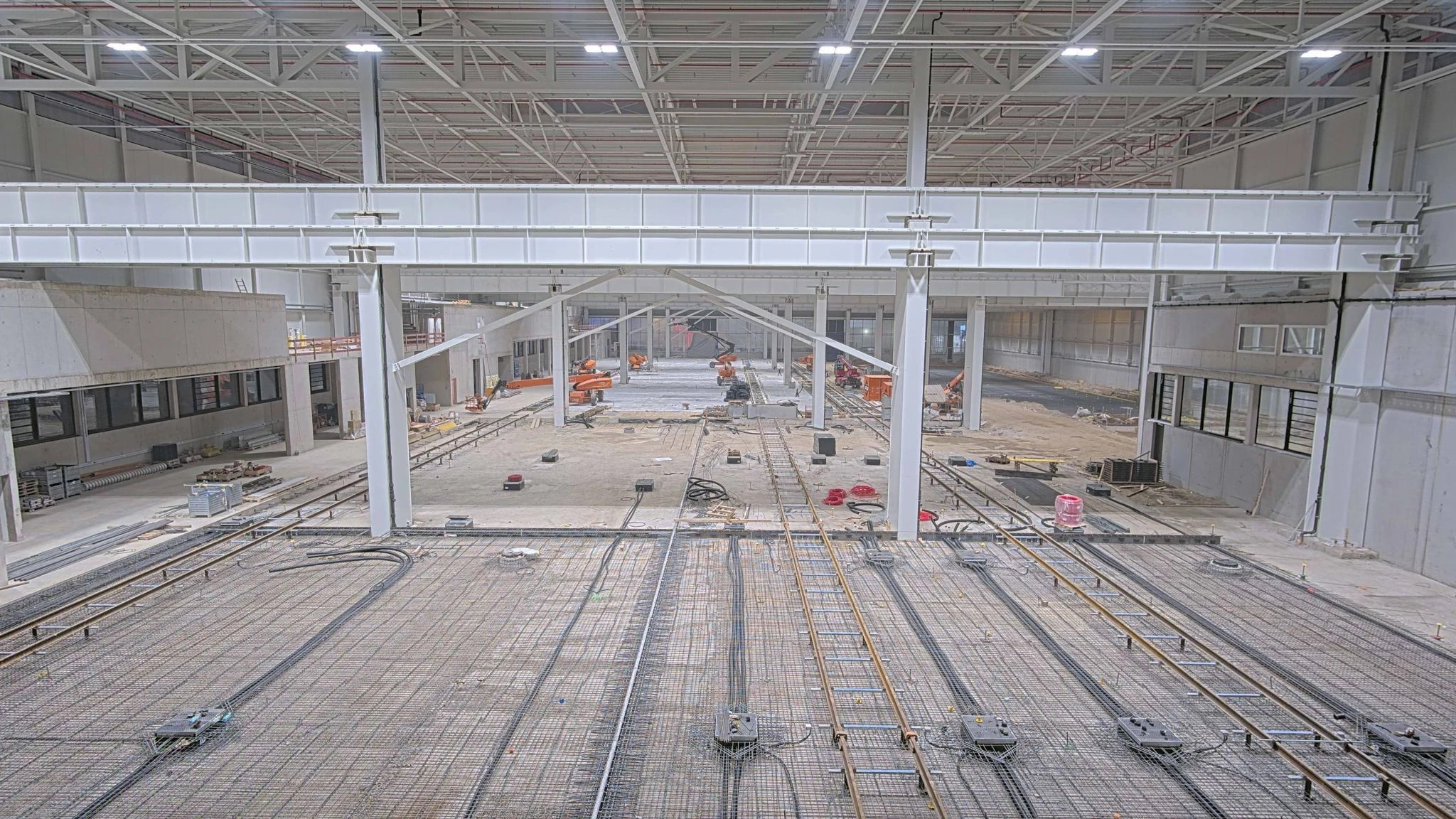
The 15 final assembly positions each measure approximately 30 metres by 8.5 metres, allowing substantial railway machines to remain accessible while equipment is installed and connected. Four tracks with a combined length of almost 330 metres provide space for commissioning, enabling completed machines to undergo their final production checks within the same facility.
The arrangement changes how work moves through the manufacturing process. Previously, final assembly and commissioning activities were distributed between separate locations. Bringing them together reduces the need to transfer large, partly completed machines between work areas and allows manufacturing and testing personnel to coordinate activities more closely.
Final assembly of railway construction and maintenance machinery involves integrating systems that have often been manufactured or prepared elsewhere. The work can include installing cable harnesses, hydraulic hoses, engines, tanks, operator cabs, and the equipment required for the machine’s specialist railway functions. These components must be positioned and connected within the restrictions imposed by the vehicle’s structure and operating requirements.
Large railway maintenance machines differ from ordinary industrial vehicles because they combine movement along the track with equipment designed to carry out engineering work on the infrastructure itself. Depending on the application, machinery may lift and position track, handle ballast, align components, or support construction and renewal operations. Those functions require substantial mechanical structures, hydraulic actuators, sensors, and control systems.
Assembly must accommodate the size of the equipment while leaving sufficient space for personnel, tools, lifting arrangements, and inspection. The large dedicated workstations at Linz allow technicians to reach different parts of a machine during installation without relying on repeated transfers between unsuitable production areas.
Commissioning begins once the necessary assemblies and systems are in place. Engineers energise electrical equipment, check mechanical movement, establish hydraulic functions, and verify that individual systems respond to their controls. The work identifies installation faults and provides evidence that the finished machine can progress towards delivery and customer acceptance.
Integrated testing is particularly important because many functions depend on more than one subsystem. An electrical control may command a hydraulic actuator, with sensors confirming its position and an interlock preventing unsafe movement. A machine can contain components that pass individual tests while still showing faults when those systems operate together.
The four commissioning tracks provide a controlled setting for this final production work. Their presence does not mean the factory can reproduce every condition encountered during railway construction or maintenance, but it allows specified tests and inspections to take place before equipment leaves the manufacturing site.
Plasser & Theurer expects the arrangement to shorten internal transport distances and simplify coordination between production stages. These are anticipated process improvements supported by the revised factory layout. The company has not published verified reductions in manufacturing hours, cost per machine, or annual throughput following the opening.
The facility is also intended to support increasingly complex equipment, including machinery from the manufacturer’s E³ range. These designs incorporate alternative or hybrid drive arrangements intended to reduce emissions and improve energy use during railway construction and maintenance operations.
Hybrid drive systems introduce additional electrical and control interfaces alongside conventional mechanical equipment. Depending on the machine configuration, power electronics, electrical drives, energy storage, and engine systems must be integrated with the functions used to move and operate the vehicle. Commissioning has to establish that those systems perform as required within their specified operating conditions.
Electrical integration becomes more demanding as the number of controlled functions increases. Harness routing, connectors, protection equipment, software configuration, and communication between controllers can influence reliability and maintenance access. The new factory is designed to provide space for these activities, although the specific equipment being produced will determine which facilities and test procedures are required.
The building incorporates environmental design features, including a photovoltaic installation and a green roof. The roof is intended to provide insulation and moderate temperature variation within the facility. No measured annual energy generation, electricity saving, or operational carbon reduction has been established by the opening announcement, so the features should be treated as installed or planned building systems rather than proven performance outcomes.
Workforce requirements reflect the combination of heavy engineering and electrical integration. Plasser & Theurer is recruiting in areas including mechanical engineering, electrical engineering, welding, and steel fabrication. The 80 additional positions are a planned employment increase associated with the investment, not evidence that every vacancy has already been filled.
The Linz operation supports a manufacturer with substantial international exposure. Founded in 1953, Plasser & Theurer develops machines for track laying, renewal, maintenance, and overhead line work. The company reports more than 17,900 heavy-duty machines delivered to customers in 110 countries and an export share of approximately 93%.
Manufacturing in Austria also exposes the company to pressures involving energy costs, skilled labour availability, and the wider cost of industrial production. Improving factory layout and equipment integration can address some controllable elements of the production process, but does not remove those external constraints.
The inauguration confirms that the new industrial building is available for the next stage of manufacturing development. Full utilisation will depend on transferring production activity, integrating the commissioning arrangements, recruiting specialist staff, and demonstrating consistent output from the combined assembly and test operation. Those measures will establish the operational effects of the investment beyond its construction and opening.