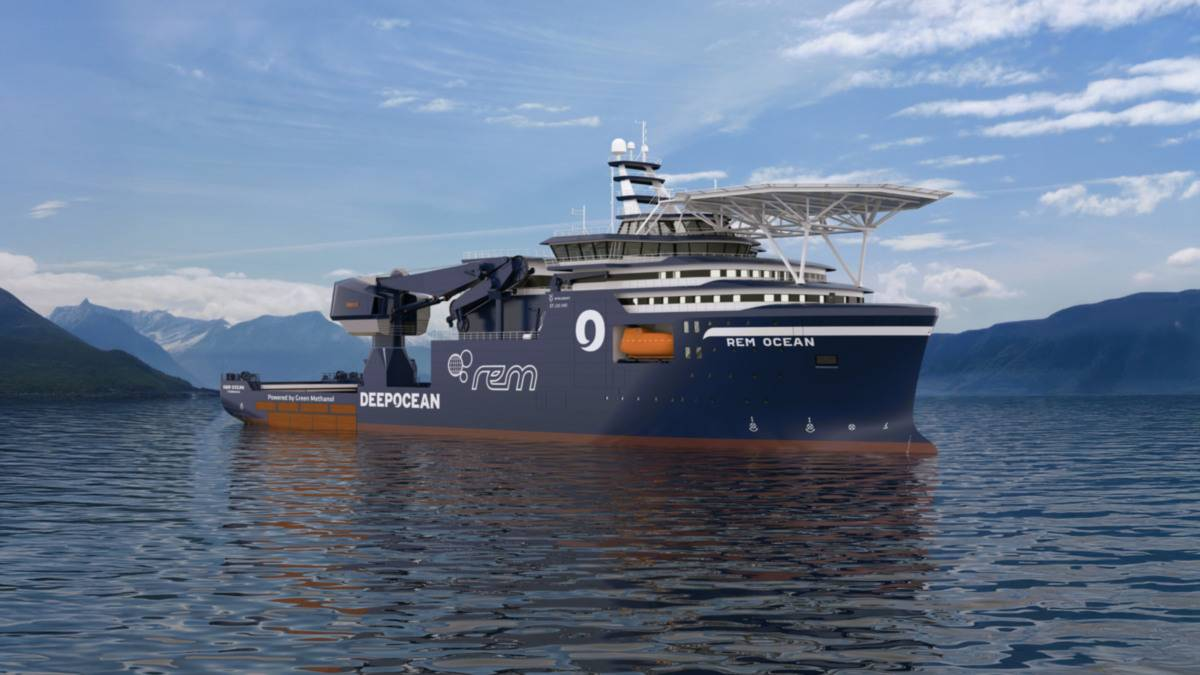
Rem Offshore‘s new subsea construction vessel REM Ocean has arrived in Norway from Vietnam, beginning the final outfitting phase of its shipbuilding programme at Myklebust Verft. Major propulsion, electrical, lifting, and subsea mission systems will be installed and integrated before the vessel’s planned delivery in 2027.
The arrival was reported on 16 October, following completion of the hull construction phase at the Song Cam shipyard in Vietnam. The hull was handed over on 15 June and began its tow from the Hai Phong area on 17 June, travelling via Singapore towards Europe. That earlier handover concerned the completed hull rather than a finished vessel ready for commercial service.
REM Ocean is the second Energy Subsea Construction Vessel developed through cooperation between Rem Offshore, DeepOcean, Myklebust Verft, naval architect Skipsteknisk, and equipment suppliers. It is being built for Rem Offshore and is intended to enter an eight-year charter with DeepOcean following delivery.
DeepOcean plans to use the vessel for subsea inspection, maintenance, and repair work supporting Equinor from 2027 to 2035. The charter remains associated with future delivery and operational readiness. Arrival at the Norwegian yard does not establish that acceptance trials have been completed or that the vessel is already carrying out work for Equinor.
REM Ocean measures approximately 111.7 metres in length and is designed to support complex subsea operations. Its planned equipment includes a 250-tonne electric crane, two electric work-class remotely operated vehicles, and an autonomous inspection drone. The vessel will also feature an internal ROV hangar of approximately 350 square metres and an outside working deck of around 1,000 square metres.
Accommodation is planned for up to 120 people, reflecting the combination of marine crew, technical specialists, and offshore project personnel needed for construction and intervention campaigns. The final operating complement will depend on the work undertaken and the requirements of individual projects.
Final outfitting converts the fabricated hull into an integrated vessel capable of carrying out its intended operations. The process involves installing equipment that may be too specialised or complex to complete during the earlier hull construction stage, including propulsion machinery, electrical distribution, control systems, mission equipment, and specialised handling arrangements.
These systems must operate together under marine conditions. Thrusters require electrical or mechanical power and suitable controls, while navigation sensors and dynamic positioning functions must maintain the vessel’s location during operations in which unwanted movement could endanger equipment deployed below the surface.
Brunvoll is supplying thruster equipment for REM Ocean. The propulsion arrangement will contribute to manoeuvring and station keeping, although the effectiveness of the integrated system must be demonstrated through testing after installation. Delivery of individual components does not establish that the complete vessel has achieved its required positioning performance.
The electrically driven crane is another substantial installation task. A crane intended for offshore use combines structural supports, winches, drives, braking equipment, load monitoring, and control systems. Its operation must account for forces transferred into the hull and the effects of vessel movement on suspended loads.
The stated 250-tonne rating is a nominal lifting capacity and should not be interpreted as the maximum load available under every offshore condition. Permitted operations depend on the crane configuration, lifting geometry, sea state, and other limits established by its approved operating arrangements.
The vessel is also designed to recover energy from suitable equipment operations through regenerative systems. Where electrical drives permit it, energy produced during particular lowering or braking operations may be returned to onboard electrical systems instead of being dissipated entirely as heat.
Whether that energy can be reused depends on the vessel’s power architecture, available electrical demand, and the state of the battery system. The announcement does not provide independently measured fuel savings or recovery efficiency from completed offshore operations.
REM Ocean is designed with dual-fuel engines capable of operating on methanol-based and conventional fuel arrangements, together with battery energy storage. The intended configuration includes provision for bio-methanol and biodiesel, but the environmental effect will depend on the fuels actually supplied and the vessel’s operating profile.
Battery storage can assist with managing fluctuating electrical demand during manoeuvring and equipment operation. The amount of energy available, charging arrangements, and configuration of the generators influence its contribution. An installed battery system does not mean that the vessel can perform every offshore task entirely on stored electricity.
The two electric work-class remotely operated vehicles will provide tools for inspecting and interacting with subsea installations. Such vehicles use onboard propulsion, cameras, sensors, and equipment interfaces while operators supervise or control their movement from the supporting vessel.
The internal hangar will need suitable handling and maintenance arrangements for both ROVs. Launching and recovering equipment offshore requires coordination between the vehicle, the vessel’s position, and its deployment system, particularly when waves and currents create relative movement.
An autonomous inspection drone is also included in the planned equipment package. Its role is to support subsea inspection and data collection, although autonomous operation remains constrained by navigation capability, available energy, communication arrangements, and the environment surrounding the infrastructure being examined.
Integration of these systems will be followed by tests covering the vessel’s machinery and electrical equipment, propulsion, lifting systems, safety functions, and subsea operational arrangements. Individual factory tests provide useful evidence about components, but acceptance of the completed ship requires the relevant systems to work together.
The Myklebust programme is therefore materially different from the June hull handover. Construction of the primary structure has already been completed, while the remaining work concerns turning that structure into a functioning offshore engineering platform and demonstrating that its systems meet the contractual requirements.
REM Pioneer, the first vessel in the same development programme, has a separate construction and delivery schedule. Its progress should not be treated as evidence that REM Ocean’s outfitting or trials have been completed, even where the vessels share design principles and suppliers.
The next milestones for REM Ocean are installation of its principal equipment, integrated commissioning, trials, and contractual delivery in 2027. Only after those stages can the vessel begin the subsea maintenance and intervention work envisaged under the DeepOcean charter.