Sumitomo Electric has opened the UK’s first factory dedicated to high-voltage direct current submarine cables at the Port of Nigg in Scotland. The £350 million investment establishes domestic capacity to manufacture 525kV transmission cable as electricity network operators prepare major offshore connections and long-distance reinforcement projects.
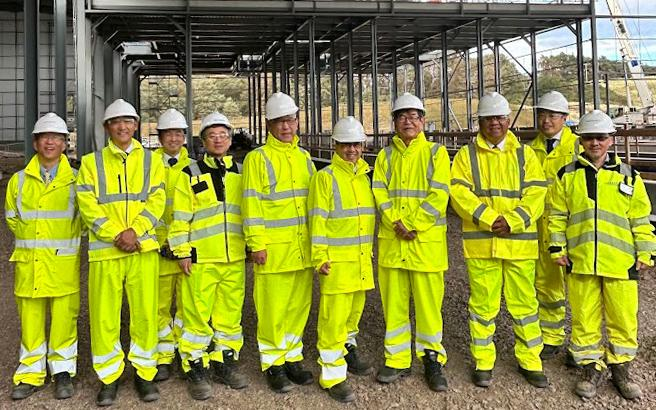
Held on 19 October, the opening ceremony followed the Japanese manufacturer’s decision to establish the site in April 2023 and the start of construction in May 2024. Its new production buildings occupy approximately 58,000 square metres on a 15-hectare site within the Inverness and Cromarty Firth Green Freeport boundary.
Sumitomo intends the factory to produce cross-linked polyethylene (XLPE) insulated 525kV HVDC subsea transmission cables and subsea inter-array cables. It expects more than 200 skilled jobs directly at the operation and projects a wider employment effect exceeding 400 jobs across the UK supply chain. These figures are forecasts associated with the opening, not a count of positions already filled.
The factory’s industrial significance lies in the equipment and production controls required to manufacture cable carrying very high electrical loads beneath the sea. A cable’s conductor must carry the specified current, while the insulating system must withstand the electrical stress imposed by hundreds of thousands of volts. Dimensional consistency, cleanliness and the integrity of interfaces between insulation layers influence whether the completed product will perform reliably throughout its intended service life.
XLPE insulation is applied around the conductor under tightly controlled manufacturing conditions. Defects or contamination in a high-voltage insulating system can concentrate electrical stress, creating weaknesses that may develop under prolonged operation. Material preparation, extrusion, handling and testing consequently have to be coordinated as part of a single quality-controlled process rather than treated as independent manufacturing steps.
Submarine service adds mechanical demands to the electrical specification. Finished cables are subjected to loads during factory handling, transport, loading and offshore installation, and their construction must accommodate those operations as well as the expected seabed environment. The design and qualification requirements vary with the transmission route, water depth, cable configuration and installation method.
HVDC technology is used for long submarine routes partly because alternating-current cables generate capacitive charging currents, which can restrict the usable power transferred over long distances. Direct-current transmission avoids that particular constraint, although converter stations are required at the ends of an HVDC link to connect it with alternating-current networks. The completed system therefore depends on cable engineering and major onshore electrical infrastructure.
The Port of Nigg location provides access to marine logistics for a product that can be difficult to move overland in long lengths. Subsea cable manufacture is closely connected to handling and installation planning because a completed length must be transferred to the appropriate vessel or storage arrangement without exceeding its permitted bending radius or mechanical loading limits. The precise shipping arrangements will still be determined by individual projects.
Scotland’s First Minister John Swinney identified £24.5 million of Scottish Government construction support at the opening. The factory’s £350 million investment figure represents the project overall, not that public contribution. The Port of Nigg also falls within a Green Freeport area supported by separate UK Government seed funding.
Sumitomo is building its local workforce through technical training, including an operator programme in Japan and a Train the Trainer model. These arrangements are intended to develop the skills required to operate and maintain specialist production equipment, inspect materials and carry out the quality assurance processes associated with subsea transmission cables.
A proposed connection to Shetland helped establish demand for the investment. In July, Sumitomo Electric and Van Oord secured a long-term framework agreement with SSEN Transmission covering HVDC cable engineering, supply and offshore installation. Under that arrangement, the parties expect a project-specific call-off contract for the Shetland 2 connection, subject to the necessary regulatory approvals and commercial steps.
Production of cable for Shetland 2 was expected to begin in the second quarter of 2027 under the July framework announcement. The opening of the factory does not establish that manufacture for the project has already started, nor does the framework remove the need for the project-specific commitments and approvals described by the parties.
A second commercial relationship illustrates the range of transmission projects that could use the new capability. At the factory opening, National Grid said it had awarded Sumitomo the HVDC cable supply contract for Sea Link. That award is distinct from the proposed Shetland 2 call-off and should not be treated as evidence that all of the manufacturer’s prospective work has reached the same contractual stage.
Cable manufacturing capacity is also expanding elsewhere in Europe. Nexans has begun 525kV HVDC XLPE cable production for the LanWin2 connection at Halden in Norway, another example of manufacturing investment required before offshore transmission systems can be installed.
Such projects require operators to reserve manufacturing capacity well ahead of offshore installation. Cable manufacture, converter stations, route approvals and marine construction must converge on a deliverable programme; delays in any of those activities can affect when a connection becomes available. Long-term framework arrangements give suppliers greater visibility, but final demand depends on projects obtaining the permissions and contracts needed to proceed.
Sumitomo president Osamu Inoue described the Nigg plant as a production base for electricity transmission infrastructure and renewable energy connections across Britain and Europe. SSEN Transmission managing director Rob McDonald said the proposed Shetland 2 project had provided an anchor for the investment, alongside the expectation of sustained network development.
Although the opening completes a major construction stage, important industrial milestones remain ahead. Equipment ramp-up, workforce development, product qualification and delivery against awarded cable contracts will determine how quickly the new factory converts its installed capacity into transmission systems ready for offshore deployment.