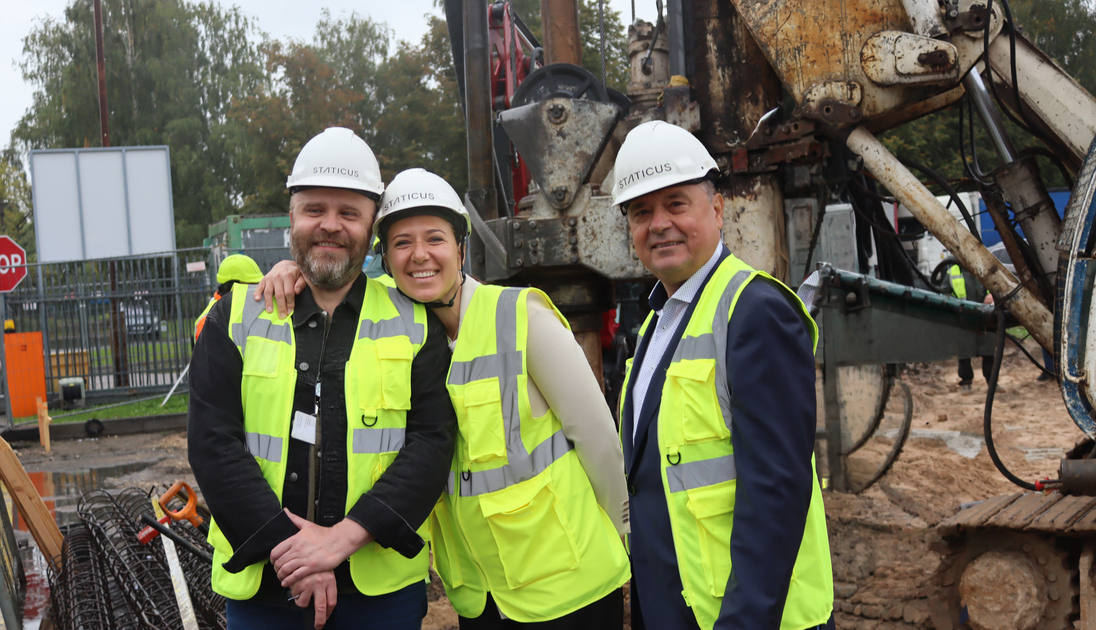
Staticus has started construction of a new factory in Vilnius as the façade systems manufacturer moves the first phase of its €31.5 million Campus Staticus investment programme into physical delivery.
Work has reached the piling stage at the company’s existing production site in the Metalo Street district after demolition of the previous factory began earlier in September. The first phase will create a 2,211-square-metre manufacturing building and represents around 30% of the wider investment planned for the Lithuanian site.
The factory will contain two semi-automated product assembly lines supported by an autonomous mobile robot for internal logistics. Staticus expects the combination to increase output while reducing manual handling between production stages, concentrating automation on repetitive movements without attempting to remove the flexibility required for project-specific façade manufacture.
That distinction is important in a sector where repetition and variation exist side by side. Unitised façade systems are assembled as factory-produced modules, but individual projects can demand different glass specifications, dimensions, structural interfaces, finishes and opening elements. Manufacturing equipment therefore has to support repeatable processes while accommodating substantial engineering variation from one contract to the next.
The new building is the first element of a much wider production and engineering programme. Campus Staticus is planned to include an automated production complex, an integrated façade testing laboratory, additional process robotisation and an enterprise resource planning system connecting manufacturing with engineering and project activity.
Staticus also intends to bring more component production inside its Lithuanian operation. The company says the investment will allow it to manufacture products in Vilnius that have previously been bought from subcontractors, retaining more of the manufacturing value chain and reducing reliance on external production for selected façade elements.
Greater vertical integration can be useful in a project business where design changes and construction schedules place pressure on lead times. Producing more components alongside final assembly gives the manufacturer additional control over sequencing, quality checks and engineering modifications, although it also transfers more capital and operating responsibility onto the factory itself.
The planned testing laboratory forms another part of that integration. Large façade packages commonly require full-scale testing before series manufacture, particularly where buildings impose demanding requirements for air permeability, water penetration, structural performance, impact resistance or other project-specific criteria.
Bringing test capability closer to engineering and production can shorten the feedback cycle when a mock-up exposes a weakness. Instead of passing design changes through several organisations or locations, engineers can adjust components, interfaces or assembly methods and return revised hardware to testing with less disruption to the manufacturing schedule.
Automation is being introduced into that environment as an enabling technology rather than the sole purpose of the investment. Two semi-automated assembly lines provide a defined production step, while the autonomous mobile robot addresses material movement between operations. Later robotisation and digital systems are intended to extend those gains across the wider campus.
The project is heavily oriented towards export markets. Staticus expects at least 90% of production generated by the expanded capacity to be sold outside Lithuania, principally into the UK, Scandinavia and Central Europe. The company employs more than 600 people and has delivered more than 100 façade projects across those markets.
That gives the investment a direct connection with British construction even though the factory is in Lithuania. Unitised façades used on large UK projects are commonly engineered and manufactured off site before being transported in installation sequence, making factory capacity, quality control and logistics part of the construction programme rather than a distant supplier issue.
Staticus has already been involved in technically demanding British developments and is currently working across major European schemes. Expanding production in Vilnius gives the company more capacity to serve those markets while retaining engineering, testing and manufacturing functions within the same organisation.
The Campus Staticus programme has received large-scale investment project status from Lithuania’s Ministry of the Economy and Innovation. Completion of the wider programme is scheduled for 2031 and is expected to create at least 24 highly qualified roles across façade testing, engineering, automation, robotics, research and development, BIM and IT.
The employment profile underlines the type of capacity being added. This is not simply a larger workshop requiring a proportionately larger manual workforce; Staticus is combining physical production with automation, digital planning and technical verification, increasing the amount of engineering wrapped around each manufacturing process.
The first piles do not deliver those productivity gains by themselves. The new factory still has to be completed, fitted out, connected to existing operations and commissioned, while the assembly equipment and autonomous logistics system will need to demonstrate that they can handle the project variation inherent in façade production.
Construction nevertheless turns the programme from a proposed investment into an operating industrial project. Staticus now has foundations under way for the first manufacturing phase, with two semi-automated lines and an AMR providing the first tangible elements of a broader €31.5 million attempt to increase capacity while pulling more engineering and production activity in house.