Siemens has launched an initiative that shifts CNC programming, simulation and production validation into the machine-build period, allowing manufacturers to prepare parts before a newly purchased machine tool is physically delivered to their factory.
Meet at the Machine brings Siemens engineering software and automation technology together with machine-builder expertise in a shared production workflow. TRAK Machine Tools is the first partner, with the initial implementation focused on shortening the period between machine installation and productive machining.
The underlying problem is familiar across capital equipment. A machine can be mechanically complete, installed and powered while still being days or weeks away from stable production because programming, tooling, operator training and process validation have not yet been completed.
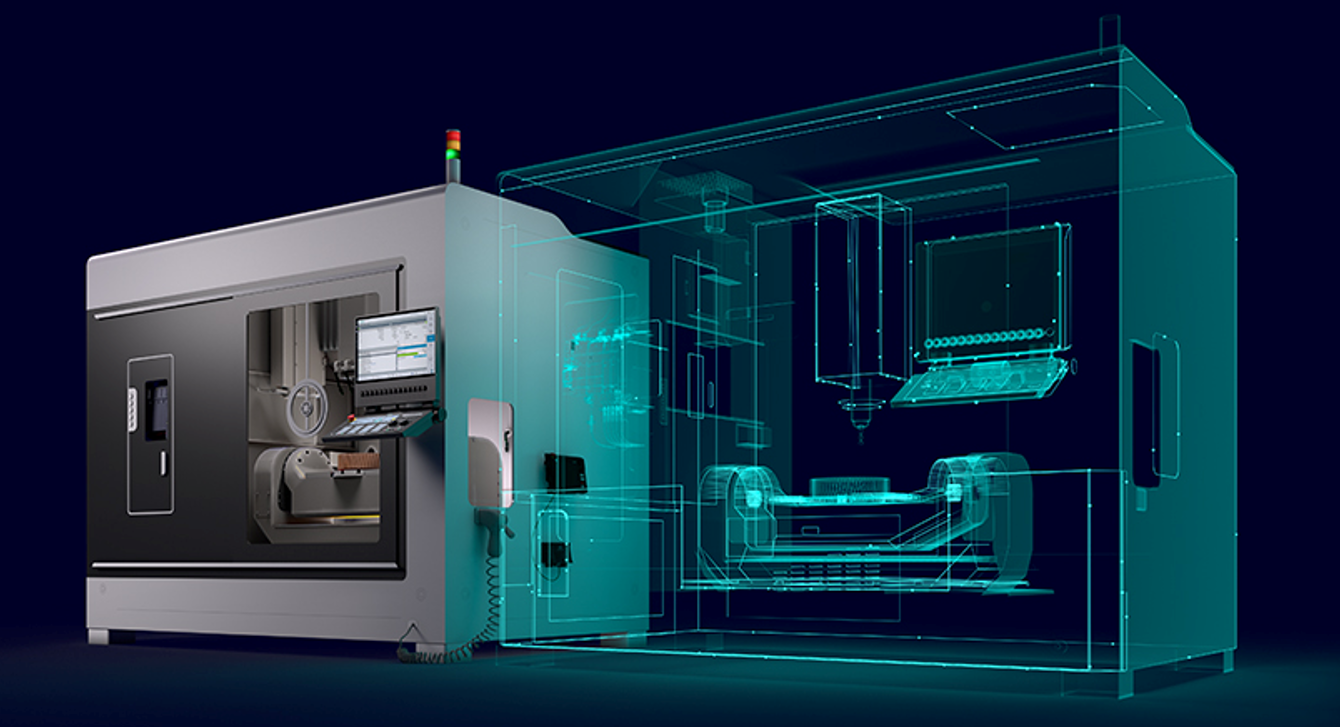
Siemens wants more of that work to take place while the machine is still being built. The framework connects engineering, programming, virtual validation and final execution so that part programmes and production processes can be developed against a digital representation of the eventual machining environment.
Mark Hindsbo, head of Operations Software at Siemens, said the approach could reduce ramp-up time by up to 50%. That is a Siemens performance claim rather than a result that will apply equally to every machine or component, but it provides a clear target against which the initiative can be judged.
The largest potential saving comes from moving work that has traditionally been sequential into parallel activity. In a conventional project, the machine is built and delivered before engineers begin some of the detailed programming, validation and training. Under the new model, those activities can begin during machine manufacture.
That makes digital accuracy critical. A virtual machining environment only saves physical commissioning time if its representation of the delivered machine is sufficiently close to reality. Kinematics, axis limits, CNC behaviour, tools, fixtures and work offsets all have to correspond with the production configuration.
The machine builder therefore remains central to the process. Siemens can provide software, simulation and control technology, but the OEM holds detailed information about mechanical behaviour and the exact configuration being delivered. TRAK’s role in the first phase is to bring those two data sets together early enough for the customer to prepare meaningful production work.
Programming before delivery can also expose problems while there is still time to address them without a stopped production line waiting for an answer. Tool reach, collision risks, fixture access and inefficient motion can be identified in simulation, allowing programmes or machining strategy to change before first metal is cut.
Physical prove-out remains necessary. Simulation cannot reproduce every cutting force, vibration effect, tool-life issue or material variation encountered on a real machine, and manufacturing engineers still need to confirm part quality under operating conditions.
The difference is the maturity of the process arriving at that stage. If the obvious programming and motion problems have already been removed, physical commissioning can concentrate on cutting performance, quality and final optimisation rather than basic debugging.
The model also addresses workforce constraints. Experienced CNC programmers, manufacturing engineers and machine operators are scarce, and conventional commissioning can require several of them to be available at the same time immediately after machine installation.
Moving programming and training work into the build period spreads that demand over a longer window. It also gives operators a way to become familiar with the intended process before production deadlines and customer orders begin to place pressure on the new equipment.
Steve Pinto, president of TRAK Machine Tools, said the partnership is focused on helping customers reach productivity and business results faster after investing in new equipment. TRAK is effectively providing the first production environment in which Siemens can turn the framework into a repeatable machine-builder workflow.
The approach is relevant because the cost of machine-tool investment does not stop at purchase price. A high-value machining centre that sits idle during a prolonged commissioning period still carries financing, factory-space and production costs while contributing no saleable output.
Time to first stable part therefore has a direct effect on return on investment. Reducing the gap between machine delivery and repeat production can be as economically important as reducing individual cycle time once the machine is operating normally.
The initiative also provides another example of digital manufacturing moving away from stand-alone software products. Manufacturers increasingly expect engineering, production planning and shop-floor systems to exchange data rather than require information to be recreated manually at every stage.
Siemens describes that flow as a continuous digital thread from engineering through programming and virtual validation to execution. The practical test is more prosaic: whether a programme prepared against a machine that has not yet arrived can be loaded, checked and moved rapidly into production when the equipment is finally installed.
Future phases are expected to add other machine builders and address further manufacturing challenges. Scaling the model will be harder than demonstrating it with one partner because each OEM uses different mechanical configurations, software stacks and customer processes.
For machine buyers, however, the measure remains straightforward. Meet at the Machine will be valuable if it converts weeks of post-installation preparation into work completed before delivery and if the virtual preparation survives first contact with the actual machine. TRAK’s first implementations will provide the evidence for whether Siemens’ claimed reduction in ramp-up can be achieved outside a controlled demonstration.