SSE has selected Siemens Energy as preferred supplier for offshore wind turbines and substation platforms at its proposed 1.4GW Berwick Bank B project, potentially supporting 2,677 manufacturing, engineering, project delivery, and servicing roles across Britain.
The proposed supply arrangements would draw on Siemens Energy's established operations in Hull, Manchester, and Newcastle, alongside engineering, assembly, and maintenance activities in Scotland. Of the roles identified, 2,222 are associated with existing and project-based employment in northern England, while 455 would be supported across Scotland, including 130 newly created positions.
The selection remains conditional on SSE reaching a final investment decision and awarding the corresponding contracts. No final equipment order or construction commitment has yet been confirmed through the preferred supplier announcement.
Berwick Bank B is planned for the outer Firth of Forth, approximately 38km off the Scottish coast, and forms part of a wider offshore wind development with a potential generating capacity of 4.3GW.
Siemens Energy's proposed involvement covers two major areas of the engineering programme: supplying offshore wind turbines and delivering offshore substation infrastructure. These packages require different manufacturing and technical capabilities, but their installation must be coordinated around the same construction programme.
Wind turbine production involves the manufacture and assembly of large mechanical, electrical, and composite components designed for prolonged operation under variable loading conditions.
Turbine blades are particularly demanding because their aerodynamic geometry must be produced accurately while maintaining the structural performance required to withstand repeated bending and fatigue loads.
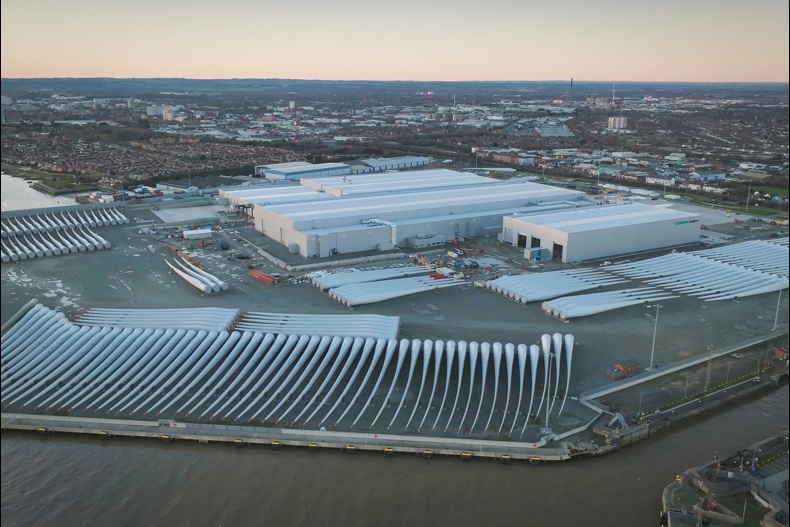
Industrial blade manufacture uses large moulds, composite materials, controlled curing processes, and inspection operations. Once completed, the structures must be handled and transported using equipment suitable for components extending well beyond the dimensions of conventional industrial loads.
Siemens Energy's Hull facility provides established UK blade manufacturing capability that could contribute to the proposed project. The factory forms part of a wider supply arrangement involving electrical engineering and project delivery operations elsewhere in the country.
Manchester would support engineering and delivery activities, while Newcastle would contribute to the assembly and project delivery work associated with offshore substations.
These substations are required to collect electricity generated by the turbine array and connect it to the project's export infrastructure. Their electrical equipment must handle the required power flows while providing protection, switching, monitoring, and control functions.
Transformers, switchgear, and other high-voltage components must be integrated within a platform suitable for installation and operation in a marine environment.
The platform structure must accommodate the equipment's weight, operating loads, access requirements, and environmental conditions. Fabrication, protective coatings, mechanical assembly, and electrical testing therefore form substantial parts of the manufacturing and construction process.
The offshore substation platforms are expected to be delivered by Siemens Energy in partnership with Smulders-HSM. The precise manufacturing commitments and final work allocation will depend on the contracts awarded following the investment decision.
Installation introduces further engineering demands. Large offshore equipment must be transported to site and positioned using specialist vessels, with lifting operations planned around sea conditions and the structural requirements of the installation.
Electrical commissioning then establishes whether the installed equipment operates correctly as part of the generating and transmission system. Protection settings, communications, monitoring equipment, and electrical interfaces require validation before power can be transferred through the completed infrastructure.
The industrial supply arrangements announced by SSE would support 2,222 existing and project-based jobs across Hull, Manchester, and Newcastle. These are positions expected to benefit from the proposed work, rather than a commitment to create 2,222 entirely new jobs.
In Scotland, SSE and Siemens Energy expect 455 engineering, project delivery, and servicing roles to be supported. The total includes 200 positions associated with SSE's Glasgow operations and 255 supported by Siemens Energy.
Of the Scottish positions, 130 are newly created roles. SSE has identified 80 new engineering and project delivery positions in Glasgow, while Siemens Energy expects to create 50 new servicing roles at Montrose Port.
Siemens Energy also expects to support work associated with turbine preparation and installation at a northern Scottish port facility, with the location still to be confirmed.
Its planned Scottish operations include a new Glasgow office with capacity for up to 150 employees, alongside investment in training and apprenticeships intended to develop skills for offshore wind and electrical infrastructure projects.
Darren Davidson, managing director of Siemens Energy UK and Ireland, said: “Being selected as preferred supplier for Berwick Bank B brings together some of the very best of Siemens Energy's UK capabilities.”
The new supplier selection follows an earlier agreement under which Seaway7 was identified as preferred supplier for foundation and inter-array cable work associated with Berwick Bank B.
That package is expected to support 465 UK roles and covers engineering and installation activities that must be coordinated with the turbine and electrical infrastructure contracts.
Other previously identified employment commitments include operations and maintenance positions associated with the proposed Montrose Port base. Across the supplier and project arrangements announced so far, SSE reports that Berwick Bank B could support 3,272 UK jobs, including 985 in Scotland.
The totals combine existing employment, project-supported roles, and newly created positions. They are not equivalent to a confirmed programme of more than 3,000 additional jobs.
Berwick Bank B secured a Contract for Difference during the UK's seventh allocation round earlier in 2026, providing a framework for qualifying electricity generation if the development proceeds.
The agreement supports the project's commercial planning, but construction remains dependent on final investment approval and the award of the principal equipment and installation contracts.
SSE expects to reach its final investment decision in late 2027. Subject to approval, preparatory offshore construction could begin during 2028, with turbine and substation installation scheduled to begin in 2030 and continue through 2032.
The period before offshore installation provides time for equipment design, manufacturing preparation, component production, testing, and transport planning. Supplier capacity must also be coordinated with other industrial contracts, particularly where factories and specialist marine equipment serve multiple large projects.
The final manufacturing programme will depend on equipment specifications, contract conditions, and the confirmed construction timetable. SSE has not yet announced a definitive turbine model or completed procurement arrangements for the proposed installation.
If constructed to its full planned capacity, the wider Berwick Bank development could generate electricity equivalent to more than 6% of current UK demand. Berwick Bank B represents one 1.4GW phase of that programme, with the latest preferred supplier selection identifying the British manufacturing and engineering operations expected to contribute if the project moves into construction.