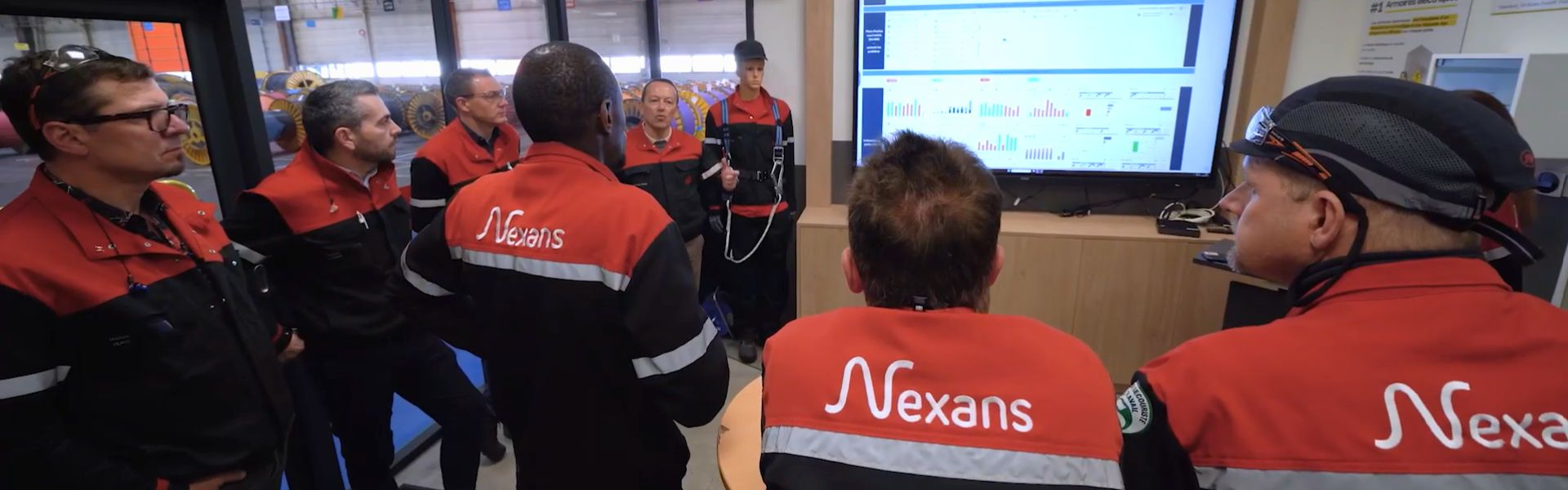
Nexans has deployed the Fabriq digital performance-management platform across 40 manufacturing plants, standardising shopfloor routines, problem escalation, and operational reporting as part of the cable manufacturer’s wider Industry 4.0 programme.
The rollout replaces a largely manual system built around physical whiteboards and local daily-management routines with interactive digital boards showing performance indicators, actions, escalations, and unresolved issues from individual production teams through to plant and group level.
Fabriq is not being positioned as a complete manufacturing execution system. Its function is more focused: digitising daily performance management, shift routines, actions, and structured problem-solving so that operating standards can be applied consistently across multiple factories. Nexans places the system alongside automation, data infrastructure, predictive maintenance, and other elements of its manufacturing digitalisation programme.
The first pilot was run at the company’s Autun plant in France, where teams used digital daily boards for shift handovers, performance reviews, and problem-solving. Nexans subsequently expanded the model to other factories, including Charleston in the United States, adapting the deployment to local production conditions while retaining the underlying management structure.
At Autun, the company reports improvements in safety and quality metrics, operational responsiveness, team communication, and operator engagement. Nexans has not published quantified before-and-after productivity or quality figures, so the current announcement establishes the scale of the deployment rather than a specific percentage gain in factory performance.
Olivier Ameline, operational excellence director at Nexans, said: “Fabriq is a key lever in our Industry 4.0 journey. By digitalizing and energizing our existing performance management standard, it helps our plants focus on what really matters: focusing on real-time operational performance, solving problems faster, strengthening our operational discipline and making life easier for operators on the shopfloor.”
Industrial plants already generate large volumes of information through machines, quality systems, maintenance tools, ERP platforms, and manufacturing execution systems. Production teams can still lose time when actions, deviations, and operating decisions remain trapped on local boards or are reproduced manually in several reporting systems.
Nexans is using Fabriq to place those routines in a common digital structure. Actions can be assigned and tracked, unresolved problems escalated, and previous corrective work retained rather than disappearing when a physical board is cleared or a reporting cycle ends. Similar deviations appearing elsewhere in the network can then be compared with earlier responses instead of being investigated entirely from scratch.
The company is extending the platform beyond headline performance indicators to shift handovers, equipment start-up procedures, first-level maintenance checks, 5S audits, and safety routines. These repetitive operating activities determine whether a digital system becomes part of normal production behaviour or remains an additional reporting burden layered over existing work.
Governance is being handled centrally through Nexans’ industrial organisation, supported by key users at individual plants and a combination of on-site and online training. Schneider Electric is also involved as a strategic digital-transformation partner, with Nexans seeking to avoid isolated systems and develop a more consistent manufacturing architecture.
The deployment sits within a production network already receiving substantial investment in automation and digitalisation. Nexans’ Autun site, for example, is undergoing a €40 million investment programme covering automation, digital technology, fire-safety cable production, and other upgrades. Fabriq adds a common operational-management layer around those physical assets and production changes.
The next phase will extend the platform from daily control towards weekly performance steering. Nexans plans to use accumulated data to identify recurring deviations, support deeper root-cause work, and retain lessons in a form that can be reused across plants rather than remaining local knowledge.
That progression will determine whether digital boards become more than electronic replacements for the whiteboards they displace. Capturing a fault faster has limited value if repeated problems continue to be treated as isolated events; retaining the operating history can instead expose recurring losses that justify engineering or process changes.
Scaling the same system across 40 plants introduces its own standardisation problem. Production processes, products, workforce structures, terminology, legacy systems, and automation levels vary between sites. Excessive central prescription can make a platform awkward locally, while unrestricted customisation can undermine the common reporting structure that justified a network-wide system.
Nexans has now moved Fabriq well beyond pilot scale. The longer test will be visible in the operating measures the company already tracks — safety, quality, delivery, cost, equipment performance, and problem-resolution time — as the 40-plant deployment settles into routine use rather than remaining a digitalisation project.