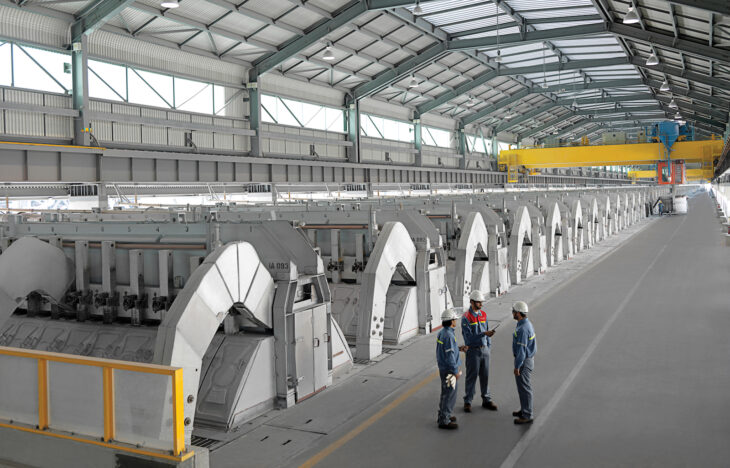
Emirates Global Aluminium has restarted 315 of the 1,262 reduction cells at its Al Taweelah smelter in Abu Dhabi, taking the restoration programme to 25% as the company works towards full primary aluminium production in the first quarter of 2027.
EGA said the Al Taweelah site sustained significant damage on 28 March during Iranian attacks on Khalifa Economic Zone Abu Dhabi, forcing an emergency shutdown of the facilities there. The company has since been repairing infrastructure and restarting the smelter progressively, with all three potlines now energised and around 1,000 people working on the hot-metal restoration programme.
Potline 1 was energised on 26 May, followed by potline 3 on 13 July and potline 2 on 3 August. Once a reduction cell is restarted, EGA says it typically takes about a week to stabilise and reach full production, so the number of energised cells does not translate immediately into the same proportion of normal saleable-metal output.
The latest milestone also shows a faster pace of restart than EGA reported earlier this month. Its half-year update on 12 August recorded 227 cells, or around 18% of the total, back in operation. Reaching 315 means another 88 cells have been restarted since that update while the restoration team works across all three potlines in parallel.
Primary aluminium reduction cells are continuous high-temperature electrochemical systems rather than conventional machines that can simply be switched off and restarted. Each pot operates with molten electrolyte and aluminium under high electrical load, and an emergency shutdown can leave frozen bath and metal that must be removed before damaged linings, electrical connections, and surrounding equipment can be repaired and recommissioned.
EGA is using part of the hot metal produced by restored cells to support further restart work, with the remainder sent to the Al Taweelah casthouse for conversion into finished aluminium products. That creates a recovery sequence in which some early production is consumed by the restoration process itself before the site can return fully to normal customer output.
The engineering task extends well beyond the potlines. Al Taweelah combines primary smelting, casting, utilities, an alumina refinery, and a newer recycling plant, so the restart programme has to coordinate electricity, natural gas, materials handling, maintenance, logistics, and downstream production while individual process areas recover at different rates.
EGA expects the capital expenditure required to restore production at Al Taweelah to be approximately AED1.5 billion, equivalent to about $400 million, with most of that spending falling in 2026 and some continuing into 2027. The estimate covers a recovery programme whose scale is visible in both the cell count and the effect on first-half production.
Cast metal output fell to 1.006 million tonnes in the first six months of 2026 from 1.420 million tonnes a year earlier, while aluminium sales declined to 939,000 tonnes from 1.373 million tonnes. Alumina production fell to 602,000 tonnes from 1.142 million tonnes after the refinery was shut down following the March incident.
The alumina refinery restarted in July and is now operating at around 50% of capacity. EGA says the pace of further ramp-up will depend on supply-chain conditions and how it optimises alumina sourcing, while emphasising that restoration of the smelter does not depend on the refinery returning to full production.
That flexibility matters because alumina is the principal feedstock for primary aluminium smelting, but an integrated producer can rebalance internal output with external supply if logistics and inventory allow. EGA has spent the year adjusting raw-material and finished-metal movements around wider regional disruption, including the use of alternative export routes outside the Strait of Hormuz.
The company reported in August that inbound deliveries of major raw materials were sufficient to support full production at Jebel Ali alongside the Al Taweelah restart, helping rebuild strategic inventories. Outbound logistics have remained more constrained, and EGA has been reducing accumulated UAE stocks as alternative shipment capacity develops.
The new Al Taweelah recycling plant is following a separate recovery path. Ramp-up restarted in May after the incident interrupted final commissioning, and EGA now expects the facility to reach full production by late in the fourth quarter of 2026. Recycling does not replace the scale of the primary smelter, but it broadens the site’s feedstock and product mix while restoration continues.
The financial impact has been softened by aluminium pricing and the continued operation of EGA’s Jebel Ali site. Despite lower volumes, the company reported adjusted EBITDA of AED4.506 billion for the first half, up 11% year on year. That result supports the balance sheet through the restoration programme, but it does not change the physical requirement to repair and stabilise hundreds more reduction cells.
Each additional cell has to be prepared, energised, stabilised, and integrated into a potline returning towards normal thermal and electrical balance. At the same time, the casthouse, refinery, recycling plant, utilities, and logistics network have to accommodate changing material flows without allowing the recovery of one process area to create a bottleneck in another.
EGA continues to target full production at Al Taweelah in the first quarter of 2027. With one quarter of the 1,262 cells now restarted, the programme has moved well beyond its initial recovery stage, but the more meaningful measure will be the rate at which those cells settle into stable production and restore saleable metal volumes rather than the percentage that has simply been energised.