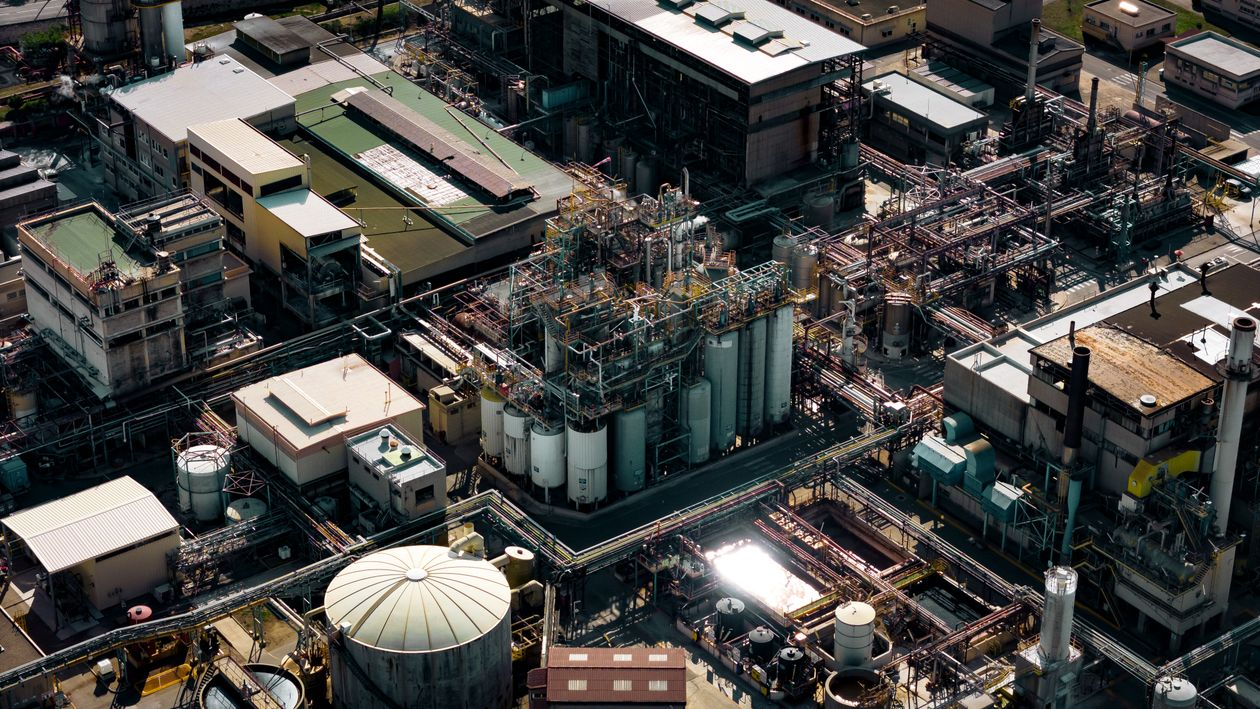
dsm-firmenich is increasing production at its new hydrogenated bio-based resin unit in Vielle-Saint-Girons, southwestern France. The automated facility was commissioned during the first half of 2026 and is now being ramped up to supply industrial adhesives, coatings and other formulated products.
The manufacturing operation forms part of the group’s DRT Industry Ingredients business. It produces hydrogenated pine-based rosin resins and derivatives, including grades marketed under the Foral and Staybelite ranges, for customers in Europe, North America and Asia.
The company has not disclosed the unit’s investment value, annual tonnage or the date on which it expects to reach full production. Its confirmation concerns a plant already commissioned and an ongoing increase in output, rather than the first decision to build the facility.
Pine rosin provides the principal renewable feedstock for these materials. Rosin contains a mixture of resin acids that can be chemically modified to obtain properties required in formulated products. The processing route influences colour, softening behaviour, compatibility with other ingredients and resistance to degradation.
Hydrogenation changes the chemical structure of rosin compounds by reducing the number of unsaturated bonds. In suitable formulations, that treatment can improve stability against oxidation and changes in appearance during processing, storage or exposure to environmental conditions.
The extent of hydrogenation is significant because different end uses impose different performance requirements. A resin intended to remain colour-stable under demanding temperatures may require different characteristics from an ingredient selected primarily to alter the tack or processing behaviour of an adhesive.
dsm-firmenich describes the new process as capable of supplying highly hydrogenated resins with low colour and a high degree of stability. Those properties are attributed to the supplier; the company has not provided a published comparative test dataset establishing performance against named competing products.
In an adhesive formulation, a tackifying resin can alter how the mixture wets and adheres to a surface. Its properties must be compatible with the base polymer and other ingredients, while the final bond also depends on application temperature, surface preparation and the loading conditions encountered in service.
The company’s customers use these materials in electronics, automotive applications and road signage. Such applications can expose adhesives and coatings to changing temperatures, light or moisture, but the relevant qualification requirements depend on each finished formulation rather than the resin’s origin alone.
Coatings and paints also rely on controlled compatibility between resins, solvents or dispersing media, pigments and other additives. Changes in a raw material’s chemistry can influence viscosity, film formation and final appearance, so consistent manufacturing is important when the ingredient is supplied to a large production operation.
Chewing-gum resin production forms another part of the Vielle-Saint-Girons site activity. It is subject to different assurance requirements from those governing industrial adhesives and coatings, despite the common use of resin chemistry and associated processing expertise.
The new unit is fully automated, with technology intended to support process stability, safety, quality and energy performance. dsm-firmenich has not identified the reactor arrangement, catalyst or control architecture used to achieve the required degree of hydrogenation.
At manufacturing scale, repeatability depends on controlling feedstock condition, reaction parameters and downstream treatment. Variation in raw materials or processing conditions can alter the chemical composition of the finished resin and affect its performance when a customer incorporates it into another product.
Automation can help execute specified operating sequences and maintain process conditions, but commissioning a plant does not establish that every product grade has reached its intended commercial output. Qualification, operating experience and customer demand influence the progress of a ramp-up.
More than 50 companies contributed to construction of the expansion, with dsm-firmenich reporting that 90% were locally based. A further 120 equipment suppliers participated in delivering the facility, although the company has not identified the individual contracts or disclosed the overall capital cost.
The site holds ISO 50001 certification for energy management and FSSC 22000 certification for chewing-gum resin production. The certifications address different management systems; the food safety certification applies to the stated production scope rather than automatically covering all industrial products made at the site.
The company also reports that more than 90% of site co-products are valorised. That describes the recovery or productive use of material streams arising from operations; no detailed mass balance or independently assessed lifecycle carbon saving has been provided for the new production unit.
A pine-derived feedstock does not on its own quantify the environmental performance of the finished material. Energy consumption, chemical inputs, feedstock sourcing, transport and the eventual product application affect the overall footprint, which would require a defined assessment boundary to compare reliably.
Vielle-Saint-Girons is part of dsm-firmenich’s wider industrial presence in southwestern France, where it reports five factories and approximately 900 employees. The additional unit is intended to increase the supply of high-performance rosin ingredients from that network.
Further commercial progress will depend on achieving repeatable manufacturing output and completing customer qualification for the grades concerned. Neither a full-capacity production date nor an incremental annual tonnage has been released, leaving the size of the eventual capacity increase undisclosed.