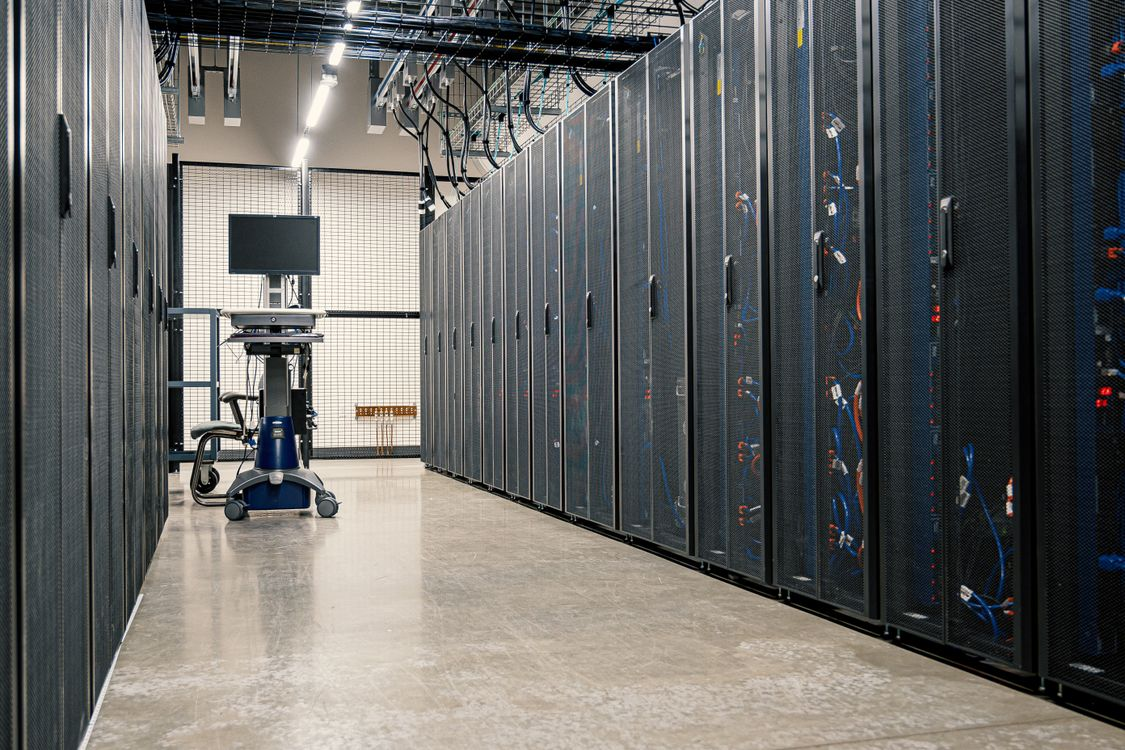
Deutsche Telekom will invest almost another €250 million in its Industrial AI Cloud at Munich’s Tucherpark, expanding the facility to 20MW and installing further NVIDIA Blackwell Ultra processors for artificial intelligence and industrial simulation.
The expansion follows demand for the computing infrastructure opened in February 2026. Deutsche Telekom says the initial phase is fully booked, and the additional investment will increase the resources available to industrial businesses, researchers and other organisations developing AI applications.
NVIDIA Blackwell Ultra B300 graphics processors will be added alongside existing Blackwell B200 systems. Deutsche Telekom says the new installation will double the number of processors in the relevant class, with a greater increase in computing performance because of the newer hardware.
The Munich facility also uses NVIDIA RTX PRO 6000 Blackwell Server Edition processors. These systems support different types of workload, including simulation and the development of applications that combine physical models with machine learning.
The expanded infrastructure is intended to provide computing capacity for training AI models, running deployed models and carrying out simulation-intensive engineering work. Applications identified by the company include digital twins, robotics development and the testing of production equipment in virtual environments.
Those applications place different demands on computing hardware. Training a machine learning model typically requires repeated numerical operations across large datasets, while a simulation may calculate the behaviour of physical components or systems through many time steps and operating scenarios.
Graphics processors are useful for workloads that can divide calculations into tasks executed in parallel. Their performance advantage depends on how the application is written and whether its mathematical operations can be distributed effectively across the available hardware.
Industrial simulation also requires suitable software, memory and access to engineering data. A large fleet of GPUs does not in itself establish that every model will run efficiently or that the results will accurately represent a production process.
For robotics, virtual environments can be used to test control algorithms before they are deployed on physical machines. A simulated robot may encounter different object positions, loads or movement paths, allowing developers to evaluate responses across many scenarios.
Such development can reduce the number of physical trials required at an early stage. The resulting software still needs testing with real equipment because simulation cannot perfectly reproduce every mechanical interaction, sensor limitation or unexpected condition encountered during operation.
Digital twins may represent machines, products or production systems using models updated with engineering or operating information. The type of analysis they support depends on the quality of those models and how closely their assumptions match the system being studied.
Deutsche Telekom says the additional computing capacity can accelerate some work that currently takes weeks or months. Those comparisons are application-dependent claims rather than a published benchmark guaranteeing a particular reduction in development time for every industrial customer.
Companies including Siemens and Daimler Truck use the infrastructure, while the wider customer and partner ecosystem includes industrial robotics and engineering software businesses. The operator has not disclosed the detailed allocation of computing capacity between individual users.
The facility is structured as shared cloud infrastructure rather than a data centre built and operated by one manufacturing company for its own exclusive use. Customers can obtain computing resources without first purchasing and maintaining a comparable fleet of specialised processors.
That model can affect the costs and timing of development work, although users must still account for data management, software configuration, connectivity and the technical requirements of their applications.
Engineering workloads can involve commercially sensitive designs and operational data, creating requirements for access control, processing location and the separation of different customer environments. Deutsche Telekom positions the service as a European-operated platform with data protection and security controls.
The location of compute resources does not alone establish compliance with every industry or regulatory obligation. Individual organisations still need to assess the controls applicable to their own data, systems and intended applications.
AI infrastructure also requires substantial electrical power and cooling. The planned expansion will raise the site’s capacity to 20MW, increasing the importance of managing the interaction between processor loads, electrical distribution and heat removal.
Deutsche Telekom reports a Power Usage Effectiveness figure of approximately 1.2 for the Munich facility. PUE compares total data centre electricity use with the energy consumed by IT equipment, including additional consumption associated with cooling and electrical infrastructure.
A PUE of 1.2 indicates that total facility energy use is approximately 1.2 times the IT energy demand under the relevant measurement conditions. It is not a measure of the energy needed to complete an AI task and cannot establish the carbon footprint of an individual model or simulation.
The site uses electricity from renewable sources and a cooling arrangement incorporating water from the nearby Eisbach. Deutsche Telekom also intends to recover heat from the installation for use across the Tucherpark district, but that district heating application remains a future arrangement rather than a completed output from the latest expansion.
Further investment opportunities in Bavaria are under discussion with potential partners. The company has not made a final investment decision on that additional development, which is separate from the confirmed expansion at Tucherpark.
The existing facility is now moving into another capacity increase only months after its opening. Installation of the B300 systems and associated infrastructure will determine when the added computing resources become available, while subsequent utilisation will show how much industrial demand progresses from experimental AI work into sustained operation.