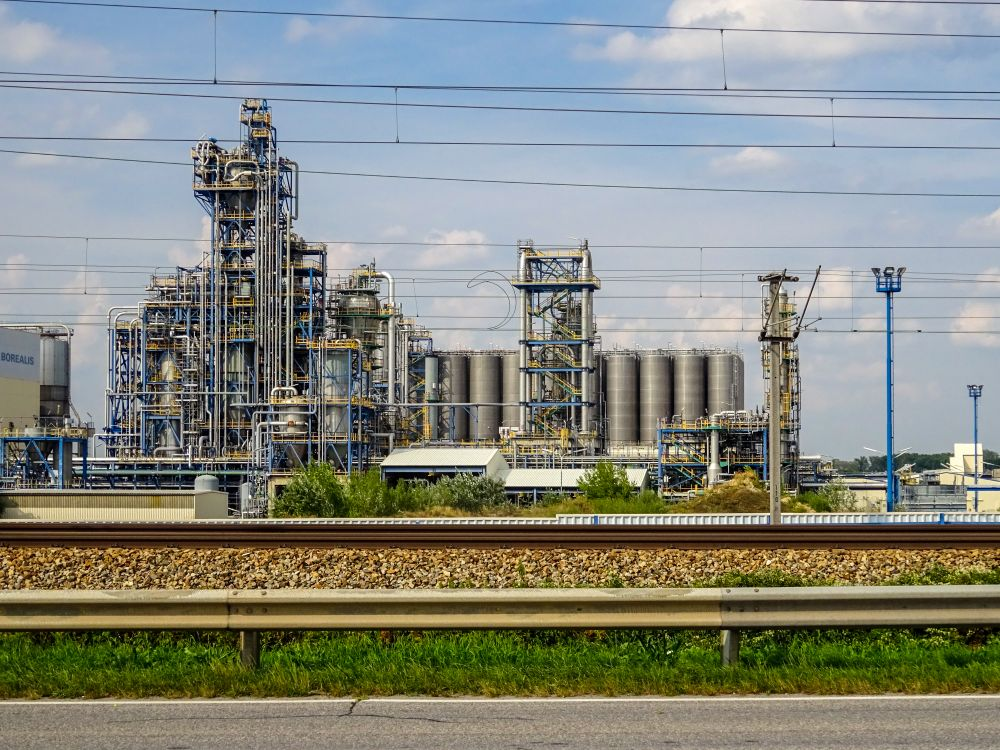
Evonik has introduced AI-based process models into live chemical plant operations in Marl, Germany, and Antwerp, Belgium, using a library of more than one million simulations to generate operational recommendations within seconds.
The deployment forms part of the COMPAS programme developed by the company’s Oxeno business, which operates integrated C4 chemical production facilities at the two sites. Evonik reports higher energy efficiency and lower associated carbon dioxide emissions from the initial applications, although it has not disclosed quantified savings.
COMPAS stands for Control and Optimization using AI Models for Process Advancement and Cost Saving. It combines established process simulation with trained artificial intelligence models, intended to make complex calculations useful during routine plant operation.
Chemical production depends on interactions between temperature, pressure, material composition, reaction rates and equipment conditions. A change to one operating parameter can influence several downstream units, making it difficult to determine the most efficient settings for the entire process from isolated measurements.
Some plant conditions cannot be measured directly with suitable frequency or precision. Engineering models can estimate them through mathematical descriptions of the process, but detailed calculations may require more computing time than is available when operators need to respond to changing feedstock or production requirements.
The COMPAS team approached the problem by running a large number of process simulations in advance. Those calculations form a training dataset for models that can approximate how the plant responds across a wide range of operating conditions.
Evonik describes the resulting approach as grey-box modelling. The method incorporates existing knowledge about the physical and chemical process while using data-driven techniques to reproduce selected relationships more quickly than a full simulation.
Thermodynamics describes the behaviour and energy balance of the materials in the system, including the conditions affecting phase changes and other process operations. Kinetics describes the rates at which chemical reactions proceed, which can influence the residence time, temperature and other requirements of production.
Both sets of relationships affect how a chemical plant can be operated. A change that improves performance in one unit may increase energy demand or create a process constraint elsewhere, so realistic optimisation requires a model that represents the connected operations.
COMPAS uses the precomputed scenarios to provide recommendations for plant settings in seconds. Evonik says the models show a high level of agreement with measured operating data in their first applications, although it has not published a complete error analysis for the deployments.
Dr Niklas Paul, head of engineering at Evonik Oxeno, said the approach allows the business to “bring complex process simulations directly into plant operations”. The technology is intended to support operating decisions even as feedstock conditions change.
Integrated C4 production involves chemical streams derived from four-carbon compounds. Their separation and conversion can involve several connected operations, with the availability and composition of input streams influencing how the production network is configured.
The company has identified quicker responses to changing feedstock conditions as an early benefit of its approach. A rapid recommendation can help operators compare available settings without repeatedly undertaking lengthy engineering studies each time conditions change.
Energy consumption in process plants arises from equipment such as pumps, compressors, heaters, refrigeration systems and separation units. Depending on the process, reducing unnecessary heating or compression can lower costs and emissions while still meeting the required production specification.
Any operating adjustment must remain compatible with equipment limits, product quality and the requirements of stable production. Lower energy consumption is not by itself evidence that every operating condition is acceptable, particularly where multiple units share material and utility streams.
Evonik reports that current applications have improved energy efficiency and reduced the carbon footprint of production. It has not given a percentage reduction, absolute energy figure or independent performance assessment, so the scale of the benefit cannot be established from the available information.
The system currently provides models that generate recommendations for plant control. Additional applications are being implemented, including the automated transfer of results from the models to the plant control system.
Automatically transferring model outputs into plant control requires safeguards that distinguish an optimisation recommendation from an authorised operating change. The permitted range of settings must be established before a recommendation can be executed without separate operator intervention.
Plant automation already relies on control systems that maintain variables within defined ranges. An AI model may propose more efficient operating conditions, but conventional control and protection arrangements still need to account for safe operation and equipment constraints.
Models also need to remain valid as equipment ages or production configurations change. Fouling, maintenance, new feedstocks and changes in available capacity can all alter the relationship between control settings and plant behaviour, requiring monitoring and possible model updates.
Evonik’s research team has described the COMPAS methodology in scientific publications including Chemical Engineering & Technology and Chemie Ingenieur Technik. The company is also seeking patent protection while expanding the number of production applications.
Its longer-term objective is a progressively self-optimising C4 production network. That remains a development direction rather than evidence that the Marl and Antwerp plants have moved entirely to autonomous AI operation.
The reported deployments provide operating experience for the combination of process engineering models and faster data-driven calculation. Further installations and disclosed performance figures will establish the extent to which the approach can improve energy use and production stability across additional chemical processes.