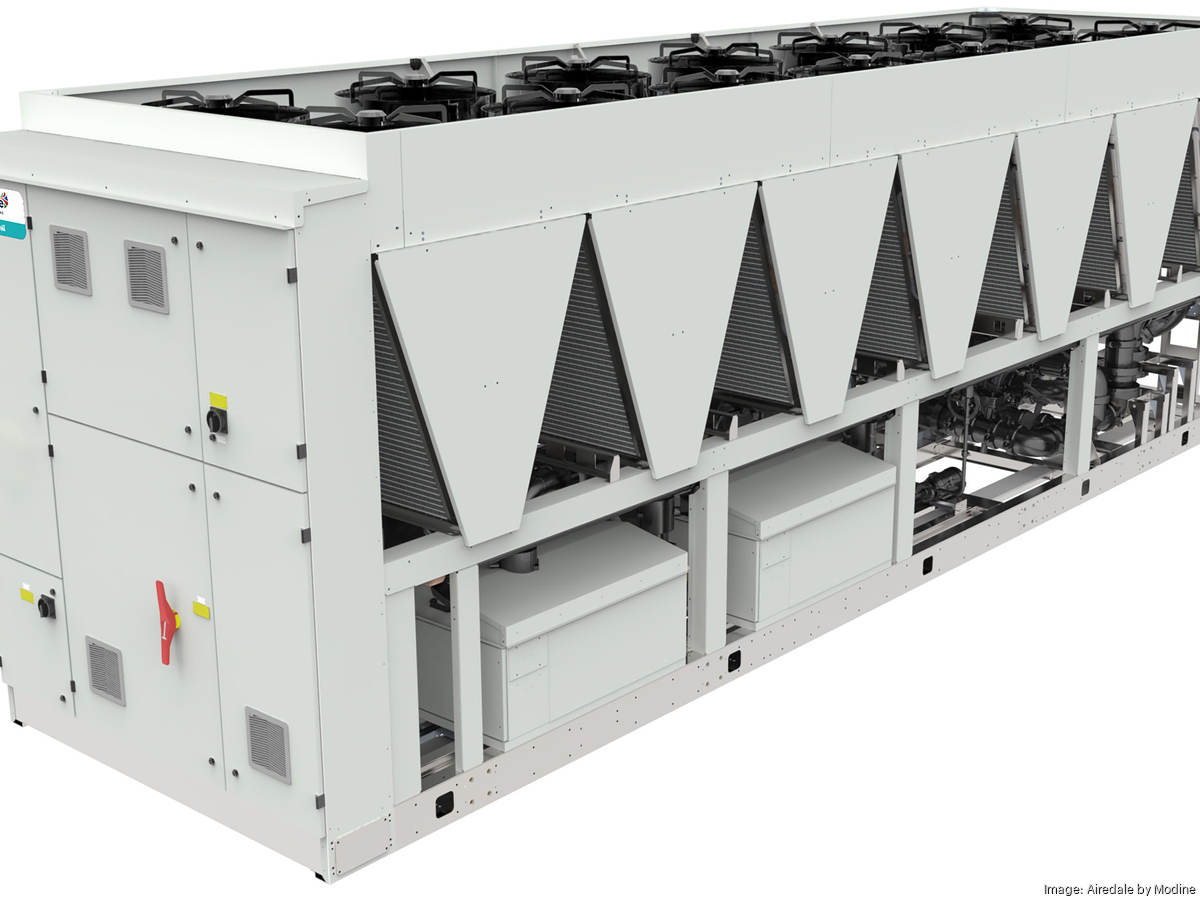
Modine Manufacturing Company has started commercial production of Airedale chillers at its new Grand Prairie factory in Texas, expanding manufacturing capacity for high-output cooling equipment used in data centres and other demanding thermal management applications.
The purpose-built facility covers 682,000 sq ft and is dedicated to manufacturing 2MW and 3MW chillers incorporating free-cooling capabilities. Its first production line began operating in November, with additional equipment and manufacturing shifts scheduled to be introduced as the factory expands.
Modine expects Grand Prairie to become the largest Airedale chiller production facility within its global manufacturing network. The company is targeting four operational production lines for 2MW chillers by the end of its current financial year, subject to equipment commissioning and workforce readiness.
The site currently operates one shift. Modine intends to progress towards a three-shift manufacturing model as production equipment is commissioned and employees are trained for the additional operations.
The production start establishes that the facility is already manufacturing commercial equipment, rather than remaining solely at the construction or planning stage. However, the planned four-line arrangement has not yet been commissioned in full.
The new factory forms part of Modine's wider investment in American production of cooling systems for large computing facilities. The programme is intended to position manufacturing capacity closer to North American customers and the infrastructure projects they are developing.
Airedale chillers are used to remove heat from circulating liquid systems, including the cooling infrastructure serving computing equipment. Their operation is particularly important where high-density installations generate substantial thermal loads within a limited building area.
Processors, power conversion equipment, and other electrical components release heat during operation. That energy must be transferred away from sensitive equipment to maintain temperatures within the limits established for reliable operation.
Chillers form part of the wider system that performs this function. They transfer heat from a cooling circuit to the environment or another heat rejection system, using refrigeration equipment where ambient conditions alone cannot provide the required cooling.
In a conventional vapour compression arrangement, refrigerant circulates through an evaporator, compressor, condenser, and expansion device. The evaporator absorbs heat from the process liquid, while the condenser releases it after the refrigerant has passed through the compressor.
The amount of electrical power required depends on operating temperatures, the condition of the heat exchangers, compressor performance, and the controls used to regulate the equipment.
Free cooling provides an alternative operating mode when external temperatures allow heat to be rejected without relying as heavily on mechanical refrigeration.
Under suitable conditions, the process cooling circuit can transfer thermal energy through heat exchangers while reducing or bypassing part of the compressor-driven refrigeration process, depending on the chiller design.
The achievable benefit varies throughout the year. Outdoor temperature, required coolant temperature, and the size of the connected thermal load determine how much cooling can be provided through the free-cooling arrangement.
Where ambient conditions are unfavourable, mechanical refrigeration may still be necessary to maintain the required supply temperature. Free cooling therefore provides additional operating flexibility rather than eliminating the need for compressors in every climate or application.
The 2MW and 3MW capacities identify the cooling equipment's intended thermal output class. They should not be confused with the electrical consumption of the chiller or the rated computing load of an entire data centre.
Manufacturing equipment at this scale involves integrating substantial heat exchangers, compressors, fans, pipework, electrical assemblies, and control systems within structures suitable for transportation and installation.
The physical size of the completed units creates requirements for factory layouts, material handling, access during assembly, and movement of equipment between production and testing areas.
Heat exchanger manufacture and installation are particularly important because the performance of these components affects the ability of the chiller to transfer heat under its specified operating conditions.
Pipework and pressure-containing assemblies must also be produced and inspected consistently. Defects in welded, brazed, or mechanically joined connections can create refrigerant or liquid leaks that compromise system performance.
Electrical systems require comparable manufacturing controls, including correct installation of motors, protective equipment, sensors, and the components used to operate and monitor the refrigeration cycle.
Following assembly, chillers must undergo appropriate inspection and testing before shipment. Checks may include pressure integrity, electrical operation, control sequences, and the functions used to protect equipment against operating outside its specified limits.
The availability of testing equipment can influence overall factory output. Increasing the number of assembly lines will not necessarily increase completed shipments at the same rate unless inspection, testing, and material handling capacity are expanded alongside production.
Modine's phased commissioning programme allows additional manufacturing operations to be introduced as equipment and personnel become available. The company has not disclosed a confirmed annual output figure measured in completed chillers.
Neil D. Brinker, president and chief executive of Modine, described the production start as a milestone in the company's plan to expand American manufacturing capacity for Airedale cooling equipment.
He said: “Scaling our capacity close to our customers enables us to partner with them to deliver the right highly engineered cooling solutions”.
Locating chiller production closer to major customers may simplify certain transport and delivery arrangements, particularly where large units must be moved to sites with tightly coordinated construction programmes.
However, manufacturing lead times will also depend on the availability of compressors, heat exchangers, motors, electronic controls, and other specialist components supplied to the factory.
A production line can operate only when those components arrive in the required sequence and meet their specifications. Managing material availability is therefore closely connected to the factory's ability to increase output.
Airedale's wider cooling portfolio includes dry coolers, coolant distribution units, and intelligent control systems. These products serve different parts of a data centre's thermal infrastructure and can be combined according to the requirements of the installation.
Dry coolers reject heat to ambient air through heat exchangers, while coolant distribution units manage the movement and thermal conditions of liquid supplied to connected computing equipment.
Complete systems may combine these components with chillers, pumps, valves, and monitoring equipment. Their design depends on the computing hardware, available space, climate, and required operating temperatures.
Manufacturing high-capacity chillers at Grand Prairie adds another source of equipment for these installations. The capacity expansion will become measurable as further production lines are commissioned and the factory increases its output of completed equipment.
The immediate industrial milestone is the start of commercial manufacturing. Additional shifts and the planned four-line operation remain future stages of the Grand Prairie expansion programme.