Phillips Medisize has announced an investment to acquire the full footprint of its Chippenham inhalation facility, seeking longer-term control of the laboratories and manufacturing space used to develop drug-device combination products for pharmaceutical customers.
The Wiltshire site works alongside the company’s Cambridge facility as part of its Global Inhalation Center of Excellence. The investment follows Molex’s completed acquisition of Vectura Group in January 2025, which brought specialist inhalation formulation and development expertise into the Phillips Medisize business.
Phillips Medisize describes the property investment as a way to secure capacity for formulation development and manufacturing of clinical trial supplies, supporting customers from initial feasibility studies through later-stage development and possible commercial production. It has not disclosed the value of the Chippenham transaction or an additional employment target, and its announcement does not provide an unambiguous legal completion date for the property acquisition.
Inhaled pharmaceutical products combine a medicine formulation with a device capable of delivering a controlled dose. The company’s UK teams work with dry powder inhalers, nebulisers and other inhalation formats, each requiring different combinations of formulation properties, device mechanics and analytical testing. Development decisions therefore affect both the drug substance and the equipment that delivers it.
Dry powder formulations must disperse into particles suitable for inhalation while remaining stable during storage and handling. Powder flow, particle size and the interaction between drug and carrier material can influence the amount of medicine emitted by a device and the fraction likely to reach the intended part of the respiratory system.
Pressurised metered-dose inhalers use a formulation held under pressure and released through a metering mechanism, while nebulisers convert liquid formulations into an inhalable aerosol. Their manufacturing routes differ from those for powder devices, and a product’s performance depends on factors including formulation stability, device geometry, dose reproducibility and the conditions under which patients use the equipment.
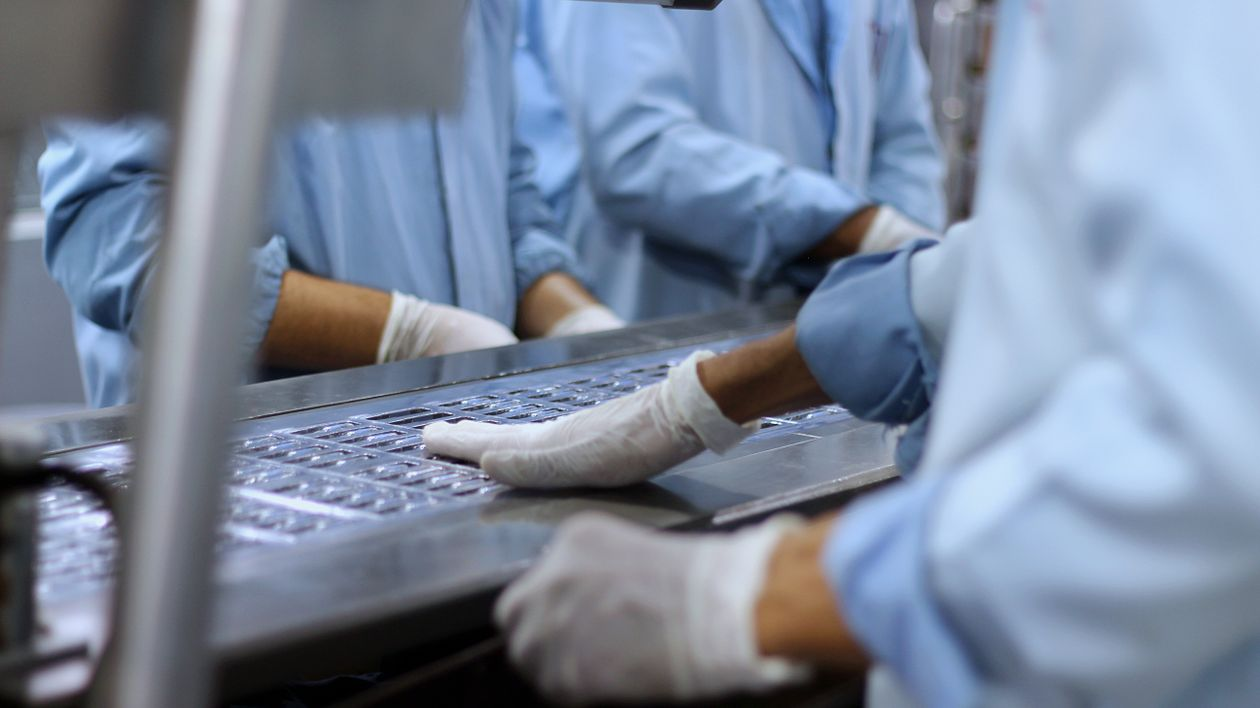
At Chippenham, the company lists spray drying, micronisation, powder blending, capsule filling and other technical capabilities. Spray drying converts a liquid feed into particles under controlled drying conditions, allowing engineers to influence particle properties through the formulation and process settings. Micronisation can reduce particle dimensions, while blending is used to create consistent powder mixtures where required by the product design.
Those processes become more demanding as programmes progress from small laboratory batches to clinical manufacturing. A formulation that performs satisfactorily at research scale must remain within its specified quality attributes when production equipment, batch sizes and processing conditions change. Analytical testing helps establish whether the resulting material retains the required characteristics.
Clinical supply manufacturing also requires documentation, traceability and control over changes to the production method. Phillips Medisize’s published Chippenham facility profile identifies Good Manufacturing Practice compliance for medicinal products, the manufacture of investigational medicinal products, and ISO 13485 certification among its operational credentials. These requirements are relevant when manufacturing medicine-device combinations for regulated development programmes.
The company says the Chippenham and Cambridge teams will jointly support formulations involving small molecules, biologics and generic medicines. Different compounds can respond differently to processing, temperature, moisture and contact with device materials, making the transfer of a formulation to a scalable manufacturing process a product-specific engineering task.
Charlie Schumacher, vice president of inhalation therapies at Phillips Medisize, said: “With our inhalation revenue projected to grow substantially over the next five years, securing this full site ensures we have the dedicated talent, laboratories and cleanroom capacity required to support pharmaceutical companies from early-stage feasibility all the way through commercial scale-up.”
The investment also extends the industrial integration undertaken after the Vectura acquisition. Vectura had established expertise in inhaled drug formulation, analytical science and clinical development, complementing Phillips Medisize’s wider experience in device design, component manufacture and assembly. Combining the capabilities can reduce the number of organisational interfaces involved when a pharmaceutical customer develops both a medicine and its delivery equipment.
That integration does not remove the need to qualify every product and manufacturing route individually. A change to an inhaler component, a formulation process or a material specification can affect the aerosol delivered to the patient, requiring engineering assessment and, where relevant, additional analytical or clinical work.
Phillips Medisize identifies pulmonary arterial hypertension and other complex conditions among the areas attracting inhalation development. The company also expects programmes involving biologics and therapies beyond conventional respiratory diseases, although the specific products and future manufacturing volumes associated with the Chippenham investment have not been identified.
Across its international operations, the company reports 30 locations in North America, Europe and Asia, comprising 23 manufacturing sites and seven research and development centres. It says it has supported more than 200 product launches and 150 drug delivery programmes during the preceding five years, providing capacity beyond the two UK inhalation centres for subsequent industrialisation.
The Chippenham announcement concerns greater control and future expansion of an existing technical operation, not the opening of a new factory. Additional output, workforce growth and commissioning milestones have yet to be specified. The immediate investment is directed at maintaining the specialist premises and manufacturing capability needed as inhalation programmes move through development and scale-up.