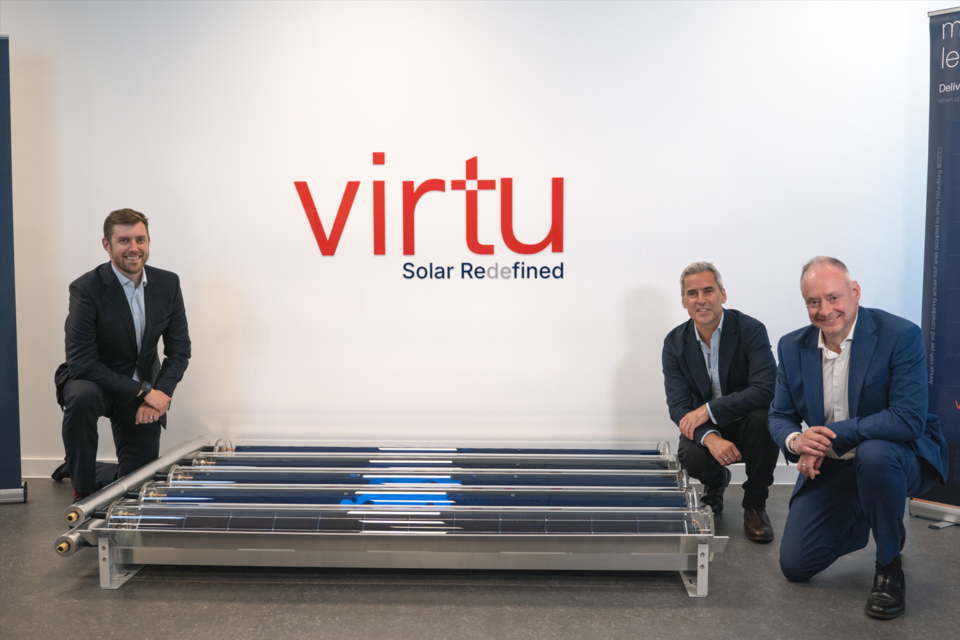
The Manufacturing Technology Centre has invested £1.3 million in a solar thermal installation at its Ansty Park campus in Coventry, using rooftop collectors to provide heat for building services and an absorption cooling system at the manufacturing research facility.
The project comprises 1,965 VirtuHOT collectors supplied by British technology company Naked Energy, with a combined peak thermal output of up to 786kW. MTC describes it as the UK’s largest solar thermal installation, while engineering company SHEco Group has delivered the physical installation work.
Unlike photovoltaic equipment, which converts sunlight into electricity, the collectors are designed to absorb solar energy and transfer it into a heated fluid. The resulting thermal energy can be used for space heating and hot water or directed to equipment that uses heat as an input to another process.
At Ansty Park, the system is intended to serve an absorption chiller during the summer. This enables solar heat to contribute to space cooling when the research buildings require it, rather than restricting the installation to winter heating or domestic hot water demand.
Absorption chillers use a thermally driven refrigeration cycle. Heat is supplied to a generator within the system, enabling the working fluids to separate and subsequently absorb and release refrigerant through a controlled process. The arrangement can provide cooling without relying on mechanical compression as the main driving mechanism, although pumps, controls and other auxiliary equipment still require power.
The suitability of absorption cooling depends on the temperature and quantity of available heat, the chiller’s operating characteristics and the required cooling conditions. A solar collector array can produce more useful thermal output during sunny periods, while its performance varies with ambient conditions, irradiation and the temperatures demanded by the receiving system.
MTC’s installation includes an 8,000-litre water storage tank to help connect heat generation with use. Thermal storage allows some energy collected during one part of the day to be delivered when the immediate demand changes, although its usable capacity depends on the operating temperature range and the losses associated with storage and distribution.
The same system will contribute to year-round space heating and general hot water supply. These applications place different demands on the thermal circuit from absorption cooling, requiring appropriate control over how heat is distributed between the chiller, storage vessel and building services equipment.
The 786kW figure is a peak rating for delivered heat under suitable operating conditions, not continuous electrical generation. Actual energy supplied over a year will depend on the weather, collector performance, system availability and how much heat can be used or stored. No independently verified annual thermal generation figure has yet been published.
MTC projects an annual reduction of 37 tonnes of carbon dioxide equivalent from the installation. That estimate depends on the energy sources displaced by the new system and its actual operating performance. It should not be read as a measured saving from a completed year of operation.
Solar thermal technology is relevant to industrial facilities because substantial energy is consumed as heat rather than electricity. Depending on the process, thermal demand may involve washing, cleaning, drying, temperature control or building services. Each application has its own operating temperature and load profile, which influences whether collected solar heat can be used directly.
Lower-temperature uses are generally easier to integrate with solar heat than processes requiring very high temperatures. Where a manufacturing operation needs more heat than a solar system can provide, additional plant or supplementary heating is necessary. The MTC project is focused on the campus’s building heating and cooling loads rather than replacing all of its industrial process energy requirements.
Joe Darlington, chief innovation solutions officer at MTC, linked the investment to the organisation’s work demonstrating industrial technologies. He said: “By making this investment, we are reducing our emissions while demonstrating how British technology can help manufacturers become more sustainable and resilient.”
The installation was delivered by SHEco Group in partnership with Naked Energy, bringing together the collector technology and engineering required to incorporate it into an existing building. SHEco is responsible for installation work, while Naked Energy supplies the VirtuHOT equipment and associated expertise.
VirtuHOT technology is designed to produce useful thermal energy from rooftop space, enabling sites to consider heat generation separately from electrical production. The MTC installation covers approximately 1,277m² of rooftop area, according to contemporaneous project reporting, although the precise collector performance over the annual operating cycle has not been established.
The Manufacturing Technology Centre is part of the High Value Manufacturing Catapult and works with industrial businesses on the development and adoption of production technologies. Its campus provides a research environment in which building energy equipment can be installed alongside engineering and manufacturing activities.
Monitoring operating performance will be necessary to establish how the collector array, thermal storage and absorption chiller behave across changing weather and demand conditions. Useful measures include thermal output, chiller performance, displaced purchased energy and the proportion of collected heat delivered to the building.
The physical installation has been delivered, but MTC has not disclosed a separate commissioning completion date or independent operating results. The project’s stated capacity and annual emissions reduction remain rated and forecast figures until performance is established under operating conditions at Ansty Park.