Ballard Power Systems has completed its £275 million acquisition of UK hydrogen power company GeoPura, extending the Canadian fuel-cell manufacturer into hydrogen production, distribution, refuelling, stationary generation, and Energy-as-a-Service operations.
The upfront consideration comprises £82.5 million in cash, 49,584,212 newly issued Ballard common shares, and restricted share units that will settle after 12 months for a further 1,084,540 shares. Former GeoPura shareholders now hold approximately 14.1% of Ballard’s outstanding common shares on a pro-forma basis.
A further £27.5 million could become payable if GeoPura meets specified financial milestones after completion. The transaction therefore combines a substantial cash commitment with a sizeable equity component and performance-linked consideration.
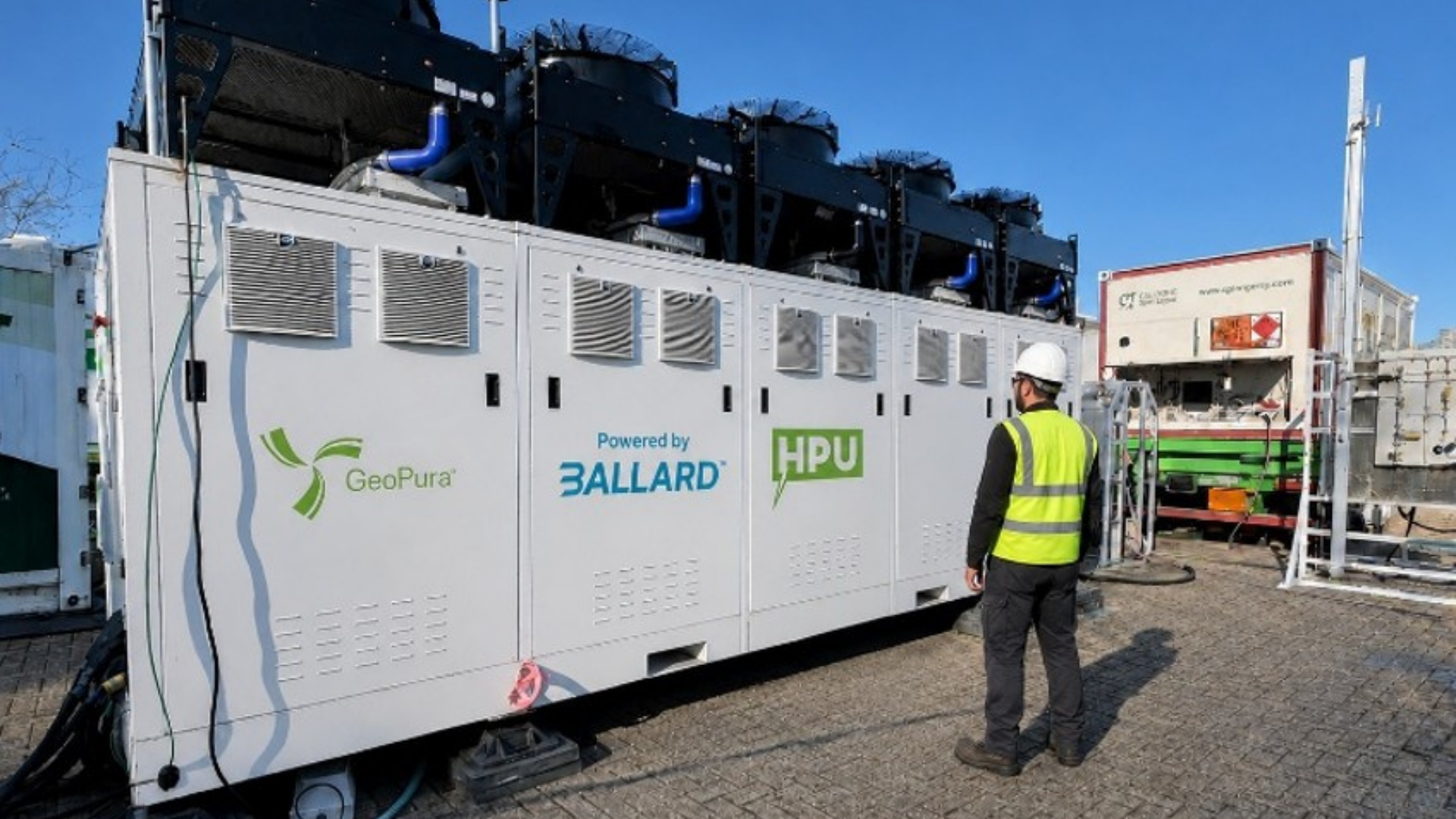
GeoPura was founded in 2019 and designs, manufactures, and operates Hydrogen Power Units for stationary and temporary applications. Its systems use Ballard fuel-cell modules to convert hydrogen into electricity and have been deployed in markets including construction, infrastructure, healthcare, temporary power, events, and other locations where a grid connection is unavailable or unsuitable.
The current HPU2 is rated at 500kW and can be deployed in modular configurations where customers require more capacity. The acquisition brings that downstream generation equipment into the same group as the fuel-cell stacks and modules already at its core.
GeoPura also produces green hydrogen through electrolysis at dedicated production facilities and operates a compressed-hydrogen distribution fleet. Ballard therefore gains infrastructure and operational capability on both sides of the generator rather than simply adding another equipment product to its portfolio.
That is a significant change in the industrial scope of the business. Supplying a fuel-cell module requires engineering, manufacturing, qualification, and customer support; supplying dependable hydrogen power as a service additionally requires fuel production, storage, transport, refuelling, maintenance, site integration, and day-to-day fleet operation.
Hydrogen generation systems are often proposed for sites where electrical demand cannot be met economically or quickly from the grid. Construction projects, temporary facilities, remote operations, and critical-power applications can all fall into that category, particularly as electrical loads increase while new network connections take years to secure.
For those users, the practical problem extends beyond the generator. Fuel has to be available when required and in sufficient quantity, delivered safely, stored within the constraints of the site, and replenished without creating operational downtime.
Bringing production, logistics, generation equipment, and fuel-cell technology together gives Ballard more direct control over that chain. It also increases its exposure to the operating economics of hydrogen itself, where electricity prices, electrolyser utilisation, transport distance, compression, storage, and equipment utilisation determine how competitive the final unit of power can be.
The acquisition builds on an existing technical relationship rather than introducing an unfamiliar fuel-cell architecture. GeoPura’s HPUs already use Ballard modules, reducing some of the product-integration work that would normally accompany an acquisition of a downstream systems business.
Leadership has also changed at completion. GeoPura founder and chief executive Andrew Cunningham has become president of Ballard, reporting to chief executive Marty Neese, while Cunningham and former UK business and industry minister Lord Richard Harrington have joined Ballard’s board as nominees of the former GeoPura shareholders.
The enlarged business now spans a much wider section of the hydrogen value chain, from fuel-cell engineering through to hydrogen production and delivered electrical power. Vertical integration can reduce the number of commercial and technical interfaces facing customers, but it also places more responsibility for plant availability, fuel supply, logistics, and service performance within one organisation.
That distinction is particularly important for stationary hydrogen power. Customers purchasing emergency, temporary, or off-grid electricity are generally more interested in whether power is available when demanded than in the electrochemical technology producing it.
Hydrogen still carries familiar cost and infrastructure constraints. Electrolysis requires significant electricity, compressed fuel is less convenient to transport than conventional liquid fuels, and dedicated storage and refuelling infrastructure adds capital and operating costs at each end of the supply chain.
The acquisition places Ballard in a stronger position to manage more of those variables internally rather than leaving customers to assemble several suppliers around a fuel-cell generator. It also means the company has to demonstrate that an integrated model can operate commercially across production, logistics, and power provision rather than relying solely on equipment sales.
GeoPura is now a wholly owned Ballard subsidiary. The transaction gives the group control of a functioning hydrogen production and power-services platform in the UK; the next industrial measure will be how efficiently it can turn that broader asset base into regularly utilised generating capacity rather than simply a longer list of technologies.