BAE Systems-built scientific hardware has launched aboard NASA’s Nancy Grace Roman Space Telescope, putting a precision opto-mechanical assembly into flight after years of design, integration, and environmental testing.
Roman lifted off from Launch Complex 39A at NASA’s Kennedy Space Center in Florida at 7:26am EDT on 30 August aboard a SpaceX Falcon Heavy. The observatory is now travelling towards the second Sun-Earth Lagrange point, L2, approximately one million miles from Earth.
BAE Systems designed and developed the Opto-Mechanical Assembly for Roman’s Wide Field Instrument, the mission’s primary scientific instrument. The assembly provides the stable mechanical structure and controlled thermal environment required for the instrument to maintain optical performance in space.
Its hardware includes an optical bench, thermal-control system, precision mechanisms, optics, electronics, and associated structures. BAE Systems also carried out integration services and testing for the assembly before it was incorporated into the completed instrument.
Instrument stability is a particularly demanding engineering requirement on a space observatory because mechanical and thermal changes that appear very small on the ground can alter optical alignment sufficiently to affect scientific measurements. The equipment also has to survive the substantially more violent mechanical environment of launch before operating in vacuum for years without routine physical access.
Materials, joints, actuators, electronics, and optical components therefore have to remain within tightly controlled limits through vibration, acoustic loading, changing temperatures, launch acceleration, deployment, and commissioning. Testing can reproduce much of that environment before launch, but only the flight article can demonstrate how the complete system behaves after the rocket has finished with it.
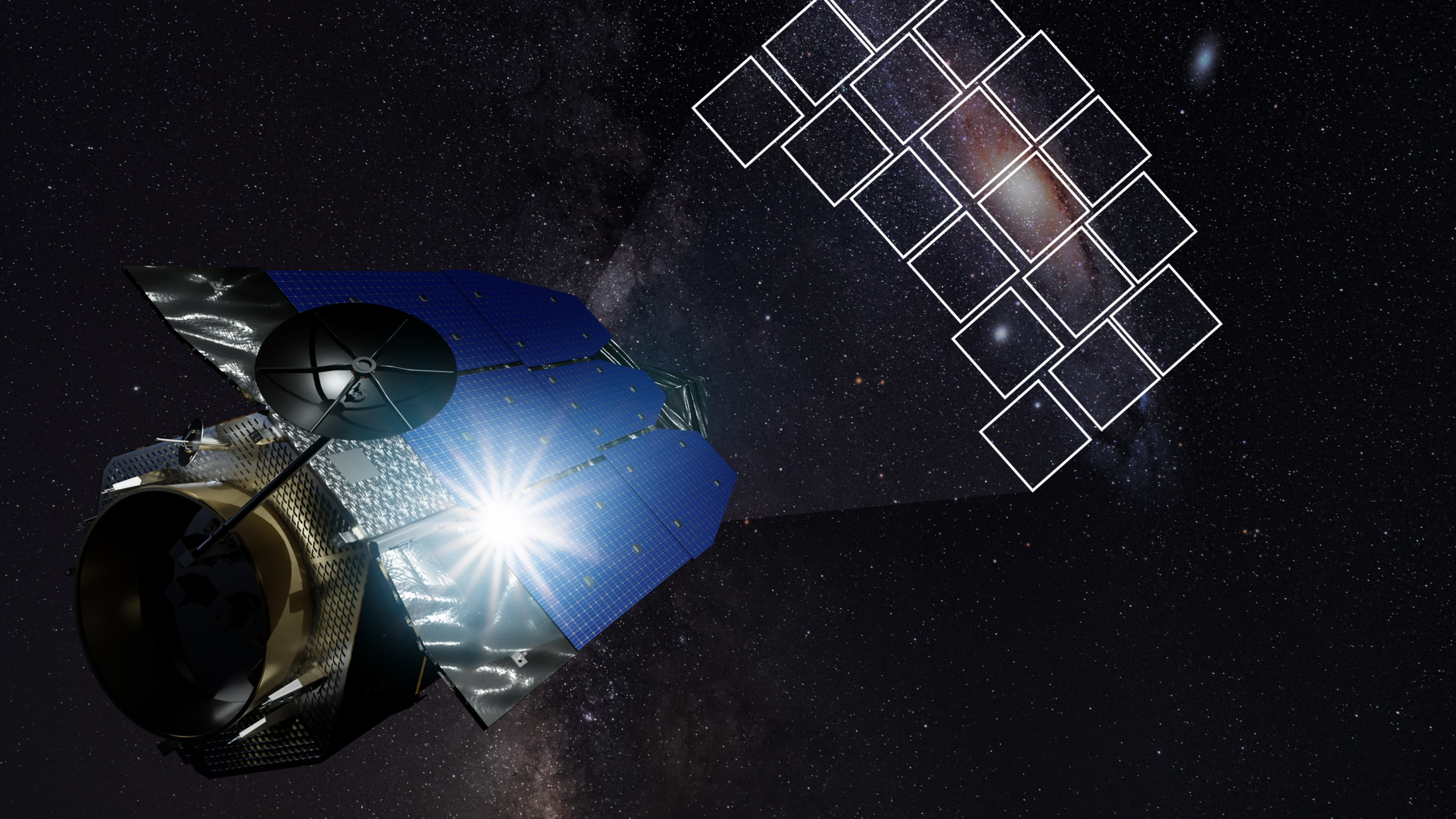
The Wide Field Instrument is central to Roman’s scientific role. BAE Systems says its field of view is at least 100 times greater than Hubble’s while retaining high-resolution imaging, allowing Roman to survey the sky as much as 1,000 times faster.
NASA expects the observatory to investigate dark matter, dark energy, galaxy formation, black holes, and planets beyond the Solar System. Its large survey area is also intended to generate a substantial public archive that researchers can reuse for investigations extending beyond the mission’s core programmes.
That capability places demanding requirements on systems outside the optics. NASA says Roman is expected to return around 1.4 terabytes of data every day, giving the mission the highest daily data rate of any NASA astrophysics mission so far.
Storage, communications, data processing, calibration, ground infrastructure, and software are therefore part of the engineering problem alongside the telescope itself. A wide-field instrument able to generate observations more quickly only creates scientific value if those observations can be transmitted, processed, calibrated, archived, and made accessible reliably.
Roman uses a 2.4m primary mirror and has a nominal five-year science mission. NASA expects the spacecraft’s journey and commissioning period to take about three months, during which engineers and scientists will deploy systems, calibrate instruments, and test the observatory before routine science operations begin.
The agency anticipates releasing Roman’s first images in early 2027. NASA has already confirmed successful deployment of the observatory’s solar panels and lower instrument sun shade following launch, with further commissioning work continuing during the journey to L2.
NASA identifies BAE Systems, L3Harris Technologies, and Teledyne Scientific & Imaging as the mission’s principal industrial partners. Contributions also come from ESA, JAXA, France’s CNES, and Germany’s Max Planck Institute for Astronomy, creating an international engineering programme in which specialist hardware has had to meet common mechanical, electrical, thermal, software, and scientific interfaces.
BAE Systems’ role follows earlier work supporting Hubble and the James Webb Space Telescope. The company is also contributing to early technology studies for NASA’s proposed Habitable Worlds Observatory, including work on ultra-stable telescope systems and picometre-capable mirror actuation.
That future programme remains at concept and technology-development stage. Roman, by contrast, now has the less theoretical task of proving that hardware qualified on Earth will remain stable after launch and throughout its operating environment.
For precision space engineering, the successful launch is therefore an intermediate milestone rather than a conclusion. The Wide Field Instrument still has to complete commissioning, achieve its required optical and thermal stability, and begin sending usable scientific data back to Earth.
The rocket has done its part and Roman is now flying independently. The next few months belong to the engineers who have to establish whether the observatory’s structures, mechanisms, electronics, and optics have arrived at L2 behaving exactly as intended — a considerably stricter test than getting them off the ground.