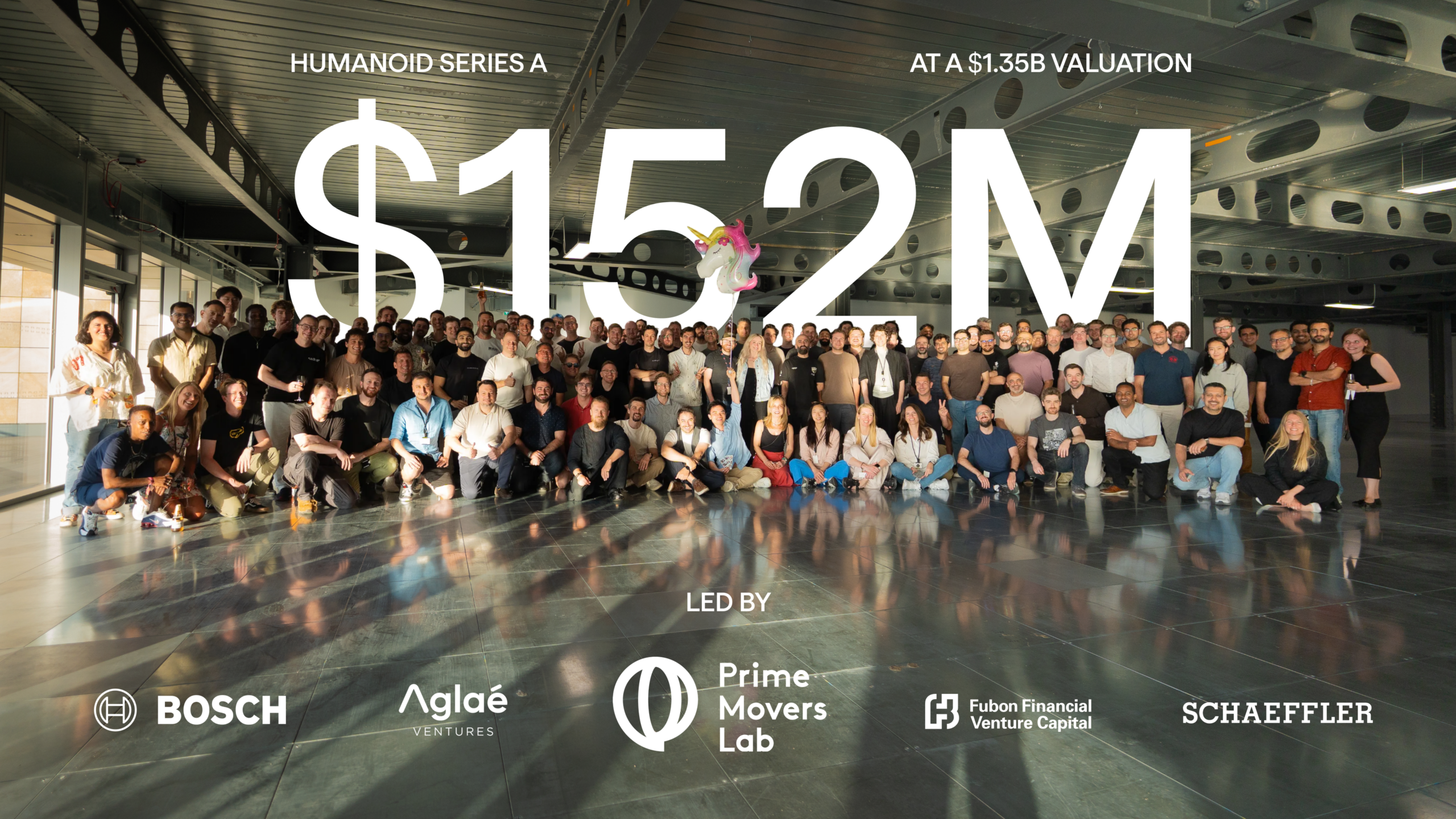
British robotics developer Humanoid has raised $152 million in Series A funding as it prepares to place beta systems in customer facilities and begin volume production of wheeled humanoid robots.
Led by Prime Movers Lab, the investment gives the London-based company a reported post-money valuation of $1.35 billion and takes its total funding to approximately $270 million. Strategic and financial participants include Bosch, Schaeffler, Fubon Financial Holding Venture Capital, and Aglaé Ventures.
Humanoid plans to begin beta deployments during the fourth quarter of 2026, initially focusing on manufacturing, logistics, and retail tasks. Alongside physical hardware, the company is developing KinetIQ, a robotics intelligence platform combining perception, reasoning, motion planning, and task execution.
Rather than relying exclusively on bipedal movement, the first industrial systems use a wheeled base beneath a human-scale upper body. Wheels reduce the mechanical and control demands associated with walking while retaining the reach and manipulation required to use shelves, trolleys, containers, and workstations designed around people.
That configuration suits factories and warehouses with relatively level floors, where stability, energy efficiency, payload, and operating time may be more valuable than stair-climbing ability. It also reduces the number of highly loaded joints required to support and move the complete machine.
Founded in 2024, Humanoid has expanded to more than 250 engineers and established relationships with SAP, Nvidia, Siemens, Bosch, and Schaeffler. Bosch has been selected to support manufacture of the HMND 01 platform after an earlier logistics trial in Germany, where the robot moved several box sizes between a conveyor and trolley.
The production partnership with Bosch covers contract manufacturing, production planning, supply development, design improvement, and cost optimisation. Those capabilities become increasingly important as an individually built prototype develops into a product assembled repeatedly by a wider manufacturing team.
Development machines can receive constant attention from engineers who know every subsystem and software workaround. A commercial fleet must arrive with controlled bills of material, stable software versions, interchangeable components, diagnostic tools, spare parts, service procedures, and technicians capable of resolving faults without support from the original design team.
Factory deployment becomes the harder test
Humanoid robots attract interest because they can enter facilities originally arranged for human movement, potentially avoiding the extensive rebuilding required by some fixed automation. Existing doors, aisles, racks, tools, and containers provide a ready-made physical environment, although compatibility with human dimensions does not automatically produce a functioning automation system.
A robot moving materials through a live plant has to interpret routes, changing obstacles, production priorities, exclusion areas, and the condition of the objects it handles. Connections to warehouse management, manufacturing execution, and enterprise systems must also provide accurate task information without exposing operational networks to unnecessary security risks.
BMW’s physical AI trials in vehicle production have placed humanoid robots within a broader system of digital twins, machine vision, autonomous logistics, and shop floor data. Such deployments show that useful autonomy emerges from the surrounding factory architecture as much as from the robot itself.
Reliability will be measured across complete shifts rather than isolated demonstrations. Joint actuators, gearboxes, motors, batteries, cameras, wiring, processors, hands, and protective covers must withstand repeated cycles, accidental contact, dust, vibration, and imperfect objects while maintaining the accuracy needed for safe handling.
Even minor faults become expensive when multiplied across a fleet. A loose connector, drifting camera calibration, worn gripper pad, or software restart may appear manageable during a trial, yet repeated interruptions can erase the labour and throughput benefits used to justify deployment.
Battery performance introduces another operational boundary, since payload, speed, reach, computing power, and running time all draw from the same stored energy. Charging periods have to fit around work schedules, and additional robots may be required where one machine cannot cover the complete shift without stopping.
Safety assurance extends beyond detecting a person immediately ahead of the robot. Shared industrial spaces contain forklifts, autonomous vehicles, moving conveyors, dropped materials, open doors, temporary barriers, reflective surfaces, and workers who may not behave in ways anticipated during development.
The machine must respond safely when sensors disagree, communications fail, or an object moves unexpectedly, while independent stopping systems prevent software errors from causing uncontrolled motion. Force limits, speed controls, monitored zones, and mechanical design all remain necessary even when AI improves perception and planning.
Humanoid platforms must also compete with established alternatives. Autonomous mobile robots, articulated arms, conveyors, lifts, pallet shuttles, and redesigned workstations already provide dependable automation for many material movements, often with clearer performance data and established safety cases.
Flexibility becomes valuable where product mix, task sequence, or facility layout changes too frequently for dedicated equipment. A single platform capable of moving between several jobs could avoid underused fixed machinery, but only when changeover is straightforward and the robot performs each task at a useful rate.
Manufacturing scale will depend on suppliers of actuators, precision reducers, motors, force sensors, cameras, processors, battery cells, and specialist electronic assemblies. Many of those components are also required across automotive, aerospace, and conventional robotics programmes, making alternative sourcing and qualification central to production resilience.
The funding provides capital for recruitment, industrialisation, customer support, and inventory, while the beta deployments will establish whether the technology can sustain useful work under normal operating pressure. Completion rates, intervention frequency, maintenance time, energy use, and deployment cost will provide a firmer measure than the number of successful demonstrations.
Humanoid’s wheeled architecture avoids some of the least mature elements of bipedal robotics, yet commercial success still requires a tightly integrated mechanical, electrical, software, and service system. The first customer installations will begin to define which industrial tasks justify that complexity and whether the platform can deliver them without prototype-level attention.