Orbital Marine Power has secured the European Commission’s Go Decision for EURO-TIDES, allowing the proposed multi-turbine tidal array in Orkney to progress towards construction. The decision follows a formal review of the project’s engineering, permitting and financing arrangements, although deployment remains dependent on completion of the developer’s current investment round.
The project is intended to install four floating turbines at the European Marine Energy Centre (EMEC), creating a coordinated tidal energy farm rather than another stand-alone device demonstration. The established EURO-TIDES programme describes an array of approximately 9.6MW. Orbital’s latest configuration comprises three next-generation O2-X turbines and its existing O2 machine, which is already generating electricity in Orkney. The developer has not published a revised aggregate nameplate rating for that particular combination.
Orbital’s role as EURO-TIDES lead dates to October 2023, when Horizon Europe selected the project for support. The Commission’s latest decision is a review milestone in that established programme, rather than a fresh award of Horizon Europe funding. The current plan targets deployment during 2028 instead of the 2027 date still appearing in some project documentation; the revised timetable remains contingent on Orbital closing its investment round.
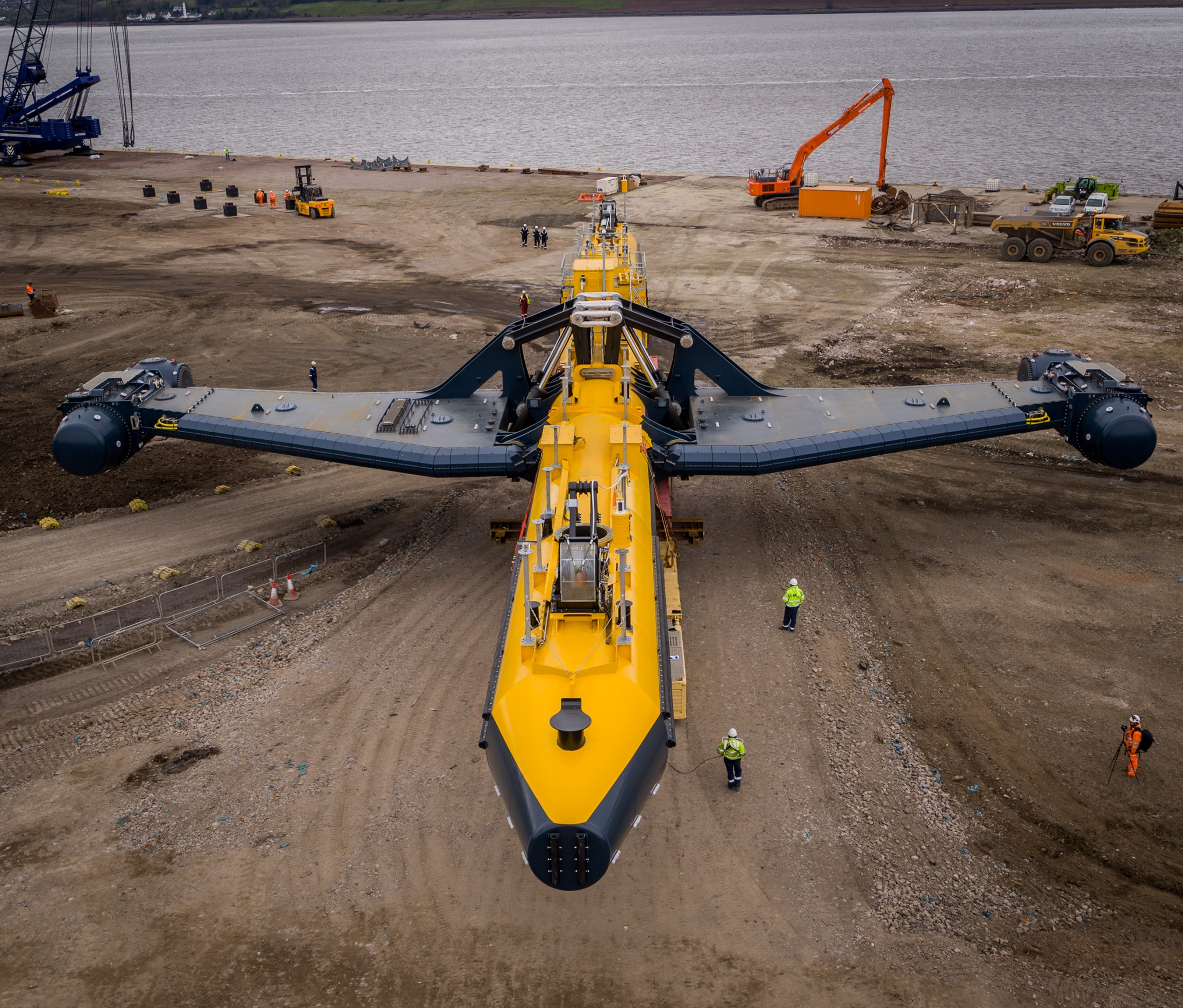
A single O2 turbine already operating at EMEC’s Fall of Warness test site provides an engineering reference for the proposed array. The floating platform is restrained by moorings, with submerged rotors converting tidal flow into mechanical drive for electrical generation. Surface access can simplify certain inspections and maintenance operations compared with a permanently submerged machine, although access still depends on local sea conditions and safe vessel operations.
Connecting four turbines would bring a different set of design constraints. Each generating unit must be integrated with electrical collection, protection and export arrangements, while anchoring and mooring designs need to account for the interaction between individual installations and marine traffic. Tidal flows are predictable in their timing, but vary through each cycle, and the electrical system must tolerate both changes in output and the loss of an individual turbine during maintenance.
The EURO-TIDES consortium brings together Orbital, EMEC, the University of Edinburgh, Ocean Energy Europe, ENGIE Laborelec, MaraSoft, Énergie de la Lune and RWTH Aachen University’s Center for Wind Power Drives. Its work spans machinery development, industrial design, marine environmental monitoring, maintenance planning and performance assessment. Those disciplines have to be considered together if a repeatable array configuration is to move beyond an experimental demonstration.
Repeatable manufacture is another strand of the programme. Bespoke fabrication may be workable for an isolated demonstrator, but additional units require consistent drawings, tolerances, inspection records and component specifications. Drivetrains, blade assemblies, electrical connections and structural joints must remain serviceable in a corrosive, cyclically loaded environment; an early production defect can otherwise become an expensive offshore intervention.
The O2-X design draws on the experience of Orbital’s operating O2 turbine, with the proposed array providing an opportunity to measure performance across several connected units. Structural reliability, drivetrain behaviour and maintenance access can then be assessed under real tidal conditions. Detailed design qualification and the production route for the new machines will need to be completed before manufacturing and deployment.
The consortium is seeking to lower the levelised cost of tidal electricity and produce operating data that lenders and insurers can assess. Its original project framework contained a cost-reduction ambition and targets for higher availability, but neither outcome has yet been demonstrated by the proposed four-unit array. The operating record from the existing O2 informs design choices without establishing how several turbines will perform as a combined production system.
Saltwater exposure, fatigue, biofouling and uncertain maintenance access make reliability a central engineering variable. A fault that could be corrected rapidly in a factory may require a suitable tidal and weather window offshore, specialist vessels and additional safety planning. The project aims for availability above 95%; it will take sustained measurement of actual downtime, generation and repair costs to establish whether that target has been met.
Its wider research programme is also intended to examine environmental interactions. Monitoring is needed to understand conditions around turbine rotors and moorings, including interactions with marine wildlife and other sea users. Evidence from one deployed machine provides a starting point, but a group of units changes the spatial extent and potential cumulative effects of the installation.
Tidal stream generation offers a different production profile from wind and solar because the timing of tidal currents can be forecast far in advance. That predictability can assist generation scheduling, although tidal output is not constant: water movement slows around slack tide and the power available changes during each cycle. An array’s electrical system must therefore handle both regular fluctuations in generation and equipment outages.
Financing and insurance assessments will require evidence on energy yield, maintenance demands, component life and construction risk. EURO-TIDES intends to gather comparable operating data from the connected turbines, complementing the record of the existing O2. Developers and funders will still need to test the projected revenue and maintenance assumptions against actual array performance once the installation is in operation.
Closing the investment round is the next commercial condition before Orbital can commit to manufacturing and the offshore installation programme. The consortium must also bring turbine construction, marine works and electrical export arrangements into a workable sequence for its 2028 target. Operating data from the four connected turbines would then allow the cost and availability assumptions to be assessed against measured performance.