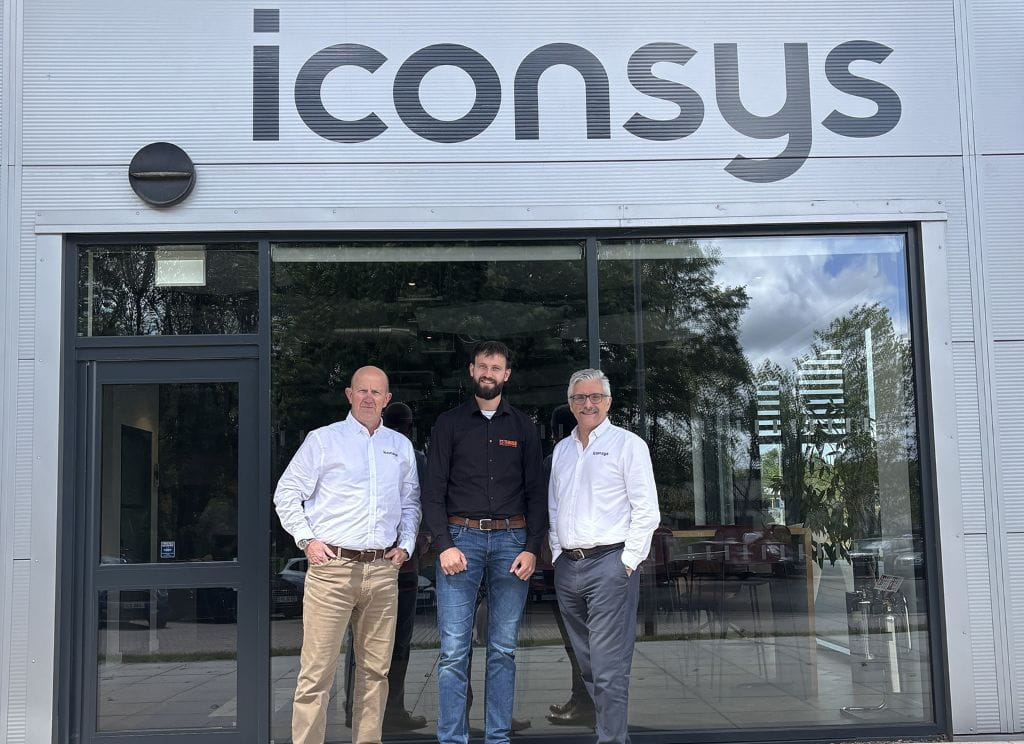
iconsys has formed a strategic partnership with Tebulo Robotics to accelerate deployment of robotic cells across UK heavy manufacturing.
The agreement combines iconsys’ controls, automation, systems integration, and machine safety capability with Tebulo’s experience in robotic handling systems for demanding production environments. The companies are targeting operations including automated destrapping, coil handling, blade coating, dross removal, marking, labelling, and other processes where heavy materials, repetitive handling, and safety constraints make manual work increasingly difficult to sustain.
A first project is already under way with a UK steel manufacturer, giving the partnership a live production setting rather than leaving it as a technology collaboration. Under the model, iconsys will integrate Tebulo robotic systems into existing and new plants, covering software, electrical systems, functional safety, installation, and commissioning.
Tebulo Robotics, based in the Netherlands, has installed more than 500 robotic systems across Europe. Its work is concentrated in heavy industrial environments, where robots are often required to handle variable products, high loads, difficult surfaces, heat, dust, and legacy line layouts that were never designed around automation.
That operating environment places particular pressure on the systems integration layer. In heavy industry, the robot arm is only one part of the cell. Payload, reach, guarding, access, gripper design, machine interfaces, recovery routines, and maintenance space all influence whether a system becomes reliable production equipment or a limited demonstration.
Heavy manufacturing has long been a more complex automation target than sectors such as automotive, where repeatable products and high volumes can support capital expenditure more directly. Steel, metals, process, and large-component operations often work with longer asset lifecycles, harsher conditions, and lower-volume variation, which makes the automation case more dependent on practical engineering than catalogue specification.
Tasks such as destrapping, loading, unloading, coating, and dross removal can also expose workers to repetitive movement, awkward access, hot materials, sharp edges, and airborne contamination. A well-engineered robotic cell can improve repeatability while removing operators from hazardous handling steps, especially where manual intervention is used to support otherwise automated production lines.
The surrounding automation challenge has become more visible as manufacturers push robotics into the handling work that sits between production processes. Developments in robotic sheet metal unloading and palletising show how factories are targeting the manual movement, sorting, and staging tasks that limit the value of automated cutting, forming, and machining systems.
In heavy industry, those intermediate steps often determine line performance. A rolling, cutting, coating, or forming operation may already have sufficient process capacity, yet still depend on manual removal, inspection, repositioning, or transfer. Robotics can reduce that gap, but only when cells are engineered around real plant constraints rather than idealised process flow.
The partnership also reflects the need for automation that can be fitted into brownfield sites. Many UK plants contain legacy assets, partial automation, restricted access, mixed control systems, and processes that have evolved over decades. Integrating robotic cells into those environments requires a combination of mechanical design, control system discipline, safety assessment, and operator involvement.
UK manufacturers are under pressure to improve productivity while managing labour shortages, energy costs, and skills constraints. Robotics is increasingly being considered not as a replacement for isolated tasks, but as a way to strengthen consistency across production systems that already depend on skilled people and expensive equipment.
The commercial test will be the repeatability of deployment. Heavy industry has no shortage of processes that appear suitable for automation, but each plant brings its own physical, operational, and safety conditions. The strongest projects will be those that translate robotic capability into cells that run reliably, recover predictably, and fit into production without creating new bottlenecks.