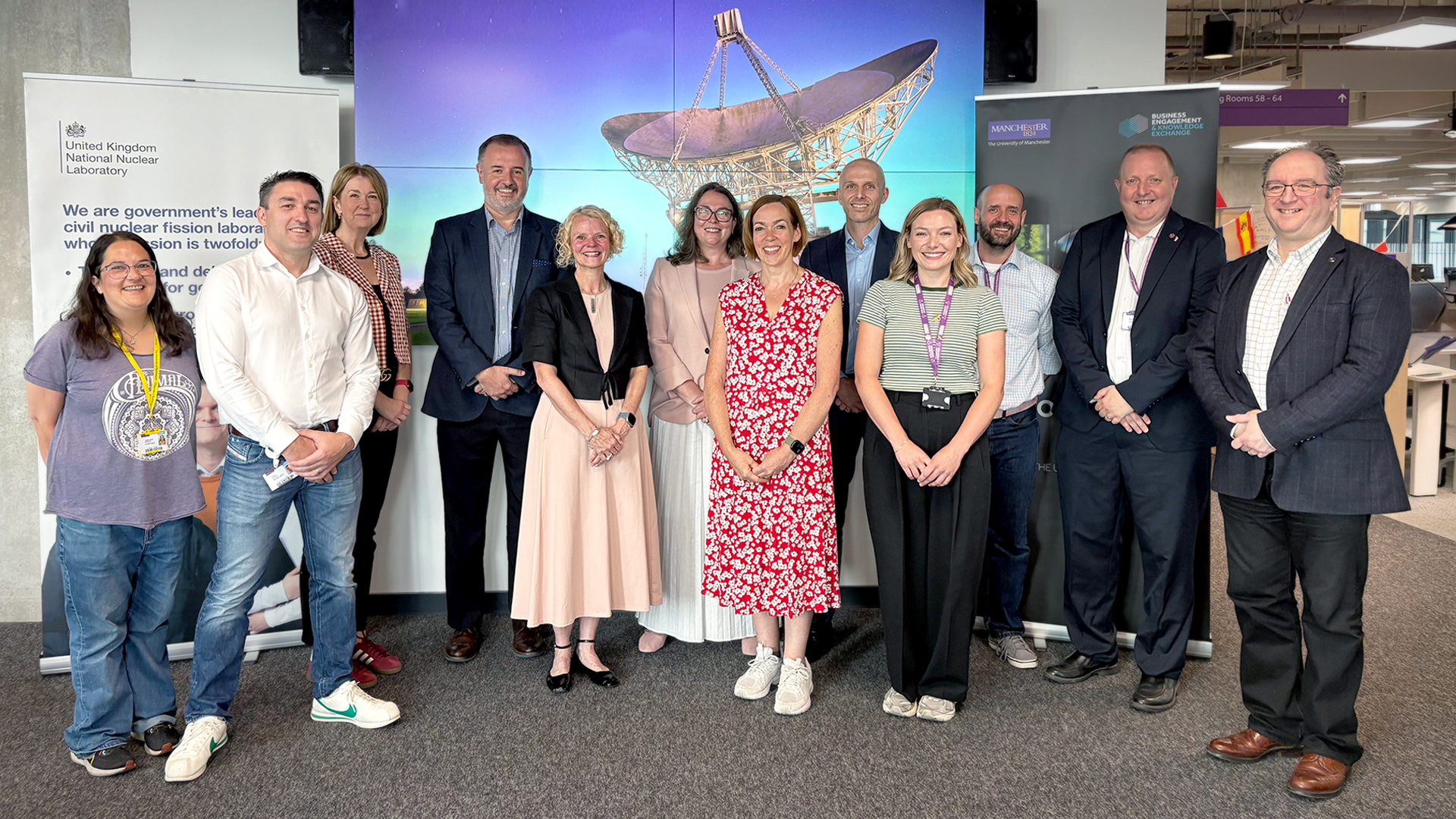
United Kingdom National Nuclear Laboratory and The University of Manchester have signed a Memorandum of Understanding to deepen collaboration across nuclear science, workforce development, facilities access, and industrial innovation.
The agreement was signed at the university by UKNNL Chief Executive Officer Julianne Antrobus and Professor Sarah Sharples, Vice President and Dean of the Faculty of Science and Engineering. It formalises a long-standing relationship between the national laboratory and one of the UK’s leading nuclear research universities.
The MoU sets out collaboration across six priority areas: decommissioning of engineered facilities, advanced materials performance and degradation for future nuclear systems, improved fuels and fuel manufacturing routes for current and future reactors, waste management, innovation and translation of research into industrial deployment, and growth of the Northwest Nuclear Arc as a globally recognised centre of expertise.
The agreement also establishes arrangements for sharing facilities and expertise. Manchester PhD students and researchers will gain access to UKNNL facilities including Preston, Central Laboratory, Windscale, and Workington, while UKNNL staff will have reciprocal access to university facilities.
Julianne Antrobus, CEO of UKNNL, said: “This MoU formalises a relationship that is already delivering world-leading science and growing the next generation of nuclear talent.”
Professor Sarah Sharples said the agreement creates “new opportunities to develop talent, advance innovation and address some of the most important challenges facing the UK’s nuclear sector.”
The partnership lands as the UK nuclear sector is being asked to support energy security, net zero, civil nuclear new build, small modular reactor development, advanced fuels, decommissioning, waste management, and skills growth. Each priority depends on scientific capability, but also on the ability to move research into industrial systems.
Nuclear engineering is unusually multidisciplinary. Reactor development depends on materials science, fuel chemistry, thermal hydraulics, radiation effects, instrumentation, manufacturing, robotics, digital engineering, safety case development, and long-term asset management. Decommissioning and waste management add further requirements around remote handling, contamination control, effluent treatment, land quality, packaging, and disposal.
Manufacturing capability is also moving closer to the centre of UK nuclear delivery. Rolls-Royce SMR’s £12m Pioneer Works facility in Derby is intended to prove production methods for small modular reactor deployment. The UKNNL-Manchester partnership connects to the same challenge: nuclear science has to become repeatable, qualified, deployable engineering.
The fuels element of the MoU is especially important. Current and future reactors require fuel designs and manufacturing routes that meet performance, safety, regulatory, and supply chain requirements. Fuel development has long lead times because materials have to be tested under irradiation, characterised, qualified, and licensed.
Materials degradation is another core area. Nuclear systems operate under demanding conditions involving radiation, heat, corrosion, stress, and long service lives. Understanding how materials behave over time affects plant life extension, new reactor design, waste package performance, and decommissioning decisions. Research in this field directly influences maintenance strategies, safety margins, and future design choices.
The workforce element is equally pressing. Nuclear programmes require specialised engineers, scientists, technicians, safety specialists, regulators, and manufacturing personnel. Many of those skills are developed over years, not short training cycles. Giving PhD students and researchers access to national laboratory facilities can help reduce the gap between academic research and industrial nuclear practice.
The Northwest Nuclear Arc element points to regional industrial strategy. The North West already contains a concentration of nuclear capability, including national laboratory sites, supply chain companies, universities, and decommissioning activity. Formal collaboration around that cluster could help coordinate research, skills, facilities, and industrial deployment more coherently.
The agreement is not a construction project or a technology launch, but it strengthens one of the knowledge systems behind nuclear delivery. Reactors, fuel cycles, waste systems, and decommissioning programmes operate on timelines that outlast individual projects and political cycles. UKNNL and Manchester are formalising a partnership built for that longer industrial horizon.