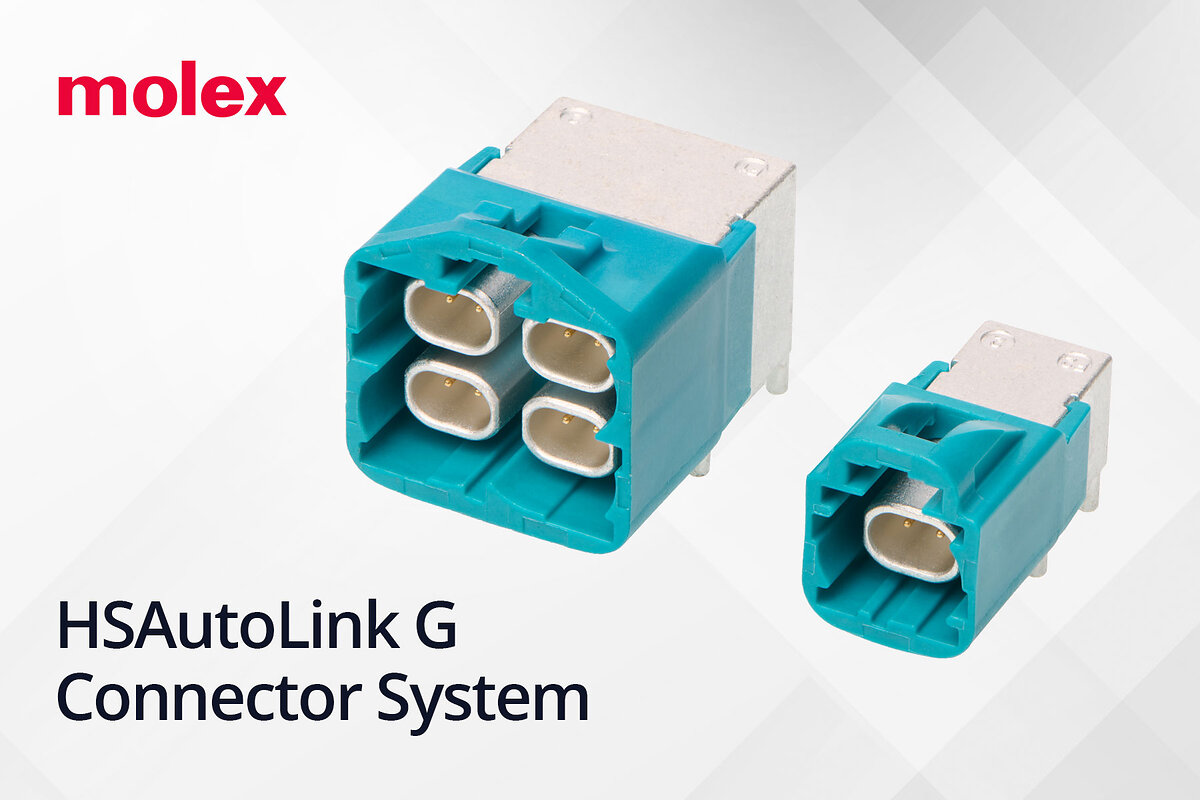
Molex has launched its HSAutoLink G automotive Ethernet connector system, targeting multi-gigabit vehicle networks used in ADAS, LiDAR, zonal architectures, immersive displays, and central compute modules.
The connector system supports differential shielded and unshielded twisted-pair automotive Ethernet performance up to 25Gbps. It uses a compact USCAR-compatible interface and extends the company’s HSAutoLink family, which Molex says has delivered more than 700 million connectors and cables to the automotive industry since 2008.
HSAutoLink G is designed for software-defined vehicles, where higher data throughput, signal integrity, packaging flexibility, and rugged validation are becoming more important. The system includes terminals, connectors, PCB headers, and cables, giving OEMs and tier-one suppliers a broader set of sourcing and integration options.
The launch addresses a structural change in vehicle electronics. Advanced driver assistance, radar, LiDAR, cameras, central compute, infotainment, battery management, and software updates all increase data movement inside the vehicle. Older distributed architectures are being replaced by zonal and centralised systems, where more functions are consolidated into compute platforms linked by high-speed networks.
That shift places new demands on components that were once treated as comparatively simple interconnect hardware. A connector now has to preserve controlled impedance, manage electromagnetic interference, survive harsh mechanical and thermal conditions, fit into crowded modules, and support manufacturable harness routing. At 25Gbps, small design weaknesses can become signal integrity problems, validation delays, or warranty risks.
Molex has included advanced EMI shielding and controlled differential impedance to support high-speed communications in dense vehicle environments. The system also uses a terminal anti-stub feature to protect contacts during mating and reduce the risk of mis-mating. A reversible housing shroud is intended to give engineers more flexibility when packaging and routing connections in constrained spaces.
High-speed data transfer is moving closer to the physical constraints of real machines. Westermo’s work on multi-gigabit data transfer from rail inspection systems showed how large volumes of operational data can be moved under harsh conditions. Automotive Ethernet faces different mechanical and electromagnetic requirements, but the engineering challenge is comparable: moving more data reliably through systems that were not originally designed around such bandwidth.
Vehicle manufacturers are also trying to simplify supply chains while increasing performance. USCAR compatibility allows HSAutoLink G to fit within existing automotive Ethernet interface expectations, reducing redesign pressure and giving suppliers a route to upgrade without rethinking every mechanical interface. In high-volume automotive programmes, that compatibility can be as important as peak data rate.
The connector family also reflects how software-defined vehicles change the economics of hardware. Software may define features, but the data still moves through copper, connectors, harnesses, modules, and boards. If the physical layer is unreliable, software features cannot be delivered consistently. Hardware selection remains central to the success of software-led vehicle architecture.
Packaging pressure is increasing as vehicles add sensors and compute while trying to reduce weight and space. Zonal architectures can simplify harnessing by grouping functions geographically, but they also concentrate data flows and create new requirements for robust local connectivity. Connectors must support automated assembly, serviceability, environmental protection, and long vehicle lifecycles.
EMI performance is especially important as electrification and high-speed communications converge. Electric powertrains, inverters, chargers, motors, and high-voltage systems create noise environments that can interfere with sensitive data links if shielding and grounding are not properly controlled. Molex’s use of multiple ground-contact points and shielding is aimed at preserving reliability under those conditions.
The launch also shows how automotive electronics suppliers are preparing for broader adoption of high-speed networks. Molex says the shift to 25G automotive Ethernet is gaining traction beyond China and into other global sectors. That suggests OEMs and tier-one suppliers are looking for common upgrade paths as architectures converge around central compute and advanced sensing.
HSAutoLink G will be judged by validation, customer adoption, and integration into vehicle platforms. Automotive manufacturing is becoming a high-speed electronic systems integration challenge as much as a mechanical assembly challenge, and connectors are now part of the performance architecture.