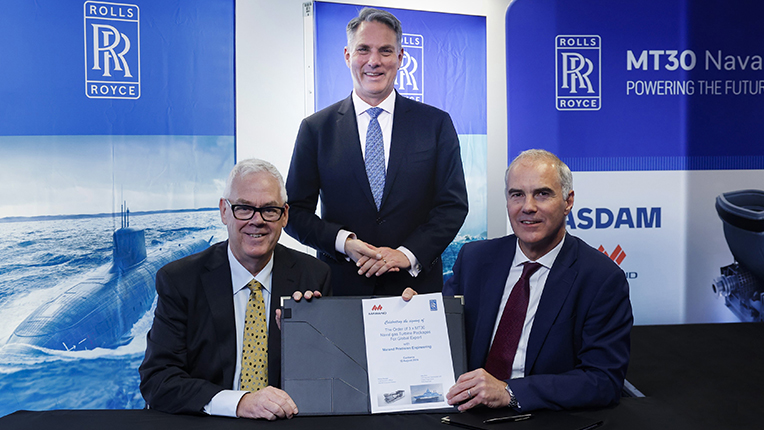
Rolls-Royce has expanded its Australian manufacturing relationship with Marand Precision Engineering, awarding the Melbourne company work on three additional gas turbine acoustic enclosures and corresponding ship interface systems for the Type 26 Global Combat Ship programme.
Marand secured the work through an international competitive tender and will manufacture and assemble the systems at its Melbourne facility before supplying them to Rolls-Royce. The contract extends an existing relationship under Australia’s Hunter-class frigate programme, where Marand already produces similar equipment for propulsion packages ultimately delivered to BAE Systems Australia.
Both programmes use Rolls-Royce’s MT30 marine gas turbine, giving the Australian manufacturer an opportunity to carry established Type 26 production experience into a wider export programme. Rolls-Royce also supplies mtu power generation equipment for the Hunter-class ships, placing several elements of the frigates’ machinery systems within the group’s portfolio.
The acoustic enclosure is an engineered subsystem rather than a simple housing around the turbine. It provides mechanical support and noise suppression while incorporating controls, ventilation, auxiliary services, the air intake, and the exhaust arrangement needed to connect the MT30 to the wider ship.
Those interfaces create a substantial integration task because the turbine package has to fit within tight naval architecture constraints while remaining accessible for installation, operation, and maintenance. Intake and exhaust routing, structural loads, vibration, cooling, controls, and service connections all have to be resolved before the equipment reaches the shipyard.
Rolls-Royce engineers are working alongside Marand’s teams in Melbourne on design development, packaging, and testing. Co-locating engineering support with production allows manufacturing questions to be resolved against the system design before completed packages enter the delivery chain, reducing the risk of late interface changes once ship construction is further advanced.
The additional work also gives Marand a route beyond production solely for Australia’s own frigates. Type 26 has been adopted in several national programmes, creating scope for suppliers that qualify equipment on one variant to compete for related work where specifications and industrial arrangements allow.
That does not make the programme a common production line in the automotive sense. National shipbuilding programmes retain different combat systems, local-content requirements, build strategies, and supply arrangements, but common propulsion architecture can still create export opportunities for specialist manufacturers already familiar with the machinery package.
For Australia, the contract adds substance to the wider effort to build defence manufacturing capability that can sell into international programmes rather than depend entirely on domestic procurement. Export work is particularly valuable where naval production volumes are limited, because it can keep specialist equipment, tooling, and skilled teams active between domestic ship milestones.
The award arrives alongside Rolls-Royce’s opening of a dedicated Pacific Rim defence headquarters in Canberra on 12 August. The company says the office will act as its strategic hub for Australia, New Zealand, Japan, and South Korea and will receive further investment over the next five years.
The Canberra operation sits alongside Rolls-Royce’s existing presence in Sydney and engineering personnel already supporting Australian defence activity. Bringing programme and customer teams closer to government and military stakeholders reflects the amount of local support required around long-lived naval and aerospace equipment after the original manufacturing contract has been signed.
That local presence becomes more important as equipment moves from design and production into decades of maintenance and upgrade work. Propulsion systems installed on naval vessels require technical support, spare parts, engineering changes, inspection, and obsolescence management over service lives that can substantially outlast the initial construction programme.
Marand’s latest order therefore represents more than another fabrication package, but it should not be inflated into wholly sovereign gas turbine production. The MT30 remains a Rolls-Royce product; the Australian contribution lies in the engineered enclosure, interfaces, assembly, and associated manufacturing capability built around it.
The value of the contract and the final destination of the three additional systems have not been disclosed. What is confirmed is a further production run in Melbourne, secured competitively and tied to an international Type 26 programme, with Rolls-Royce engineers supporting the work locally.
That gives the partnership a measurable industrial milestone: three more complex propulsion packages must now move through design completion, manufacture, assembly, testing, and delivery. Export capability is ultimately demonstrated by equipment leaving the factory to specification, rather than by the number of supply-chain strategies describing how desirable that would be.