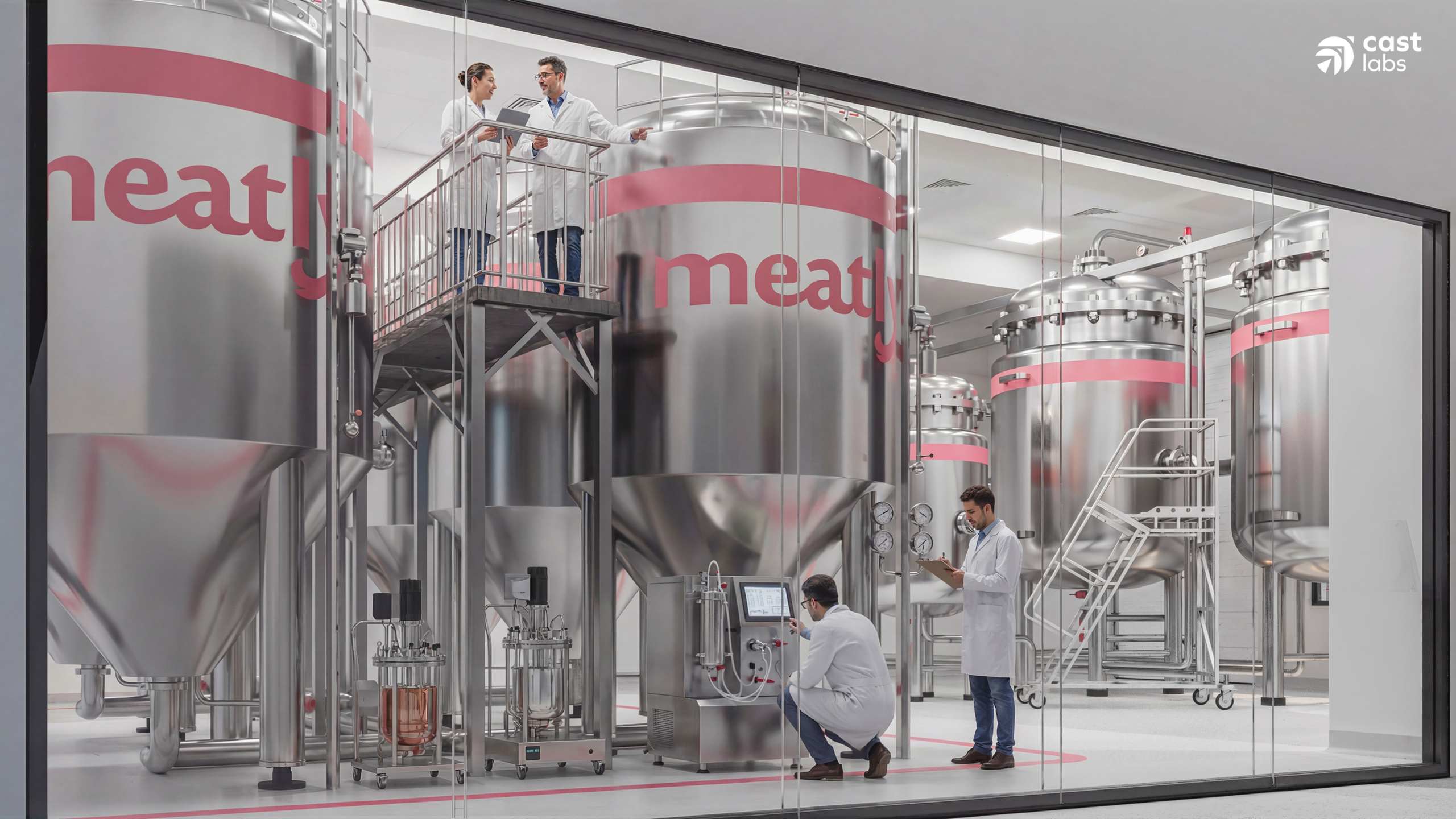
Meatly has moved into Imperial College London’s Grapht Works pilot and advanced manufacturing site in west London as it prepares to scale cultivated meat production for pet food. The relocation brings the company into an industrial development facility at the Old Oak Innovation Cluster ahead of planned production runs in 2027.
The move follows a £10.4 million Series A financing round secured in May to support construction of a facility designed around 20,000 litres of bioreactor capacity. Meatly is targeting commercial production of cultivated chicken for the UK pet food market, building on earlier regulatory approval and initial sales of products containing its cultivated meat.
Grapht Works provides flexible industrial space for businesses progressing from laboratory development into prototyping, pilot operation and demonstration manufacturing. The site is part of Imperial College London’s Old Oak Innovation Cluster within the wider WestTech London area, which is intended to accommodate engineering and science-based businesses requiring infrastructure beyond a conventional office or research laboratory.
Cultivated meat manufacturing requires the controlled growth of animal cells in a nutrient medium. Cells are maintained under conditions designed to support their growth and are eventually harvested for incorporation into the finished food product. Moving towards industrial output means increasing the amount of material that can be produced while controlling contamination, consistency and the cost of the growth process.
Increasing bioreactor volume offers the prospect of more cultured cells per batch, but mixing, oxygen transfer, temperature control, cleaning and process monitoring become harder to manage as the system grows. Operating conditions have to suit the particular cell line and growth medium, so a stated 20,000-litre capacity does not by itself establish an output tonnage or production cost.
Meatly has developed its own bioreactors and growth medium to reduce production costs. Its May financing disclosure said the cost of its chemically defined, protein-free culture medium had reached £0.22 per litre in 2024, while it achieved an approximately tenfold reduction in bioreactor costs during 2025. Both figures describe development progress that the planned London production operation will have to carry through into repeatable manufacture.
Medium expenditure is an important part of the process economics because nutrient solution is consumed during cell cultivation. Even where growth conditions are technically successful, the volume of medium used relative to harvested product affects the price at which a factory can supply an ingredient. Similarly, lowering the capital cost of bioreactors affects the investment needed to establish additional production capacity.
The proposed 20,000-litre facility will bring medium consumption, equipment utilisation and process consistency together at a substantially larger scale than laboratory development. Repeatable operation requires controlled cleaning between batches, quality monitoring, equipment maintenance and reliable movement of materials into and out of the process. The May investment plan established the intended London capacity, while the November relocation positions the company for its next phase of industrial development.
Meatly was founded in 2022 and develops cultivated meat specifically for pet food. It received UK regulatory authorisation in 2024 and sold what it described as the world’s first cultivated pet food product in 2025. The company and Imperial both identify 2027 as the next operational milestone, when production and further product releases are expected to begin.
Cultured cell production also depends on dependable utilities, sanitary handling, process monitoring and suitable separation between clean materials and potential contamination sources. Industrial space must accommodate modifications while the process is being developed, before operating parameters and equipment layouts can be fixed for routine production.
Grapht Works offers the flexible industrial accommodation needed for that commissioning and process-development work. Changes to pipework, process equipment or material flows may be necessary as larger runs expose constraints that are less apparent at laboratory scale. Meatly is preparing for 2027 production; the move itself is not the start of routine commercial manufacturing.
Other businesses at Grapht Works include Solena Materials and Aed Energy, reflecting Imperial’s focus on physical prototyping and pilot manufacturing rather than laboratory and office space alone. Meatly will be developing its own operating arrangements within that wider industrial setting as it progresses from research towards more substantial production.
Chief executive Owen Ensor expects Meatly to begin operating its first larger production facility in 2027. The May £10.4 million Series A round followed £7.1 million of seed investment from Agronomics and Pets at Home, bringing cumulative funding to £17.5 million, according to Agronomics’ regulatory filing.
The immediate work will involve developing its industrial process, preparing equipment and establishing the operating procedures required for repeatable batches. The company expects its next production runs and further cultivated pet food launches in 2027, after a period of facility preparation and manufacturing scale-up.