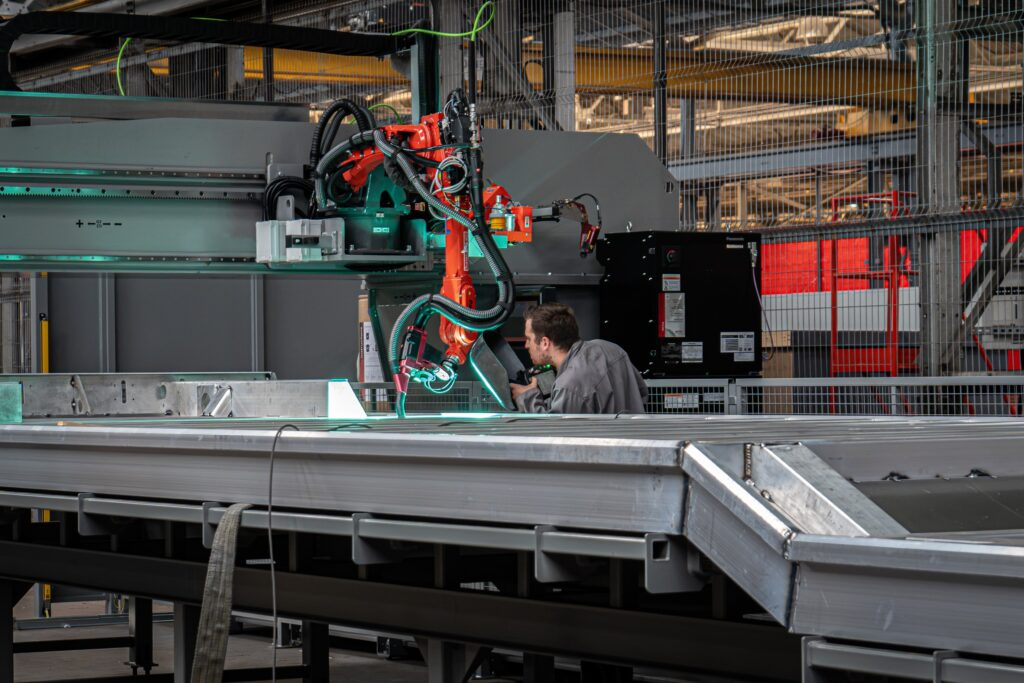
Lantek has partnered with TECOI to develop a robotic unloading and palletising system for sheet metal manufacturing, linking CAD/CAM software with automated handling after cutting.
The system is built around TECOI’s CF modular cutting architecture for multi-head cutting processes and large-scale operations. After cutting, a servo-automated crane equipped with liftable magnets transfers cut material to an intermediate zone. Robotic systems with adaptive gripping technology then collect and palletise parts according to instructions generated by Lantek’s software.
Lantek Expert manages the production intelligence behind the operation, organising parts by geometry and orientation so that identical components with matching angles are stacked together. The approach is designed to preserve stability and traceability through downstream logistics.
The companies say palletising can take place while cutting continues, reducing downtime compared with handling approaches that require production pauses. Additional collaborative robot units can be added to work in synchronisation, allowing the architecture to support both lower-demand facilities and higher-throughput operations.
The collaboration forms part of the Sortec framework, a project aimed at full automation from sheet metal processing through to final palletising. That scope is important because metal fabrication often loses efficiency not only during cutting, but also in the handling, sorting, stacking, and movement of parts between process steps.
Sheet metal production shows why automation has to extend beyond the headline machine. Laser, plasma, or oxyfuel cutting systems can deliver high productivity, while surrounding processes still depend on manual separation, identification, stacking, forklift movement, and production paperwork. If those stages are slow or error-prone, the cutting machine becomes only one part of a constrained workflow.
Automation investment is increasingly moving towards connected process flow. Manufacturers are examining how equipment, robots, software, and production data interact across whole operations. The same pattern is visible in machining, where Grob is linking machine tools, robotics, MES, and tool management rather than treating automation as an isolated cell at the edge of production.
Part identification and traceability are commercially significant in sheet metal operations. A single nest may contain multiple components for different jobs, customers, assemblies, or downstream processes. Once parts are cut, they have to be sorted and routed correctly. Manual handling creates opportunities for mixed stacks, lost parts, rework, and delays, particularly in high-mix environments.
Robotic palletising guided by CAD/CAM data gives the handling system access to production logic before the part leaves the cutting area. The software knows the geometry, orientation, and job data, allowing the robot to build useful stacks rather than arbitrary piles of parts. That connection between design data and material movement is where practical automation gains are likely to be found.
Adaptive gripping broadens the potential application range. Sheet metal parts vary in size, weight, thickness, cut profile, and surface condition. A fixed gripper may handle one family of parts well but struggle as the production mix changes. Adaptive handling gives fabricators more flexibility, although real-world performance will depend on part variability, edge condition, material type, and handling speed.
The ability to add extra robot units also suits the way many fabricators invest. Rather than buying a large bespoke automated system in one step, companies often need modular investments that can grow with demand. Synchronised collaborative architecture offers a scalable route, provided safety, scheduling, and cell control are engineered correctly.
Labour availability adds further pressure. Skilled fabricators, machine operators, and production supervisors are in demand, while manual unloading and stacking can be physically demanding and repetitive. Automating those stages allows human labour to move towards setup, quality, programming, maintenance, and production planning.
Lantek and TECOI’s work points to a more connected model of fabrication, where software is not confined to nesting and machines are not judged only by cutting speed. Productivity increasingly depends on how accurately and traceably material moves from raw sheet to the next operation. Robotic palletising becomes part of the production system rather than a warehouse convenience.