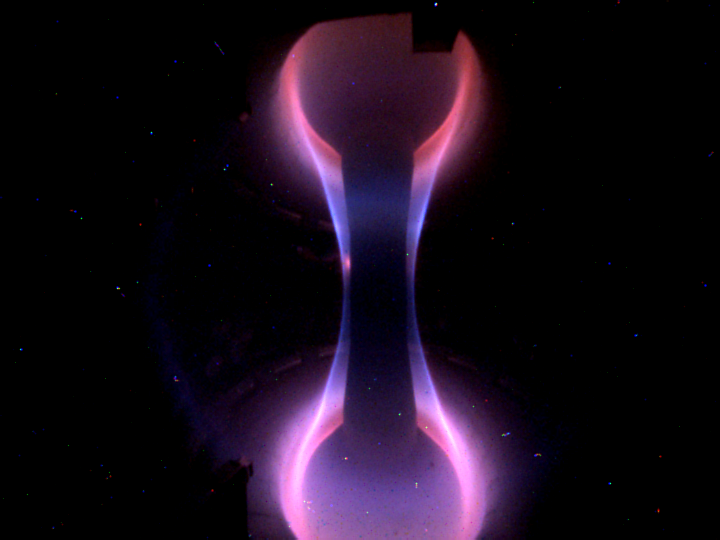
The UK Atomic Energy Authority has completed the fifth experimental campaign on MAST Upgrade after producing more than 1,100 plasmas and reaching the machine’s highest stable plasma pressure.
The campaign ran through 2025 and 2026 at Culham Campus in Oxfordshire, combining higher-pressure operation with work on plasma stability, heat exhaust, and real-time control. Those problems have to be addressed together before an experimental machine can inform the design of a power plant expected to operate repeatedly and protect its internal components.
Higher plasma pressure can increase the fusion power produced within a given volume, but it also raises the difficulty of maintaining a stable boundary. MAST Upgrade’s programme concentrated on Edge Localised Modes, or ELMs, which are sudden bursts at the plasma edge that can expel up to a tenth of the stored energy in one event.
Repeated ELMs would expose plasma-facing surfaces and exhaust components to damaging transient loads, increasing inspection, replacement, and maintenance demands. The team used Resonant Magnetic Perturbations, applied through coils that introduce three-dimensional magnetic fields, alongside Quasi-Continuous Exhaust mode to reduce pressure at the edge while retaining improved confinement.
MAST Upgrade also accessed Quiescent H-mode and I-mode, giving the programme several stable high-performance operating approaches under conditions that differ from those used on other fusion machines. The result is not a single preferred regime, but a broader operating envelope from which future plant designers can assess confinement, exhaust, and component protection.
Control development formed a second strand of the campaign. UKAEA developed a technique that measures visible light emitted by deuterium at the machine’s upper and lower outer divertors, allowing minute positional imbalances to be detected and corrected in real time.
A commercial fusion system will need automated control capable of responding faster and more consistently than manual intervention. Position, instability, heat loading, and component risk must remain inside a defined operating envelope while sensors and actuators work in an environment shaped by heat, electromagnetic forces, radiation, and restricted maintenance access.
The campaign also examined heat exhaust around MAST Upgrade’s Super-X divertor, which is designed to spread power and particle loads before they reach internal surfaces. Injecting small quantities of nitrogen at the plasma edge caused a substantial fraction of the exhaust power to be radiated as light, dissipating heat through a larger volume and lowering the peak load on the divertor.
UKAEA describes the work as the first detailed study of this interaction in a tightly baffled Super-X, double-null geometry on a spherical tokamak. The experiments also tested negative-triangularity plasma shapes, another route being studied internationally for high-power operation without large ELMs.
The fifth campaign sits within a wider shift from isolated plasma records towards integrated plant engineering. Recent UK–US fusion cooperation links plasma science with diagnostics, advanced computing, facility access, and workforce development, reflecting the range of systems that must mature alongside confinement physics.
Future plants will require maintainable magnets, heating systems, power electronics, vacuum equipment, diagnostics, plasma-facing materials, remote handling, fuel-cycle technology, and high-integrity digital controls. Peak performance has limited industrial value if the machine cannot manage wear, abnormal events, inspection intervals, and the time required to return equipment to service.
The MAST Upgrade results are intended to inform both STEP, the UK prototype fusion power plant planned for West Burton in Nottinghamshire, and the international ITER programme. They also support UKAEA’s 2026–2030 strategy, which places greater emphasis on making fusion deployable and building the engineering and industrial capability required around future plants.
Further modifications are planned at Culham. Two neutral beam injectors are due to double the machine’s neutral-beam heating capacity, while an Electron Bernstein Wave system will add 1.6MW of heating power. The EBW approach is also planned for STEP, giving the upgraded machine a direct role in testing technology expected to feed into the prototype programme.
The additional heating power will increase the range of plasma conditions available for study, but it will also raise the demands placed on control, exhaust, diagnostics, and machine protection. That makes the upgrade a systems test as much as a performance programme.
The enhancement work is expected to finish in 2027, followed by a sixth MAST Upgrade campaign focused on STEP-relevant research in 2028. The latest pressure record provides a stronger test platform; the harder task is preserving stability, exhaust control, and automated operation as heating power and campaign demands increase.